

 Aperçu en situation
 Partager
 Partager
 Détails
 Guide imprimable

 Télécharger
 Articles similaires
 Radiographie
 Voir le diaporama
 Statistiques
Goblet with Forget-me-nots


 Afficher la suite
Giclées et impressions d'art
Impressions giclées ou sur toile de qualité musée, avec une production rapide et des finitions au choix. ( Acheter la peinture faite à la main Passer au format image numérique)




P118B €10

P118H €10

P118W €10

P438Z €10

P508JH €12

P508YH €12

P805H €10

P805Z €10

P919BZ €10

P919G €10

P919XJ €10

P959ZH €10

P968JZ €12

W106C €8

W218G €10

W218JH €8

W218Y €10

W307PJ €10

W316G €10

W316PJ €8

W316Y €10

W398PJ €8

W4111J €10

W500HY €15

W500JH €15

W692G €12

W849H €8

W940BG €15

W953PJ €8




Choisissez parmi nos formats prédéfinis qui respectent les proportions originales de l’œuvre.

Saisissez la largeur et la hauteur souhaitées pour qu'elles s'adaptent à votre cadre ou à votre mur. Une impression ne peut être que découpée, elle ne peut jamais être agrandie au-delà de l'image originale ; ainsi, un format de forme différente entraînera la perte d'une partie de l'image. Nous vous envoyons une maquette numérique pour approbation avant toute impression. L'image présentée sur cette page ne montre pas le recadrage réel — seule la maquette le permet.
Livraison dans le monde entier () en 2 semaines au lieu des 4/5 semaines habituelles. (24 octobre)

Livraison express gratuite dans le monde entier

Toile de lin de haute qualité

Assurance transport complète

Garantie de remboursement des droits de douane

Garantie de fidélité des couleurs

Garantie de retour de 100 jours (uniquement en cas de défaut)

Garantie de remboursement à 100%

Tarifs dégressifs sur quantité
 L'option verre n'est disponible que pour les dimensions inférieures à 110 cm.

Goblet with Forget-me-nots
Giclées et impressions d'art
Format de la reproduction
-


Prix total final
€ 70
Questions et réponses
Quels sont les pseudonymes ou autres noms sous lesquels Léon Bonvin est connu ?
Léon Bonvin est également connu sous le nom de Leon Bonvin.
Que représente «Goblet with Forget-me-nots» de Léon Bonvin ?
«Goblet with Forget-me-nots» de Léon Bonvin représente : floral still life, silver goblet art, forget-me-not flowers, french watercolorist, vintage elegance, 19th century art, symbolic beauty.
L'image de «Goblet with Forget-me-nots» de Léon Bonvin peut-elle être librement reproduite ?
Le statut des droits d'auteur pour «Goblet with Forget-me-nots» de Léon Bonvin : l'œuvre est dans le dans le domaine public - ses droits d'auteur ont expiré. Cela détermine si les reproductions de l'image peuvent être réalisées librement.
Biographie de l'artiste
Léon Bonvin: A Tragic Master of Melancholy
Born in the humble outskirts of Paris in 1834, Léon Bonvin’s life was a poignant paradox—a soul deeply attuned to beauty and melancholy, yet tragically cut short before his artistic potential could fully blossom. His story is not merely that of an artist; it's one of quiet resilience, profound observation, and the heartbreaking struggle against poverty and despair. His legacy resides in a collection of delicate watercolors, imbued with a haunting stillness that continues to captivate viewers today.
Bonvin’s early life was marked by hardship. The son of a constable and a seamstress who operated a small guinguette (a popular outdoor tavern), he grew up amidst scarcity and the constant awareness of his family's limited resources. His older stepbrother, François Bonvin, recognizing Léon’s nascent talent, provided him with rudimentary art supplies—paints and encouragement—and instilled in him a deep appreciation for the works of the Dutch masters, particularly their meticulous attention to detail and atmospheric perspective. While he likely attended some classes at the École royale gratuite de dessin, his primary education came from self-study and an innate sensitivity to light and shadow. Adding another layer to his life was a passion for music; he learned to play the harmonium, finding solace in its melodies amidst the difficulties of his existence.
A World Rendered in Watercolor
Bonvin’s artistic style is immediately recognizable—a quiet realism characterized by an exquisite delicacy and a pervasive sense of melancholy. He primarily worked in watercolor, a medium he favored for its affordability and ability to capture fleeting atmospheric effects. His subjects were often humble: domestic scenes, still lifes of fruit and flowers, and solitary figures immersed in contemplation. He meticulously studied the works of Jean Siméon Chardin, replicating his ability to convey profound emotion through seemingly simple objects. His still lifes are not merely depictions of items; they’re imbued with a sense of quiet dignity and a poignant awareness of mortality.
Unlike many artists of his time who sought grand narratives or dramatic events, Bonvin focused on the everyday—the ordinary moments of life that often go unnoticed. He possessed an extraordinary eye for detail, rendering textures and light with remarkable precision. His landscapes are particularly noteworthy, capturing the subtle shifts in mood and atmosphere with a sensitivity rarely seen. He was known to work at dawn, dusk, or late into the night, seeking out those quiet moments when the world seemed most receptive to his artistic vision.
Struggles and Rejection
Despite his undeniable talent, Bonvin faced significant challenges throughout his career. He struggled financially, working as an innkeeper alongside his wife, a venture that ultimately proved unsuccessful. He approached numerous Parisian gallerists—particularly those on Rue Laffitte and Rue du Bac—hoping to gain recognition for his work, but was largely dismissed due to his lack of fame and the prevailing preference for more established artists. His watercolors, though admired by some, were deemed too dark and melancholic for the tastes of the commercial art market.
In January 1866, driven by desperation and rejection, Bonvin traveled to Paris one last time, seeking a dealer who might appreciate his work. When this attempt failed, he tragically took his own life in the forest outside the city on January 30th of that year, at the young age of 32. His death was a devastating loss for the artistic community and a stark reminder of the precariousness faced by many artists during that era.
A Lasting Legacy
Remarkably, Bonvin’s work gained recognition posthumously thanks to the efforts of his stepbrother, François. A special art sale was organized in 1866, featuring works by both brothers and including donations from prominent artists like Claude Monet, Henri Fantin-Latour, and Johan Barthold Jongkind—individuals who recognized the quality of Léon’s art or knew of his brother's artistic abilities. This event helped to establish a collection of Bonvin’s watercolors that continues to be studied and admired today.
Today, Bonvin’s paintings reside in prestigious collections around the world, including those at the Metropolitan Museum of Art, the Walters Art Museum, and the J. Paul Getty Museum. His work is celebrated for its quiet beauty, its poignant observation of human experience, and its enduring sense of melancholy. Léon Bonvin's story serves as a testament to the power of art to transcend hardship and a reminder that even in the darkest of times, beauty can still be found—and captured with exquisite sensitivity.

Léon Bonvin
1834 - 1866
En bref
- Full Name: Léon Bonvin
- Nationality: French
- Date Of Birth: 1834
- Date Of Death: 1866
- Place Of Birth: Vaugirard, France
- Notable Artworks:
- Goblet with Forget-me-nots
- Maisons au bord d'une route
- Moonlight Scene, Houses in the Background
- Artistic Movement Or Style: Watercolorist; Realism
- Artists Who Influenced This Artist: ['Jean Siméon Chardin']
- Artists Or Movements Influenced By This Artist: ['Dutch Golden Age']
Articles connexes

Jean-Léon Gérôme: Academic Rigor & Orientalist Visions Shaping 19th-Century French Painting
Explore the captivating world of Jean-Léon Gérôme, a master of 19th-century academic painting & orientalism. Discover his historical works, artistic techniques, and lasting influence on art history.
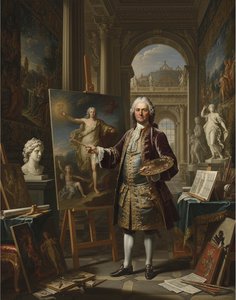
Charles Le Brun: Master of French Baroque Classicism & His Enduring Legacy
Explore the life & art of Charles Le Brun, master of French Baroque Classicism. Discover his royal commissions, influence on Versailles, and enduring legacy through detailed analysis & stunning artworks.

Léon Bonnat: Realism, Academic Mastery & the Depths of Portraiture
Explore the life & work of Léon Bonnat, a leading French Realist painter renowned for his masterful portraits and Spanish Baroque influence. Discover his academic legacy & pursuit of psychological depth in 19th-century art.

Simon Vouet: A Baroque Master's Journey from Italian Influence to French Classicism
Explore the life & art of Simon Vouet, a pivotal French Baroque painter who introduced Italian styles to France. Discover his masterpieces and lasting influence on 17th-century art.

Léon Augustin L'Hermitte: Capturing the Soul of French Rural Life
Discover the captivating realist paintings of Léon Augustin L'Hermitte, masterfully depicting French rural life. Explore his technique, influences & legacy – a cornerstone of 19th-century art.