() ·

A painting made for you, by hand

Façade (detail)

Reproduction à l'huile faite à la main

Huile sur toile peinte à la main, avec cadre et dimensions personnalisés, réalisée sur commande par nos artistes. ( Passer au format impression Passer au format numérique)

Description de la pièce

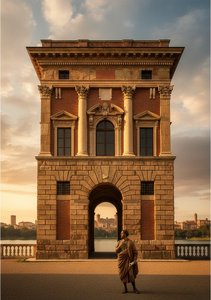
Admire Leon Battista Alberti’s iconic ‘Façade,’ a masterpiece of Renaissance architecture from Florence (1446). Explore its symmetrical design, arched windows & geometric precision – a testament to humanist ideals.

Biographie de l'artiste

Découvrez Leon Battista Alberti (1404-1472), architecte, théoricien & humaniste de la Renaissance ! Explorez ses créations emblématiques comme le Palazzo Rucellai et le Tempio Malatestiano.

from ·

Chapter 1

How large should it be?

Slide to change the size; the picture on the left shows the frame at its real width. The proportions of the original are kept.

Format standard
sur mesure
CM
INCH

Choisissez parmi nos formats prédéfinis qui respectent les proportions originales de l’œuvre.

largeur
hauteur

Saisissez la largeur et la hauteur souhaitées, pour s'adapter à votre cadre ou à votre mur. Cette œuvre est peinte à la main ; ainsi, pour un format de forme différente, l'artiste peut peindre un peu plus autour du tableau ou réduire légèrement les bords — c'est vous qui choisissez. Nous vous envoyons une maquette numérique pour approbation avant que la peinture ne commence. L'image présentée sur cette page ne reflète pas le résultat réel — seule la maquette le fait.

Chapter 2

How should it arrive?

Choose the edges of the stretched canvas

Choose your frame

Corner sample of the WhiteWrap canvas edge finish, stretched on bois massif bars
White €1
Corner sample of the BlurSideWrap canvas edge finish, stretched on bois massif bars
Blurside €1
Corner sample of the ExtendedWrap canvas edge finish, stretched on bois massif bars
Extended €1
Corner sample of the P118B picture frame: polystyrène moulé, 5 cm wide and 3 cm thick
P118B €10
Corner sample of the P118H picture frame: polystyrène moulé, 5 cm wide and 3 cm thick
P118H €10
Corner sample of the P118W picture frame: polystyrène moulé, 5 cm wide and 3 cm thick
P118W €10
Corner sample of the P438Z picture frame: polystyrène moulé, 5.5 cm wide and 3.5 cm thick
P438Z €10
Corner sample of the P508JH picture frame: polystyrène moulé, 7 cm wide and 3.5 cm thick
P508JH €12
Corner sample of the P508YH picture frame: polystyrène moulé, 7 cm wide and 3.5 cm thick
P508YH €12
Corner sample of the P805H picture frame: polystyrène moulé, 5 cm wide and 3.5 cm thick
P805H €10
Corner sample of the P805Z picture frame: polystyrène moulé, 5 cm wide and 3.5 cm thick
P805Z €10
Corner sample of the P919BZ picture frame: polystyrène moulé, 7 cm wide and 3.5 cm thick
P919BZ €10
Corner sample of the P919G picture frame: polystyrène moulé, 7 cm wide and 3.5 cm thick
P919G €10
Corner sample of the P919XJ picture frame: polystyrène moulé, 7 cm wide and 3.5 cm thick
P919XJ €10
Corner sample of the P959ZH picture frame: polystyrène moulé, 5 cm wide and 3 cm thick
P959ZH €10
Corner sample of the P968JZ picture frame: polystyrène moulé, 6 cm wide and 4 cm thick
P968JZ €12
Corner sample of the W106C picture frame: bois massif, 5 cm wide and 3 cm thick
W106C €8
Corner sample of the W218G picture frame: bois massif, 5 cm wide and 3 cm thick
W218G €10
Corner sample of the W218JH picture frame: bois massif, 5 cm wide and 3 cm thick
W218JH €8
Corner sample of the W218Y picture frame: bois massif, 5 cm wide and 3 cm thick
W218Y €10
Corner sample of the W307PJ picture frame: bois massif, 6 cm wide and 3 cm thick
W307PJ €10
Corner sample of the W316G picture frame: bois massif, 6 cm wide and 3 cm thick
W316G €10
Corner sample of the W316PJ picture frame: bois massif, 6 cm wide and 3 cm thick
W316PJ €8
Corner sample of the W316Y picture frame: bois massif, 6 cm wide and 3 cm thick
W316Y €10
Corner sample of the W398PJ picture frame: bois massif, 5 cm wide and 3 cm thick
W398PJ €8
Corner sample of the W4111J picture frame: bois massif, 6.5 cm wide and 3.5 cm thick
W4111J €10
Corner sample of the W500HY picture frame: bois massif, 7 cm wide and 5 cm thick
W500HY €15
Corner sample of the W500JH picture frame: bois massif, 7 cm wide and 5 cm thick
W500JH €15
Corner sample of the W692G picture frame: bois massif, 8 cm wide and 4 cm thick
W692G €12
Corner sample of the W849H picture frame: bois massif, 5 cm wide and 3 cm thick
W849H €8
Corner sample of the W940BG picture frame: bois massif, 7.5 cm wide and 4.5 cm thick
W940BG €15
Corner sample of the W953PJ picture frame: bois massif, 6 cm wide and 3.5 cm thick
W953PJ €8
Corner sample of the H24-GOLD picture frame: bois sculpté et apprêté au gesso, 10 cm wide and 6 cm thick
H24-GOLD €30
Corner sample of the H24-SILVER picture frame: bois sculpté et apprêté au gesso, 10 cm wide and 6 cm thick
H24-SILVER €30
Corner sample of the H36-GOLD picture frame: bois sculpté et apprêté au gesso, 15 cm wide and 6.5 cm thick
H36-GOLD €45
Corner sample of the H36-SILVER picture frame: bois sculpté et apprêté au gesso, 15 cm wide and 6.5 cm thick
H36-SILVER €45
Aperçu du cadre
Sous cadre

Moulding: . Overall size with the frame: .

Chapter 3

Who paints it, and should anything change?

Examples of what can be changed: Replace face with customer photo; Add pet (e.g., replace cat with dog); Include hidden message in background; Change background landscape or elements.
After order, OriginalUniqueArt.com team will email client for instructions and provide a mockup preview

Livraison dans le monde entier () en 3 à 4 semaines au lieu des 5 semaines habituelles. (2 novembre). Aucun compromis sur la qualité.

Chapter 4

The finishing touches

A nameplate, as in a museum?

Détails de la plaque en bronze gravée

This elegant plaque features the artist's name and the title of the artwork, finely engraved for a timeless presentation.

It is made from bronze with a refined, elegant finish. The text is precisely laser-engraved for a sharp and permanent result. Measuring 9x2 cm, the plaque is compact yet easy to read. It's built to be durable and scratch-resistant, offering a professional, museum-quality look. Mounting is simple thanks to the included adhesive backing.

Détails de la plaque en acrylique transparent

The plaque includes essential engraved details such as the artist's name, the title of the artwork, the date it was created, the type of media used-like oil on canvas or watercolor-a brief description of the piece, and a QR code that links to the complete artwork information.

It is crafted from clear acrylic, offering a sleek, modern appearance. The text is UV-engraved in black to ensure strong visual contrast. With a size of 10x15 cm, it ensures optimal readability. It comes equipped with two metal hooks for secure wall mounting. The plaque is designed to be weather-resistant, making it suitable for various environments, and it includes interactive features that work seamlessly with smartphone scanning.

Détails de la plaque en acrylique noir

This elegant plaque includes engraved information such as the artist's name, the title of the artwork, the date it was created, the type of media used (like oil on canvas or watercolor), a short description of the artwork, and a QR code for quick access to more information.

The plaque itself is made from refined black acrylic with a premium finish. The text is laser-engraved in white for high contrast and readability. Its size is 10x15 cm, designed to be easy to read. It comes with two metal hooks for professional mounting. The design is sleek and fits any interior style. It is also weather-resistant and durable, with built-in digital integration for mobile compatibility.

A protective varnish?

When do you need it?

Chapter 5

Your painting, as you ordered it

Façade (detail)

Technique de reproduction

Format de la reproduction

-

Artiste de prestige

Plus de détails, de finesse et un temps de production accru

-

Cadre de reproduction

-

-

Pour les œuvres ou reproductions dont un côté mesure plus de 105 cm (environ 41 pouces), le cadre sera expédié sous forme de kit démonté. Cette méthode garantit une livraison sécurisée et prévient tout dommage pendant le transport.

Assemblage professionnel requis - ce produit n'est pas destiné au bricolage (DIY).
Le kit doit être assemblé et la toile tendue par un encadreur professionnel expérimenté, en utilisant de la colle à bois (non fournie), une pince à tendre la toile et des serre-joints pour maintenir les traverses d'équerre pendant le séchage de la colle. Un assemblage incorrect ou une tension inégale de la toile peut endommager l'œuvre de manière irréversible et n'est pas couvert par notre garantie.

  • Toutes les baguettes en bois massif sont incluses, découpées avec précision à la taille requise.

  • À assembler avec les vis fournies, ainsi qu'avec de la colle à bois pour les assemblages d'angles (non fournie), à prévoir par votre encadreur.

  • L'utilisation d'outils professionnels est requise et non incluse : une pince à tendre la toile (tendeur) et des serre-joints pour maintenir les baguettes bien d'équerre pendant le séchage de la colle.

Important :
L'assemblage des angles nécessite de la colle à bois, les barres doivent être maintenues avec des serre-joints jusqu'au séchage complet de la colle, et le tendage de la toile sur le châssis assemblé nécessite une pince à tendre la toile. Aucun de ces éléments n'est inclus dans le kit. Veuillez consulter un encadreur professionnel expérimenté avant de commander ce format.

Cartel

-

-

Vernis de protection

Vernis brillant (intensifie les couleurs, protège de la lumière et de l'humidité)

-

Personnaliser mon œuvre

Exemples de personnalisation : remplacer le visage par une photo du client ; ajouter un animal de compagnie (par exemple, remplacer un chat par un chien) ; inclure un message caché en arrière-plan ; modifier le paysage ou les éléments d'arrière-plan.

-

Livraison urgente

Livraison dans le monde entier () en 3 à 4 semaines au lieu des 5 semaines habituelles. (2 novembre). Aucune concession sur la qualité.

-

Livraison express

Livraison dans le monde entier () sous 5 semaines. (9 novembre).

Inclus

Prix total

€ 267

Prix total € 267

L'option verre n'est disponible que pour les dimensions inférieures à 110 cm.

Included with every order

  • Livraison express gratuite dans le monde entier

  • Toile de lin de qualité supérieure
  • Assurance transport complète
  • Garantie de remboursement des droits de douane
  • Garantie de fidélité des couleurs
  • Politique de retour de 100 jours (uniquement en cas de défaut)
  • Garantie de remboursement à 100%
  • Offre de tarifs dégressifs

A Window into Renaissance Harmony: Façade (detail) by Leon Battista Alberti

  • Subject Matter: This meticulously rendered detail captures the iconic façade of Palazzo Rucellai in Florence, Italy – a building that embodies the very principles of Renaissance architectural design. The painting isn't merely a depiction of stone and brick; it’s an exploration of order, proportion, and the harmonious relationship between human intellect and the natural world.
  • Artist’s Vision: Painted by Leon Battista Alberti in 1446, this work represents more than just a commission. Alberti was a pivotal figure in the Renaissance – an architect, theorist, humanist scholar, and artist who sought to codify the rules of beauty and proportion. He believed that architecture should be rooted in mathematical ratios and geometric forms, reflecting divine order.

Technical Brilliance: A Study in Perspective and Light

  • Renaissance Technique: Alberti’s masterful use of linear perspective is immediately apparent. The receding lines of the façade create a convincing illusion of depth, drawing the viewer into the heart of the building. Notice how he employs subtle shading – *chiaroscuro* – to model the stone blocks and highlight their textures, adding a remarkable sense of three-dimensionality to what is essentially a two-dimensional surface.
  • Materiality: The choice of light-colored stone is crucial. It reflects the Florentine sunlight, enhancing the building’s luminosity and contributing to its overall elegance. Alberti's attention to detail extends beyond mere representation; he sought to capture the *essence* of the material itself.

Symbolism and Context: The Architecture of Humanism

  • Architectural Principles: Palazzo Rucellai, designed by Alberti, was a groundbreaking structure that exemplified the humanist ideals of the Renaissance. Its symmetrical design, based on classical Roman precedents, reflected a belief in human reason and potential. The evenly spaced arches and windows were not just functional; they were symbolic representations of order and harmony.
  • Historical Significance: Created during a period of immense intellectual and artistic ferment, this painting offers a valuable glimpse into the burgeoning Renaissance spirit. Alberti’s work influenced generations of architects and artists, shaping the course of Western art and architecture for centuries to come. It stands as a testament to the power of observation, mathematical precision, and human creativity.

Emotional Impact & Reproduction

  • A Timeless Masterpiece: “Façade (detail)” evokes a sense of serenity, order, and intellectual contemplation. The painting’s harmonious composition invites the viewer to appreciate the beauty of architectural design and the enduring legacy of Renaissance thought.
  • OriginalUniqueArt Reproduction: Our hand-painted reproductions capture every nuance of Alberti's original work, ensuring an authentic representation for your home or office. We utilize archival quality materials and skilled artisans to create a stunning piece that will be treasured for generations.

Questions et réponses

Quelle ambiance "Façade (detail)" apporterait-elle à une pièce ?

«Façade (detail)» de Leon Battista Alberti dégage une atmosphère Elegant et s'intègre parfaitement dans une Living Room. Cette ambiance reflète l'émotion que l'œuvre apporte à l'espace qui l'entoure.

Dans quelle pièce est-il suggéré d'exposer « Façade (detail) », compte tenu de sa palette ?

Avec sa palette Neutrals, «Façade (detail)» de Leon Battista Alberti est recommandé pour une Living Room. Ses couleurs justifient d'ailleurs cette suggestion.

Quelle est la teinte dominante de «Façade (detail)» de Leon Battista Alberti ?

La teinte dominante de «Façade (detail)» de Leon Battista Alberti est Ochre to Sepia. Cette nuance constitue la tonalité de fond de la palette.

More about this painting

Aperçu en situation Visualiser en RA Passer au format impression Passer au format numérique Envoyer
Détails de l'œuvre Guide Ajouter aux favoris Télécharger l'image Articles similaires Radiographie Diaporama Q&A Statistiques

In numbers

  • 1446the year it was painted
  • 29frames to choose from
  • standard sizes, in its own proportions
  • 5weeks to paint and deliver it
Leon Battista Alberti

Leon Battista Alberti

1404 - 1472, Italie

Quick facts about Leon Battista Alberti

  • Artistic Movement Or Style: Humanisme de la Renaissance
  • Artists Or Movements Influenced By This Artist:
    • Piero della Francesca
    • Léonard de Vinci
  • Artists Who Influenced This Artist:
    • Vitruve
    • Filippo Brunelleschi
  • Date De Décès: 25 avril 1472
  • Date De Naissance: 14 février 1404
  • Full Name: Léon Battista Alberti
  • Nationalité: Italienne
  • Notable Artworks:
    • Palazzo Rucellai
    • Tempio Malatestiano
    • Santa Maria Novella
  • Place De Naissance: Gênes, Italie

Biographie de l'artiste

Léon Battista Alberti : Un Polymathe de la Renaissance

  • Né : 14 février 1404, Gênes
  • Décédé : 25 avril 1472, Rome
  • Nationalité : Italien
  • Connu pour : Architecture, écriture, mathématiques, cryptographie, théorie de l'art.

Jeunesse et Formation

  • Léon Battista Alberti est né à Gênes en 1404, fils d’un père florentin exilé, Lorenzo di Benedetto Alberti.
  • Sa formation initiale a eu lieu à Padoue et Bologne, où il étudia le droit mais développa un vif intérêt pour les mathématiques.
  • Il reçut une instruction en mathématiques de la part de son père et poursuivit plus tard ses études de manière indépendante, trouvant refuge dans ces disciplines face aux exigences des études juridiques.
  • Vers 1424, Alberti écrivit sa première comédie, *Philodoxius*, témoignant d'un talent littéraire précoce.
  • En 1431, il déménagea à Rome et entra au service de la cour papale, recevant les sacrements. Cette période lui permit d’étudier les ruines romaines antiques, ce qui influença profondément sa pensée architecturale.

Contributions Architecturales et Écrits

  • Alberti est considéré comme une figure fondatrice de l'architecture de la Renaissance, principalement grâce à son traité *De re aedificatoria* (Sur l’Art de Construire), publié à titre posthume en 1485. Cet ouvrage s’inspirait largement des écrits de Vitruve mais intégrait les propres observations et innovations d'Alberti.
  • Le traité exposait les principes de la conception classique, soulignant la proportion, la symétrie et l’harmonie. Il devint un pilier de l’enseignement architectural pendant des siècles.
  • Des projets architecturaux notables attribués à Alberti comprennent la façade du Palazzo Rucellai à Florence (commencée en 1446), le Tempio Malatestiano à Rimini et les conceptions pour des églises à Mantoue, San Sebastiano et la Basilique Saint-André.
  • Son travail sur Santa Maria Novella à Florence a démontré sa capacité à intégrer des éléments classiques dans des structures existantes.

Recherches Artistiques et Intellectuelles au-delà de l'Architecture

  • Alberti était un véritable polymathe, excellant dans divers domaines au-delà de l’architecture. Il a apporté des contributions significatives à la théorie de l'art, en particulier concernant la perspective. Son traité *De pittura* (Sur la Peinture), écrit vers 1435 mais publié plus tard, a codifié les principes de la perspective linéaire, révolutionnant la représentation artistique.
  • Il était également un mathématicien et un cryptographe habile, pionnier dans l'analyse fréquentielle en cryptographie.
  • Ses intérêts s’étendaient à la linguistique, à la philosophie et même à la cosmologie. Il écrivit *De componendis cifris* (Sur la Composition de Chiffres), un ouvrage précoce sur la cryptographie, et collabora avec Paolo Toscanelli sur des études astronomiques.
  • Il a rédigé *De statua* (Sur la Sculpture) qui explorait les principes de la sculpture.

Héritage et Importance Historique

  • L'héritage de Léon Battista Alberti réside dans sa synthèse des connaissances classiques avec l’humanisme de la Renaissance, façonnant le paysage intellectuel et artistique de l’époque.
  • Ses théories architecturales ont profondément influencé les générations futures d’architectes, établissant une base pour les principes de conception de la Renaissance qui se sont répandus dans toute l'Europe.
  • En tant que théoricien et praticien, il a défendu la raison, la proportion et l’harmonie dans l’art et l’architecture, incarnant les idéaux de l’homme universel de la Renaissance.
  • Son travail sur la perspective a fondamentalement changé la pratique artistique, permettant des représentations plus réalistes et convaincantes de l'espace.
  • Giorgio Vasari a reconnu l'importance d'Alberti dans *Les Vies des Plus Excellents Peintres, Sculpteurs et Architectes*, consolidant ainsi sa place en tant que figure essentielle de l’histoire de l’art.

Informations clés

  • Subject or theme: Architecture
  • Title: Façade
  • Artist: Leon Battista Alberti
  • Artistic style: Symmetry & Proportion
  • Notable elements or techniques: Light-colored stone blocks, horizontal & vertical lines
Explorez des œuvres d'art classées par thèmes, styles et caractéristiques.