
![Pas Mèche [nothing Doing] — Jules Bastien-lepage](/media/artworks/images-full/0a/a4/0aa443b038cfee7a0eeae71195adba8a.jpg)
 Aperçu en situation
 Envoyer
 Partager
 Détails de l'œuvre
 Guide
Guide

 Télécharger l'image
 Articles similaires
 Radiographie
 Diaporama
 Statistiques
Pas Mèche [Nothing Doing]


 Lire la suite
Reproduction à l'huile faite à la main
Huile sur toile peinte à la main, avec cadre et dimensions personnalisés, réalisée sur commande par nos artistes. ( Passer au format impression Passer au format numérique)




P118B €10

P118H €10

P118W €10

P438Z €10

P508JH €12

P508YH €12

P805H €10

P805Z €10

P919BZ €10

P919G €10

P919XJ €10

P959ZH €10

P968JZ €12

W106C €8

W218G €10

W218JH €8

W218Y €10

W307PJ €10

W316G €10

W316PJ €8

W316Y €10

W398PJ €8

W4111J €10

W500HY €15

W500JH €15

W692G €12

W849H €8

W940BG €15

W953PJ €8




Choisissez parmi nos formats prédéfinis qui respectent les proportions originales de l’œuvre.

Saisissez la largeur et la hauteur souhaitées, pour s'adapter à votre cadre ou à votre mur. Cette œuvre est peinte à la main ; ainsi, pour un format de forme différente, l'artiste peut peindre un peu plus autour du tableau ou réduire légèrement les bords — c'est vous qui choisissez. Nous vous envoyons une maquette numérique pour approbation avant que la peinture ne commence. L'image présentée sur cette page ne reflète pas le résultat réel — seule la maquette le fait.
Après la commande, l’équipe OriginalUniqueArt.com contactera le client par e-mail pour recueillir ses instructions et lui fournira une maquette d’aperçu
Livraison dans le monde entier () en 3 à 4 semaines au lieu des 5 semaines habituelles. (26 octobre). Aucun compromis sur la qualité.

Livraison express gratuite dans le monde entier

Toile de lin de qualité supérieure

Assurance transport complète

Garantie de remboursement des droits de douane

Garantie de fidélité des couleurs

Politique de retour de 100 jours (uniquement en cas de défaut)

Garantie de remboursement à 100%

Offre de tarifs dégressifs
 L'option verre n'est disponible que pour les dimensions inférieures à 110 cm.
![Pas Mèche [Nothing Doing]](/static/images/originaluniqueart/artworks/painting.a1e74a1cb7dc.png)
Pas Mèche [Nothing Doing]
Technique de reproduction
Format de la reproduction
-


Prix total
€ 263
A Moment Frozen in Rural France: Jules Bastien-Lepage’s *Pas Mèche*
Jules Bastien-Lepage's *Pas Mèche* (Nothing Doing), painted in 1882, isn’t merely a portrait; it’s a carefully constructed tableau of rural life imbued with a quiet dignity and an unspoken narrative. The painting depicts a young boy, likely a barge worker, standing on the edge of a small village road, his gaze direct and unwavering. He is a figure of remarkable composure amidst what appears to be a mundane scene – a worn brown jacket, raggedy trousers, and large, unlaced boots speak to a life of hard work and simple means. Yet, within this apparent ordinariness lies a profound sense of observation and a subtle suggestion of melancholy. Bastien-Lepage, a pivotal figure in the transition from Realism to Naturalism, masterfully captures not just an image but also a feeling—a poignant awareness of time passing and the quiet realities of peasant existence. The title itself, *Pas Mèche*, is a French slang phrase meaning “Nothing Doing,” hinting at a state of weary resignation or perhaps simply a moment’s pause before returning to labor.The Naturalist Approach: Light, Texture, and Observation
Bastien-Lepage's artistic approach was deeply rooted in the tenets of Naturalism, a movement that sought to depict life as it truly was—without idealization or romantic embellishment. He achieved this through meticulous observation and a masterful understanding of light and texture. Unlike the polished surfaces favored by earlier academic painters, Bastien-Lepage employed loose, visible brushstrokes, allowing the canvas to breathe and revealing the materiality of his subjects. The paint itself seems almost tactile—one can practically feel the roughness of the boy’s clothing and the weathered surface of the road beneath his feet. He utilized a muted palette dominated by earthy browns, greens, and greys, reflecting the colors of the rural landscape he so faithfully rendered. Crucially, Bastien-Lepage spent considerable time *en plein air* (outdoors), directly observing his subjects in their natural environment, ensuring an unparalleled level of accuracy and authenticity in his depictions. This commitment to direct observation is evident in the boy’s posture, the way the light falls across his face, and the subtle details of the surrounding village.Symbolism Within Simplicity: The Tools of Labor
Beyond the immediate depiction of the boy, *Pas Mèche* is rich with symbolic elements. The fishing rod clutched in his hand immediately establishes his profession—a barge worker who would have been responsible for guiding and controlling the boats navigating the canals and rivers of France. The horn slung across his back was a vital tool for communication, alerting lockmasters to the approach of a boat. These seemingly simple objects – the rod, the horn, the worn boots – represent not just labor but also a connection to tradition, community, and the rhythms of rural life. The boy’s direct gaze is particularly significant; it suggests an awareness beyond his years, perhaps a recognition of the limitations imposed upon him by his circumstances. His stillness conveys a quiet dignity—a refusal to be defined solely by his humble profession.A Legacy of Rural Realism
Jules Bastien-Lepage’s *Pas Mèche* stands as a cornerstone of French Naturalist painting, profoundly influencing generations of artists. His ability to capture the essence of rural life with such honesty and sensitivity resonated deeply with audiences seeking an alternative to the idealized depictions prevalent in academic art. Born in 1848 and tragically dying at just thirty-six, Bastien-Lepage’s brief but impactful career left behind a body of work that continues to captivate viewers today. *Pas Mèche* exemplifies his signature style—a blend of meticulous observation, evocative light, and a profound understanding of the human condition. It's a painting that invites contemplation, prompting us to consider the lives of those who labor unseen and the quiet beauty found in the most unassuming corners of the world. Reproductions of *Pas Mèche* offer a valuable opportunity to bring this poignant work into any interior space, serving as a reminder of France’s rich artistic heritage and the enduring power of simple, honest representation.Questions et réponses
Quelle est la taille d'impression recommandée pour «Pas Mèche [Nothing Doing]» de Jules Bastien-Lepage ?
La taille d'impression recommandée pour «Pas Mèche [Nothing Doing]» de Jules Bastien-Lepage est Medium.
Quel est le format de « Pas Mèche [Nothing Doing] » ?
L'œuvre « Pas Mèche [Nothing Doing] » est au format Portrait. Cette information est utile pour prévoir l'emplacement de sa reproduction.
À quelle étape de la carrière de Jules Bastien-Lepage appartient « Pas Mèche [Nothing Doing] » (1882) ?
Datée de 1882, l'œuvre « Pas Mèche [Nothing Doing] » appartient à la période Mature Period de Jules Bastien-Lepage.
Biographie de l'artiste
Jules Bastien-Lepage : Pionnier du Naturalisme
- Né: Damvillers, France (1848)
- Décédé: 1884
Jules Bastien-Lepage fut un peintre français étroitement associé au début du naturalisme, un style artistique qui s'est développé à partir du mouvement réaliste et a ouvert la voie au développement de l'impressionnisme. Ses représentations en plein air de la vie paysanne dans la campagne furent très influentes sur de nombreux artistes internationaux.
Jeunesse et Formation
Bastien-Lepage est né en 1848 dans le village de Damvillers, Meuse, où il a passé son enfance. Il a commencé sa formation artistique sous la direction de son père, qui était également artiste, avant de déménager à Paris en 1867 pour étudier à l'École des Beaux-Arts. Là, il a travaillé sous Alexandre Cabanel et a développé ses compétences en tant que peintre.
Style Artistique et Influences
Le style de Bastien-Lepage se caractérise par des coups de pinceau complexes et une palette pure baignée d'une lumière naturelle chaude. Il s’est principalement concentré sur les banlieues occidentales de Paris, peignant en plein air selon la tradition du plein-air. Son travail a été influencé par le mouvement réaliste, mais il a également puisé son inspiration auprès d'autres artistes, notamment George Clausen et Tom Roberts.
- Caractéristiques Principales: Coups de pinceau complexes, palette pure, lumière naturelle chaude, peinture en plein air.
- Influences: Mouvement Réaliste, George Clausen, Tom Roberts.
Œuvres Majeures et Reconnaissance
Bastien-Lepage a obtenu un premier succès en 1874 avec son tableau "Portrait de mon Grand-Père", qui a suscité une grande admiration critique et a reçu une médaille de troisième classe. Il a également remporté la renommée pour ses peintures historiques, notamment “Jeanne d’Arc”, aujourd'hui conservée au Musée d'Orsay à Paris.
- Tableaux Notables:
- "Portrait de mon Grand-Père" (1874)
- “Jeanne d’Arc” (Musée d’Orsay, Paris)
- "La Fauconnerie" – reconnu comme le chef du courant naturaliste émergent.
- "Octobre - cueillette des pommes de terre"
- "A la moisson"
- "Laura, Lady Alma Tadema"
- "Sarah Bernhardt" (1879) – un portrait qui lui a valu d'importantes commandes.
- "Paysage hivernal au fusain"
Après le succès de "La Fauconnerie", Bastien-Lepage a été reconnu comme le chef du courant naturaliste émergent. En 1883, un critique pouvait affirmer que « tout le monde peint aujourd'hui tellement comme M. Bastien-Lepage que M. Bastien-Lepage semble peindre comme le monde entier ». Cette renommée lui a valu d'importantes commandes, notamment un portrait de Sarah Bernhardt en 1879.
Le Naturalisme et l’Héritage
Le naturalisme était un mouvement artistique qui est né comme une réaction à la révolution industrielle et à son impact sur la société. Il représentait la classe ouvrière et les pauvres, se concentrant sur leurs luttes et leurs difficultés. Le mouvement a commencé en France et s'est répandu dans toute l'Europe, devenant largement considéré comme un style artistique majeur.
- Signification: Bastien-Lepage fut une figure importante dans le développement du naturalisme et de l'impressionnisme. Ses peintures continuent d’être célébrées pour leur beauté et leur profondeur émotionnelle, et son influence peut être observée chez de nombreux artistes qui l'ont suivi.

Jules Bastien-Lepage
1848 - 1884 , France
L'essentiel de l'artiste
- Artistes Influents:
- Alexandre Cabanel
- George Clausen
- Tom Roberts
- Date De Décès: 1884
- Date De Naissance: 1848
- Influences Artistiques: ['Impressionnisme']
- Lieu De Naissance: Damvillers, France
- Mouvement Artistique: Naturalisme, Réalisme
- Nationalité: Française
- Nom Complet: Jules Bastien-Lepage
- Oeuvres Notables:
- Portrait de mon grand-père
- Jeanne d'Arc
- La moisson
- Sarah Bernhardt
Articles connexes

Echoes of Rural Life: Art's Enduring Representations of the Countryside
Explore the rich history of rural life in art! Discover masterpieces from Millet to Mauve & beyond. Learn about Realism, Barbizon School & find inspiration for your home with OriginalUniqueArt.

Léon Augustin L'Hermitte: Capturing the Soul of French Rural Life
Discover the captivating realist paintings of Léon Augustin L'Hermitte, masterfully depicting French rural life. Explore his technique, influences & legacy – a cornerstone of 19th-century art.

The Enduring Legacy of Oil on Canvas: Technique, History & Aesthetic Impact
Explore the rich history & techniques of oil painting – from Renaissance masters to Impressionism. Discover pigments, layering methods, and why this timeless medium endures. Expert insights for artists & art enthusiasts.

L'Huile sur Toile : Exploration Historique et Technique d'un Médium Artistique Intemporel
Explorez l'histoire fascinante de la peinture à l'huile, des techniques ancestrales aux maîtres flamands comme Van Eyck. Découvrez les secrets des pigments, liants et glacis pour comprendre cet art intemporel.
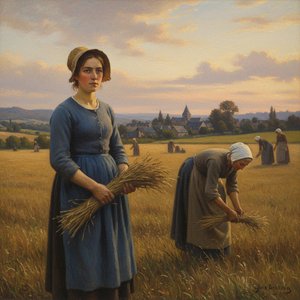
Jules Breton: Capturing the Poetic Soul of French Rural Life
Explore the captivating world of Jules Breton, master of French Realism. Discover his iconic paintings of rural life, learn about his artistic journey, and find high-quality reproductions to elevate your art collection at OriginalUniqueArt.


