

 Aperçu en situation
 Partager
 Partager
 Détails
 Guide imprimable

 Télécharger
 Articles similaires
 Radiographie
 Voir le diaporama
 Statistiques
Glass and Water Bottle
 Oil On Canvas
- WallArt
- Cubism
 1917
1917- Modern
 32.0 x 54.0 cm
 Musée d'art Ohara
 Afficher la suite
Giclées et impressions d'art
Impressions giclées ou sur toile de qualité musée, avec une production rapide et des finitions au choix. ( Acheter la peinture faite à la main Passer au format image numérique)




P118B $10

P118H $10

P118W $10

P438Z $10

P508JH $12

P508YH $12

P805H $10

P805Z $10

P919BZ $10

P919G $10

P919XJ $10

P959ZH $10

P968JZ $12

W106C $8

W218G $10

W218JH $8

W218Y $10

W307PJ $10

W316G $10

W316PJ $8

W316Y $10

W398PJ $8

W4111J $10

W500HY $15

W500JH $15

W692G $12

W849H $8

W940BG $15

W953PJ $8




Choisissez parmi nos formats prédéfinis qui respectent les proportions originales de l’œuvre.

Vous pouvez saisir vos propres dimensions pour vous adapter à un cadre ou à un espace spécifique. Si la taille sélectionnée ne correspond pas aux proportions de l'image originale, nous recadrerons l'œuvre ou étendrons l'image avec une bordure en miroir ou une couleur unie. Une maquette numérique vous sera envoyée pour approbation avant le début de la production.
Veuillez noter que l'aperçu à l'écran ne reflète pas le recadrage ou l'extension réelle. Seule la maquette montrera avec précision la composition finale.
Bien que des tailles personnalisées soient disponibles, nous vous recommandons de choisir une dimension dans la liste prédéfinie afin de préserver les proportions originales.
Livraison dans le monde entier () en 2 semaines au lieu des 4/5 semaines habituelles. (27 septembre)

Livraison express gratuite dans le monde entier

Toile de lin de haute qualité

Assurance transport complète

Garantie de remboursement des droits de douane

Garantie de fidélité des couleurs

Garantie de retour de 100 jours (uniquement en cas de défaut)

Garantie de remboursement à 100%

Tarifs dégressifs sur quantité
 L'option verre n'est disponible que pour les dimensions inférieures à 110 cm.

Glass and Water Bottle
Giclées et impressions d'art
Format de la reproduction
-


Prix total final
$ 80
A Fragmented Reflection of Modernity
In the quiet intersection of geometry and light, Juan Gris’s 1917 masterpiece, "Glass and Water Bottle," invites the viewer into a world where reality is not merely observed, but meticulously reconstructed. As a cornerstone of Cubist aesthetics, this work transcends the simple depiction of everyday objects to offer a profound meditation on form and space. To gaze upon this canvas is to enter a rhythmic dance of planes and facets, where the boundaries between object and atmosphere dissolve into a singular, cohesive vision. It is an invitation to contemplate the complexities inherent in capturing the essence of our physical world through multiple viewpoints simultaneously, making it a captivating centerpiece for any collection that values intellectual depth and visual intrigue.
The painting serves as a window into the radical reimagining of perspective that defined the early 20th century. Moving away from the traditional illusion of depth, Gris employs a flattened perspective that stacks and overlaps elements, creating a sense of structural rigidity and architectural beauty. The composition, though seemingly abstract, retains a soulful connection to the tangible; through the careful arrangement of angular blocks, one can sense the weight of the glass and the presence of the bottle. For the discerning collector or interior designer, this piece offers a sophisticated balance of intellectual rigor and aesthetic harmony, providing a focal point that stimulates thought while anchoring a room with its disciplined structure.
The Alchemy of Technique and Color
Executed with masterful precision in oil on canvas, the technical execution of "Glass and Water Bottle" is nothing short of extraordinary. Gris utilizes the medium to achieve a delicate balance between texture and luminosity. Visible brushstrokes dance across the surface, lending a physical presence to the work that hints at the artist’s deliberate consideration of materiality. The palette is intentionally restrained—a sophisticated symphony of dark browns, deep blacks, and soft off-whites. This muted scheme does not merely depict objects; it creates an atmosphere of quiet contemplation. The subtle interplay of light and shadow within these geometric shapes provides a sense of volume without relying on traditional shading, allowing the sharp, defined lines to delineate each facet with crystalline clarity.
This mastery of color and form allows the artwork to function beautifully in diverse interior settings. Whether placed in a minimalist modern gallery or a richly textured classical study, the painting’s subdued tones act as a versatile anchor. The lack of a singular, dramatic light source creates an even, diffused glow that feels timeless, ensuring that the piece remains visually engaging regardless of the surrounding environment. It is this very technical excellence—the ability to convey subtle tonal variations through a limited spectrum—that makes a high-quality reproduction of this work such a prestigious addition to a curated space.
A Legacy of Cubist Innovation
To understand the emotional resonance of this piece, one must look back to the vibrant intellectual ferment of Paris during the height of the Cubist movement. While pioneers like Picasso and Braque laid the groundwork for breaking down reality, Juan Gris brought a unique, analytical precision to the genre. His background in engineering is subtly whispered through the mathematical harmony of his compositions. Unlike the more expressive or chaotic interpretations of Cubism, Gris’s work possesses a synthetic elegance—a way of pulling disparate fragments together into a unified, beautiful whole. This sense of "deconstruction and synthesis" is what gives the painting its enduring emotional impact; it represents the human desire to find order within complexity.
Ultimately, "Glass and Water Bottle" is more than a still life; it is a symbol of the modern era's search for truth through structure. The fragmented forms represent an attempt to capture the multifaceted nature of perception, reflecting a world that was rapidly changing and becoming increasingly interconnected. For those seeking to surround themselves with art that embodies both historical significance and timeless beauty, this work stands as a testament to the power of the analytical mind to transform the mundane into the magnificent. Owning a reproduction of such a pivotal moment in art history allows one to bring the spirit of Cubist revolution into the contemporary home.
Biographie de l'artiste
Juan Gris : Pionnier du Cubisme
- Né : 23 mars 1887, Madrid, Espagne
- Décédé : 11 mai 1927
Jeunesse et Développement Artistique
José Victoriano González-Pérez, connu sous le nom de Juan Gris, est né à Madrid, en Espagne. Sa jeunesse a été marquée par des études d'ingénierie à l’École des Arts et Sciences de 1902 à 1904. Durant cette période, il contribuait avec des dessins à des périodiques locaux, démontrant un talent précoce pour la représentation visuelle. De 1904 à 1905, Gris a étudié la peinture avec José Moreno Carbonero, perfectionnant ainsi ses compétences artistiques. En 1905, il adopta le pseudonyme Juan Gris, un nom qui deviendrait synonyme de son style distinctif.
Influences Parisiennes et l'Émergence du Cubisme
Un moment décisif dans la carrière de Gris survint en 1906 lorsqu’il déménagea à Paris. Ce déménagement l’exposa à une communauté artistique vibrante, où il se lia d’amitié avec des figures influentes telles que Henri Matisse, Georges Braque et Fernand Léger. Il fut profondément influencé par Pablo Picasso, soumettant initialement des illustrations humoristiques à des revues comme *L'Assiette au Beurre*, *Le Rire*, *Le Charivari* et *Le Cri de Paris*. Vers 1910, Gris se consacra sérieusement à la peinture, se dévouant au développement d’un style cubiste personnel. Il s’éloigna de l’illustration satirique pour adopter des compositions plus abstraites.
Œuvres Clés et Style Artistique
La production artistique de Juan Gris se caractérise par plusieurs éléments clés :
- Clarté et Ordre : Son œuvre mettait l’accent sur la clarté et l’ordre, influençant le style puriste défendu par Amédée Ozenfant et Charles Edouard Jeanneret (Le Corbusier).
- Structure Géométrique : La « période cristalline » de Gris, illustrée par des œuvres telles que *Nature morte devant une fenêtre ouverte* et *Place Ravignan* (1915), présentait une structure géométrique forte.
- Cubisme Synthétique : Après 1913, Gris adopta le cubisme synthétique, utilisant intensivement des techniques comme le papier collé ou le collage. Cela impliquait d’incorporer des matériaux du monde réel dans ses peintures, ajoutant texture et profondeur.
Parmi ses œuvres notables figurent :
- Guitare devant la mer (1925) : Démontre sa simplicité et son adhésion aux principes cubistes.
- Hommage à Pablo Picasso (1912) : Sa première exposition au Salon des Indépendants, témoignant de sa reconnaissance croissante dans le monde artistique.
Héritage et Importance Historique
La contribution de Juan Gris au cubisme est significative. Il a dépassé la phase analytique initiale du mouvement pour adopter une approche plus structurée et synthétique. Son insistance sur la clarté, les formes géométriques et l’incorporation d’objets du quotidien dans ses compositions l'ont établi comme une figure de proue de l'art du XXe siècle. Son œuvre continue d'être célébrée pour sa rigueur intellectuelle et sa beauté esthétique, influençant les générations futures d'artistes.

Juan Gris
1887 - 1927 , Espagne
En bref
- Artistes Influents:
- Pablo Picasso
- Georges Braque
- Henri Matisse
- Date De Décès: 11 mai 1927
- Date De Naissance: 23 mars 1887
- Influences Artistiques:
- Amédée Ozenfant
- Le Corbusier
- Lieu De Naissance: Madrid, Espagne
- Mouvement Artistique: Cubisme, Cubisme synthétique
- Nationalité: Espagnole
- Nom Complet: Juan Gris
- Oeuvres Notables:
- Guitare devant la mer
- Hommage à Picasso
- Nature morte Place Ravignan
Articles similaires

Neo-Abstract Art: The High-Impact Evolution of Modern Visual Energy and Geometric Sophistication
Discover the power of Neo-Abstract art. Explore how bold geometric forms and high-impact visual energy are redefining modern design. Learn to curate sophisticated, high-energy spaces with the latest trends in contemporary abstraction and structural color.

Abstraction Géométrique : Les 10 Chefs-d'œuvre qui ont Marqué l'Histoire de l'Art
Plongez au cœur de l'abstraction géométrique avec OriginalUniqueArt.com ! Découvrez les 10 œuvres majeures de Mondrian, Malevitch et Kandinsky qui ont révolutionné l'art moderne. Inspirez votre décoration intérieure avec des reproductions de tableaux exceptionnelles. Explorez la collection en ligne !

Beyond Form & Color: Geometric Abstraction's Evolution in 20th/21st Century Art
Explore the evolution of geometric abstraction from Cubism to contemporary art. Discover key artists like Malevich & Mondrian, investment insights, and expert collecting advice at OriginalUniqueArt.
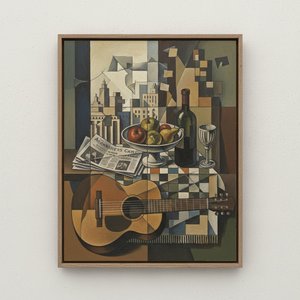
Juan Gris: Cubist Deconstruction & Synthesis – A Comprehensive Exploration
Explore the revolutionary art of Juan Gris – a master of Cubism. Discover his unique approach to deconstruction, vibrant Synthetic Cubist works, and lasting influence on modern art. Expert analysis for collectors.
Fernand Léger : Les 25 Œuvres Maîtresses d'un Pionnier du Modernisme | OriginalUniqueArt
Plongez dans l'univers vibrant de Fernand Léger ! Découvrez les 25 œuvres majeures du cubisme et du tubisme, explorant formes géométriques et couleurs audacieuses. Retrouvez des reproductions d'art exceptionnelles sur OriginalUniqueArt.com.


