

 Aperçu en situation
 Envoyer
 Partager
 Détails de l'œuvre

 Télécharger
 Articles similaires
 Radiographie
 Diaporama
 Stats
StatsIn Ictu Oculi
 Acrylic
- WallArt
- Baroque
 1670
1670 220.0 x 216.0 cm
 Hôpital de la Caridad
 Lire la suite
Giclées et impressions d'art
Impressions giclées ou sur toile de qualité musée, avec une production rapide et des finitions au choix. ( Commander la reproduction peinte à la main Switch to Digital Image)




P118B $10

P118H $10

P118W $10

P438Z $10

P508JH $12

P508YH $12

P805H $10

P805Z $10

P919BZ $10

P919G $10

P919XJ $10

P959ZH $10

P968JZ $12

W106C $8

W218G $10

W218JH $8

W218Y $10

W307PJ $10

W316G $10

W316PJ $8

W316Y $10

W398PJ $8

W4111J $10

W500HY $15

W500JH $15

W692G $12

W849H $8

W940BG $15

W953PJ $8




Choisissez parmi nos formats prédéfinis qui respectent les proportions originales de l’œuvre.

Vous pouvez saisir vos propres dimensions pour vous adapter à un cadre ou à un espace spécifique. Si la taille sélectionnée ne correspond pas aux proportions de l'image originale, nous recadrerons l'œuvre ou étendrons l'image avec une bordure en miroir ou une couleur unie. Une maquette numérique vous sera envoyée pour approbation avant le début de la production.
Veuillez noter que l'aperçu à l'écran ne reflète pas le recadrage ou l'extension réelle. Seule la maquette montrera avec précision la composition finale.
Bien que des tailles personnalisées soient disponibles, nous vous recommandons de choisir une dimension dans la liste prédéfinie afin de préserver les proportions originales.
Livraison dans le monde entier () en 2 semaines au lieu des 4/5 semaines habituelles. (8 septembre)

Livraison express gratuite dans le monde entier

Toile de lin de qualité supérieure

Assurance transport complète

Garantie de remboursement des droits de douane

Garantie de fidélité des couleurs

Politique de retour de 100 jours (uniquement en cas de défaut)

Garantie de remboursement à 100%

Offre de tarifs dégressifs
 L'option verre n'est disponible que pour les dimensions inférieures à 110 cm.

In Ictu Oculi
Giclées et impressions d'art
Format de la reproduction
-


Prix total
$ 80
A Meditation on Mortality: Juan de Valdés Leal’s “In Ictu Oculi”
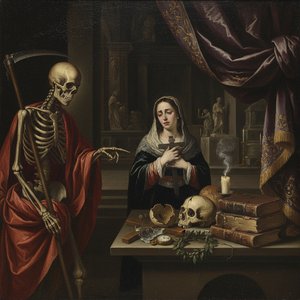
The painting "In Ictu Oculi," attributed to Juan de Valdés Leal (1622-1690), stands as a poignant emblem of Baroque art's preoccupation with the ephemeral nature of existence. Executed in 1670, this monumental canvas—measuring 220 x 216 cm—captures a scene steeped in theological symbolism and rendered with meticulous detail that speaks volumes about Leal’s artistic prowess. It’s more than just an image; it's a carefully constructed dialogue between faith and decay, inviting contemplation on the inevitability of death and the importance of spiritual reflection.Subject Matter and Composition
At its core lies a stark depiction of a skeleton—a ubiquitous motif in Baroque art representing mortality—holding aloft a book and a crucifix. This juxtaposition immediately establishes the painting’s thematic focus: the soul's journey through life towards eternal salvation, juxtaposed against the inescapable reality of physical demise. The skeleton isn’t merely presented as an anatomical specimen; it exudes solemn dignity, positioned atop a substantial pile of books—symbols of knowledge and earthly pursuits—some scattered around its feet, suggesting that even intellectual endeavors ultimately succumb to time's relentless march. Leal skillfully utilizes perspective to create depth within the composition, drawing the viewer’s eye upwards towards the crucifix while simultaneously grounding it in the tangible world of literature and decay.Style and Technique
Leal’s artistic style aligns perfectly with the Baroque aesthetic—characterized by dramatic chiaroscuro (contrast between light and dark), opulent ornamentation, and a fervent emotional intensity. The painting demonstrates exceptional technical skill, achieved through oil paint on canvas. Leal employs painstaking brushwork to capture the textures of bone and parchment alike, conveying both physicality and intellectual contemplation. The artist’s masterful manipulation of light enhances the dramatic effect, highlighting the skeleton's form against the muted tones of the surrounding books, creating a visual representation of spiritual illumination battling against darkness.Historical Context: Baroque Theology
“In Ictu Oculi” emerged during a period profoundly influenced by Catholic theology—specifically, Jansenism—which emphasized introspection and the contemplation of God’s divine justice. The image reflects this intellectual climate, serving as a reminder that earthly achievements are ultimately meaningless in comparison to spiritual salvation. Leal's work aligns with broader Baroque artistic trends aimed at conveying moral instruction and provoking emotional responses from viewers. It was commissioned for the Church of San Francesco in Córdoba, underlining its purpose as devotional artwork intended to inspire piety and reinforce religious beliefs.Symbolism: Vanitas Revisited
The painting’s symbolism resonates deeply within the tradition of vanitas—a genre that explores themes of mortality, decay, and the futility of earthly pleasures. The skull represents death itself, while the book symbolizes wisdom and spiritual enlightenment – a paradox highlighting the limitations of human understanding in confronting eternity. Similarly, the crucifix embodies Christian faith and redemption, offering solace amidst despair. Leal’s deliberate arrangement reinforces these concepts, prompting viewers to confront their own mortality and consider the significance of their lives beyond the temporal realm.Emotional Impact: A Silent Plea for Reflection
Ultimately, “In Ictu Oculi” transcends mere visual representation; it evokes a profound emotional response. The painting's subdued palette—dominated by browns and ochres—contributes to its solemn atmosphere, fostering contemplation and prompting viewers to confront uncomfortable truths about human existence. Leal’s masterful execution compels us to consider the brevity of life and the enduring power of faith – leaving an indelible impression on anyone who engages with this arresting artwork.Biographie de l'artiste
Premières années et formation
Juan de Valdés Leal, un peintre et graveur espagnol renommé, est né le 4 mai 1622 à Séville, en Espagne. Il devint peintre, sculpteur et architecte, témoignant de sa polyvalence dans le monde artistique. Dès ses vingt ans, il étudiait sous la direction d’Antonio del Castillo à Cordoue, perfectionnant ses compétences à l'époque baroque.Œuvres notables et collaborations
Les œuvres notables de Valdés Leal comprennent :- L'histoire du prophète Élie pour l’église des Carmélites
- Le martyre de saint André pour l'église San Francesco à Cordoue
- Le triomphe de la croix pour La Caridad à Séville.
Vie personnelle et héritage
Valdés Leal épousa Isabella Carasquilla, également peintre, en 1647. Le couple eut cinq enfants, dont plusieurs devinrent artistes, notamment Lucas, Maria et Laura. Valdés Leal est décédé le 15 octobre 1690 à Séville, laissant derrière lui un héritage dans le monde artistique.Style artistique et influence
L'œuvre de Valdés Leal se caractérise par son style baroque dramatique et émotionnel. Il était influencé par les maîtres flamands et hollandais, mais a développé une sensibilité unique qui se traduit par des compositions sombres, des contrastes forts et une attention particulière aux détails. Ses thèmes récurrents, tels que la mortalité, le *vanitas* et les scènes religieuses, reflètent une profonde méditation sur la condition humaine et la fragilité de l'existence. Son travail a contribué à façonner l’art baroque espagnol et a influencé plusieurs générations d’artistes.Découvrir ses œuvres sur OriginalUniqueArt
Pour explorer davantage les œuvres de Valdés Leal, visitez https://OriginalUniqueArt.com/@/juan de valdés leal, où vous trouverez :- 165 œuvres d'art par Juan de Valdés Leal
- Des reproductions de qualité muséale de ses peintures
- Un style artistique baroque, caractéristique de l'époque. Wikipedia: Juan de Valdés Leal
Découvrez davantage sur OriginalUniqueArt
- Musée des Beaux-Arts d'Asturies (Espagne) : Explorez la collection du musée, présentant l’art européen du XIIe au début du XXe siècle.
- Le musée des beaux-arts de Séville, Espagne : Découvrez l'histoire du musée, sa collection et ses informations sur les visites. Découvrez le monde de l’art avec OriginalUniqueArt

Juan de Valdés Leal
1622 - 1690 , Espagne
L'essentiel de l'artiste
- Artistic Movement Or Style: Baroque
- Artists Who Influenced This Artist: ['Antonio del Castillo']
- Date Of Birth: 4 mai 1622
- Date Of Death: 15 octobre 1690
- Full Name: Juan de Valdés Leal
- Nationality: Espagnol(e)
- Notable Artworks:
- Histoire du prophète Élie
- Martyre de saint André
- Triomphe de la croix
- Place Of Birth (City And Country): Séville, Espagne
Articles connexes

Goya : 25 Chefs-d'Œuvre Inoubliables d'un Maître de l'Âme
Plongez au cœur de l'œuvre inégalable de Goya ! Découvrez 25 chefs-d’œuvre emblématiques, des portraits saisissants aux scènes dramatiques. Explorez la vie et l'art du maître espagnol avec OriginalUniqueArt.com – reproductions d'art de qualité musée et inspirations déco.
Juan de Valdés Leal: Baroque Realism, Memento Mori & Theatricality of Spanish Grief
Explore the powerful Baroque realism of Juan de Valdés Leal (1622-1690). Discover his somber masterpieces, iconic 'In Ictu Oculi', and profound explorations of mortality. Museum-quality reproductions available at OriginalUniqueArt.

The Dramatic Flourish: Exploring the Baroque Movement's Enduring Legacy in Art History
Explore the dramatic world of Baroque art! Discover iconic artists like Caravaggio & Rubens, defining techniques, and its lasting impact on art history. Expert insights for collectors & enthusiasts at OriginalUniqueArt.

À propos de nous
Découvrez notre univers artistique ! Nous mettons l’art de renommée mondiale à portée de main grâce à une sélection pointue, des créations sur mesure et des conseils personnalisés. Apprécié des particuliers et des professionnels depuis plus de 20 ans.

The Golden Age Reforged: Dramatic Realism & Religious Zeal in Spanish Baroque Art
Explore the dramatic world of Spanish Baroque art! Discover masters like Zurbarán & the powerful influence of religious zeal on painting techniques – a guide for collectors and enthusiasts.

