

 Envoyer
 Partager
 Détails de l'œuvre
 Guide
Guide

 Télécharger l'image
 Articles similaires
 Diaporama
 Statistiques
Brooch


 Lire la suite
Giclées et impressions d'art
Impressions giclées ou sur toile de qualité musée, avec une production rapide et des finitions au choix. ( Commander la reproduction peinte à la main Passer au format numérique)




































Choisissez parmi nos formats prédéfinis qui respectent les proportions originales de l’œuvre.

Saisissez la largeur et la hauteur souhaitées pour qu'elles s'adaptent à votre cadre ou à votre mur. Une impression peut être recadrée, mais jamais agrandie au-delà de l'image originale ; ainsi, un format de forme différente entraînera la perte d'une partie de l'image. Nous vous envoyons une maquette numérique pour approbation avant toute impression. L'image présentée sur cette page ne montre pas le recadrage réel — seule la maquette le permet.
Livraison dans le monde entier () en 2 semaines au lieu des 4/5 semaines habituelles. (25 octobre)

Livraison express gratuite dans le monde entier

Toile de lin de qualité supérieure

Assurance transport complète

Garantie de remboursement des droits de douane

Garantie de fidélité des couleurs

Politique de retour de 100 jours (uniquement en cas de défaut)

Garantie de remboursement à 100%

Offre de tarifs dégressifs
 L'option verre n'est disponible que pour les dimensions inférieures à 110 cm.

Brooch
Giclées et impressions d'art
Format de la reproduction
-


Prix total
€ 70
A Jewel of the Vienna Secession
In the delicate interplay of light and color, the Brooch by Josef Hoffmann emerges as a breathtaking testament to the dawn of modern design. Created around 1910, this exquisite piece serves as more than mere ornamentation; it is a window into the soul of the Wiener Werkstätte era. The artwork presents a mesmerizing close-up of stained glass artistry, where deep, velvety blues collide with vibrant, pulsating reds. At its heart, a pristine white letter 'M' stands as a focal point of geometric clarity, anchored within an intricate web of design that speaks to the precision and elegance of the early 20th-century avant-garde.
The technique employed in this piece reflects the mastery of Hoffmann, a man who redefined the boundaries between architecture and decorative arts. The use of stained glass creates a luminous effect, where light does not simply hit the surface but seems to emanate from within the very fibers of the composition. This translucency allows the bold red border to frame the central motif with a rhythmic intensity, drawing the eye inward toward the delicate white calligraphy. For the discerning collector or interior designer, this piece offers a sophisticated way to introduce a sense of historical grandeur and structural beauty into a contemporary space.
The Legacy of Geometric Elegance
To understand the emotional resonance of this work, one must look to the historical context of its creator. As a founding member of the Vienna Secession, Hoffmann sought to break free from the suffocating traditions of academic art, favoring instead a language of functionalism and geometric purity. This brooch embodies that revolution. The stark contrast between the primary colors and the sharp, clean lines of the central letter evokes a sense of organized passion—a controlled explosion of color that feels both ancient in its glasswork tradition and strikingly modern in its minimalist execution.
Integrating such a piece into a curated collection or a high-end interior provides an immediate touchpoint of intellectual luxury. It invites conversation about the transition from the flowing, organic curves of Art Nouveau to the structured, rhythmic patterns of Art Deco. Whether displayed as a focal point in a gallery setting or used as inspiration for textile and glass decor, the Brooch remains a timeless symbol of an era when every small object was treated with the reverence of a masterpiece. It is an invitation to experience the brilliance of Hoffmann’s vision, where every fragment of color tells a story of architectural precision and artistic liberation.
Questions et réponses
Les couleurs de "Brooch" sont-elles vives ou plutôt atténuées ?
«Brooch» de Josef Hoffmann présente une saturation de Subtle Color et une intensité Balanced.
Qui est l'auteur de « Brooch » et en quelle année a-t-elle été créée ?
Josef Hoffmann a réalisé « Brooch » en 1910.
Quel est le format de « Brooch » ?
L'œuvre « Brooch » est au format Square. Cette information est utile pour prévoir l'emplacement de sa reproduction.
Biographie de l'artiste
Josef Hoffmann fut un architecte et designer austro-morave de premier plan. Il compta parmi les fondateurs de la Sécession viennoise et fut le cofondateur de la Wiener Werkstätte. Son œuvre architecturale la plus célèbre est le Palais Stoclet, à Bruxelles (1905–1911), une réalisation pionnière de l'architecture moderne et de l'Art déco, représentant l'apogée de l'architecture de la Sécession viennoise.

Josef Hoffmann
1870 - 1956 , Croatie
L'essentiel de l'artiste
- Artistes Ou Mouvements Influencés Par Cet Artiste: ['Wiener Werkstätte']
- Date De Décès: 1956
- Date De Naissance: 1870
- Lieu De Naissance: Příbor, Croatie
- Mouvement Ou Style Artistique: Sécession viennoise, Art déco, Modernisme
- Nationalité: Austro-Morave
- Nom Complet: Josef Maria Gustav Hoffmann
- Œuvres Notables: ['Palais Stoclet']
Articles connexes
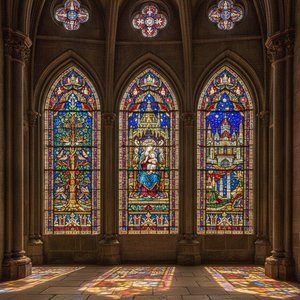
Luminous Masterpieces: The Captivating Beauty and Timeless Elegance of Stained Glass Artworks
Embark on a visual journey through the luminous world of stained glass art. Discover the exquisite craftsmanship, historical significance, and captivating beauty of masterworks from Art Nouveau to the Gothic era, curated for the discerning fine art enthusiast.

Crimson Threads of Narrative: Exploring Symbolism & Representation in Artworks Featuring the Red Dress
Explore the rich symbolism of the red dress in art history! From ancient power displays to iconic portraits like Cézanne’s 'Madame Cezanne', discover the cultural and artistic significance behind this captivating color. Expert analysis & insights.

Blancs Sublimes : Les 10 Chefs-d'œuvre de la Peinture Révélés par
Plongez dans l'univers fascinant des 10 plus beaux tableaux blancs de l'histoire de l'art ! Découvrez Monet, Whistler, Kandinsky et d'autres maîtres. Inspirez votre décoration intérieure avec : reproductions de qualité muséale en ligne.

Les 10 Chefs-d'œuvre Dominés par le Bleu Ardoise : Art, Histoire & Décor
Plongez dans l'univers fascinant des 10 plus beaux tableaux dominés par le bleu ardoise. Découvrez l'histoire, les artistes et les techniques de ces chefs-d'œuvre impressionnistes et contemporains. Inspirez votre décoration intérieure avec !

The Allure of Azure: Exploring the Symbolic & Aesthetic Depths of Blue in Art History
Explore the rich history of blue in art! Discover its symbolism, from ancient pigments to modern masterpieces by Kandinsky & Seurat. Uncover the psychological impact and cultural meanings behind this captivating hue.