Peinture à l'huile
 Tout sur Composition







































 Pour les œuvres ou reproductions dont un côté mesure plus de 105 cm (environ 41 pouces), le cadre sera expédié sous forme de kit démonté. Cette méthode garantit une livraison sécurisée et prévient tout dommage pendant le transport.


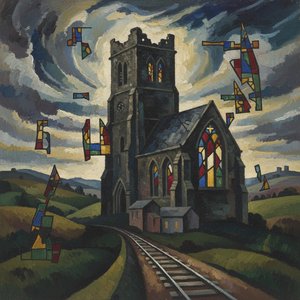
A Fractured Landscape in Flux
The canvas vibrates with a quiet, geometric tension, as if the very bones of the English countryside have been stripped of their skin and rearranged. In this 1937 oil painting, the world does not appear as a collection of trees or stones, but as a rhythmic dance of intersecting planes. Angular rectangles overlap and recede, creating a sense of depth that defies traditional perspective. There is a stillness here, yet it feels precarious, as if the viewer is witnessing a moment of structural transformation. The muted tones of grey, brown, green, and beige ground the work in the earthy reality of the British landscape, even as the forms themselves drift toward pure abstraction.
The eye finds a sudden, sharp pulse of red amidst the subdued palette. This small, deliberate puncture of color acts as a focal point, drawing the gaze through the layered complexity of the composition. It provides a sense of vitality against the more somber, contemplative tones that dominate the scene. The surface carries a subtle texture, where the layering of paint suggests a physical depth, making the abstraction feel tangible and rooted in the material world.
The Language of Form and Spirit
The way the lines interact suggests a struggle between stability and movement. Some edges are precise and sharp, while others appear slightly blurred, contributing to a feeling of fragmentation. This approach reflects a specific tension within the era's artistic spirit, blending the structured logic of Cubism with a deep, personal sensitivity to place. The work avoids the literal, choosing instead to distill the essence of a landscape into its most fundamental components:
This abstraction does not seek to distance the viewer from the world, but to bring them closer to its underlying structure. The painting moves beyond mere shape to touch upon a spiritual resonance, inviting a quiet contemplation of how we perceive the space around us. It is a study of harmony found within complexity, where the fractured pieces of the world are held together by a careful, rhythmic balance.
Questions et réponses
Est-ce que Composition est peint à la main ou est-ce une impression ?
Peint à la main : un peintre professionnel reproduit Composition à l'huile sur une toile en lin.
Quelle taille choisir pour Composition ?
L'original mesure 55 x 68 cm. Les tailles vont de 28.6 x 35.0 cm (€178) à 198.5 x 243.5 cm (€1578) ; le tableau sur cette page présente les principales étapes et leurs prix respectifs.
Quel est le délai de livraison ?
La livraison prend 4 à 5 semaines, avec une expédition express mondiale gratuite ; une option de production urgente est proposée sur cette page. Vous pouvez la retourner sous 100 jours pour un remboursement intégral, sans condition.
Où se trouve l'original de Composition ?
L'original fait partie de la collection du The Ashmolean Museum of Art and Archaeology, à Oxford.
Quelle technique John Piper a-t-il utilisée pour Composition ?
Oil On Canvas
 Aperçu en situation

 Envoyer
 Partager
 Détails de l'œuvre
 Fiche pédagogique


 Télécharger l'image
 Articles similaires
 Radiographie
 Diaporama
 Questions et réponses

 Statistiques