Aperçu en situation
 Envoyer
 Partager
 Détails de l'œuvre
 Guide
Guide

 Télécharger l'image
 Articles similaires
 Radiographie
 Diaporama
 Q&A
Q&A Statistiques
Mountain Landscape with Indians


 Lire la suite
Giclées et impressions d'art
Impressions giclées ou sur toile de qualité musée, avec une production rapide et des finitions au choix. ( Commander la reproduction peinte à la main Passer au format numérique)




P118B €10

P118H €10

P118W €10

P438Z €10

P508JH €12

P508YH €12

P805H €10

P805Z €10

P919BZ €10

P919G €10

P919XJ €10

P959ZH €10

P968JZ €12

W106C €8

W218G €10

W218JH €8

W218Y €10

W307PJ €10

W316G €10

W316PJ €8

W316Y €10

W398PJ €8

W4111J €10

W500HY €15

W500JH €15

W692G €12

W849H €8

W940BG €15

W953PJ €8




Choisissez parmi nos formats prédéfinis qui respectent les proportions originales de l’œuvre.

Saisissez la largeur et la hauteur souhaitées pour qu'elles s'adaptent à votre cadre ou à votre mur. Une impression peut être recadrée, mais jamais agrandie au-delà de l'image originale ; ainsi, un format de forme différente entraînera la perte d'une partie de l'image. Nous vous envoyons une maquette numérique pour approbation avant toute impression. L'image présentée sur cette page ne montre pas le recadrage réel — seule la maquette le permet.
Livraison dans le monde entier () en 2 semaines au lieu des 4/5 semaines habituelles. (2 novembre)

Livraison express gratuite dans le monde entier

Toile de lin de qualité supérieure

Assurance transport complète

Garantie de remboursement des droits de douane

Garantie de fidélité des couleurs

Politique de retour de 100 jours (uniquement en cas de défaut)

Garantie de remboursement à 100%

Offre de tarifs dégressifs
 L'option verre n'est disponible que pour les dimensions inférieures à 110 cm.

Mountain Landscape with Indians
Giclées et impressions d'art
Format de la reproduction
-


Prix total
€ 71
A Pioneer’s Vision: John Mix Stanley's “Mountain Landscape with Indians”
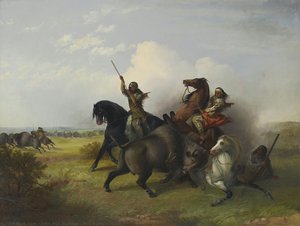
John Mix Stanley’s “Mountain Landscape with Indians,” painted circa 1870-75, isn’t merely a depiction of the American West; it’s a carefully constructed narrative of exploration, cultural encounter, and the burgeoning romanticism of the era. This oil on canvas, now housed within the Detroit Institute of Arts, offers a glimpse into a pivotal moment in American art history – a time when artists were actively seeking to document and interpret the vast, untamed territories of the nation. Stanley’s work stands as a testament to his dedication to capturing both the grandeur of the landscape and the dignity of its indigenous inhabitants, a perspective increasingly rare for the period.
The painting immediately draws the eye with its dramatic composition. A towering mountain range dominates the background, its snow-capped peaks piercing a hazy blue sky – a classic Romantic motif emphasizing the sublime power of nature. Below, a verdant valley unfolds, bisected by a winding river and dotted with small settlements nestled amongst the trees. Yet, it’s not just the landscape that commands attention; several canoes glide across the lake, carrying figures who suggest both peaceful coexistence and the subtle tension inherent in interactions between settlers and Native American tribes. The inclusion of these boats subtly hints at the burgeoning trade and interaction between cultures, a complex dynamic often overlooked in simpler portrayals of westward expansion.
The Artist’s Journey: Stanley's Western Odyssey
Understanding “Mountain Landscape with Indians” requires appreciating John Mix Stanley’s extraordinary life. Born in upstate New York, he was orphaned at twelve and apprenticed as a coach maker – experiences that instilled within him a remarkable self-reliance and an acute observational skill. Stanley’s artistic journey began humbly, painting signs and portraits to make ends meet before embarking on his ambitious project: to document the lives of Native Americans in the American West. This wasn't a casual undertaking; it was driven by a genuine desire to understand and represent these cultures with respect and accuracy – a radical stance for an artist of that time.
His travels took him across vast distances, from the Cherokee Council at Tahlequah to the plains inhabited by the Comanche. He meticulously observed tribal customs, documented their clothing, weaponry, and social structures, translating these observations onto canvas with remarkable detail. Stanley’s decision to accompany Colonel Stephen Watts Kearney's expedition further cemented his role as a chronicler of the West, capturing not only landscapes but also the realities of military campaigns and the challenges faced by both soldiers and indigenous peoples.
Symbolism and Romantic Ideals
The painting is deeply rooted in the tenets of Romanticism. The dramatic lighting, the emphasis on emotional response to nature’s grandeur, and the portrayal of Native Americans as noble figures embodying a connection to the land all align with this artistic movement. Stanley wasn't simply recording what he saw; he was imbuing his work with a sense of awe, wonder, and a romanticized vision of the West – a vision that often idealized both the wilderness and its inhabitants.
The presence of the canoes and the figures within them carries symbolic weight. They represent not just trade or interaction but also a potential for harmony between cultures, albeit one fraught with historical complexities. The mountains themselves can be interpreted as guardians of ancient wisdom, while the river symbolizes the flow of time and the interconnectedness of all things. Stanley’s deliberate use of color – the vibrant greens of the valley contrasting with the stark blues and whites of the mountains – further enhances this symbolic richness.
A Legacy in Reproduction: Bringing Stanley's Vision to Life
Today, “Mountain Landscape with Indians” stands as a significant work of American art, offering a valuable window into the 19th century. OriginalUniqueArt’s meticulously crafted reproductions aim to faithfully capture the essence of Stanley’s original vision, preserving the painting’s dramatic composition, evocative colors, and profound sense of place. By reproducing this iconic artwork with such care, we honor Stanley's legacy as a pioneering artist who sought to document and celebrate the beauty and complexity of the American West – a journey that continues to resonate with viewers today.
Questions et réponses
« Mountain Landscape with Indians » est-il représentatif de l'œuvre habituelle de John Mix Stanley ?
Les thèmes récurrents de John Mix Stanley incluent catlin’s native american portraits, westward exploration, settlement themes, cherokee, creek tribal depictions, stanley’s documented west journey, documenting frontier life, culture ; « Mountain Landscape with Indians » se concentre sur landscape, indians, mountains, west, exploration, stanley, native americans, 1870.
Quel sujet et quelle atmosphère «Mountain Landscape with Indians» de John Mix Stanley associe-t-elle ?
«Mountain Landscape with Indians» de John Mix Stanley dépeint landscape, indians, mountains, west, exploration, stanley, native americans, 1870, dans une atmosphère Calm. Le sujet et l'ambiance définissent ensemble l'œuvre.
Puis-je prévisualiser «Mountain Landscape with Indians» de John Mix Stanley avant de commander ?
Un aperçu de «Mountain Landscape with Indians» de John Mix Stanley est disponible sur la page Aperçu en situation de l'œuvre.
Biographie de l'artiste
Première Vie et Origines
- Né: Le 17 janvier 1814, à Canandaigua, dans l'État de New York
- Parents: Seth et Sally (McKinney) Stanley
- Orphelin à l'âge de 12 ans.
- Apprenti chez un fabricant de voitures à l'âge de 14 ans.
- Compétences picturales autodidactes.
- Déménagé à Detroit, dans le Michigan en 1832, devenant un peintre itinérant de panneaux et de portraits.
Carrière et Développement Artistique
- Débuts (années 1830-1840) : A commencé comme peintre de panneaux publicitaires et portraitiste à Detroit et dans les environs. Voyagea vers Fort Snelling, Galena et Chicago.
- Exploration du Sud-Ouest (1842-1845) : Accompagna Sumner Dickerman dans le sud-ouest américain spécifiquement pour peindre des Amérindiens. S'installa à Fort Gibson en territoire indien (aujourd’hui Oklahoma). Documenta la vie tribale, notamment en assistant à un conseil entre les représentants Cherokee et du Texas à Tahlequah.
- Service pendant la guerre américano-mexicaine (1846) : Nommé dessinateur pour l'expédition du colonel Stephen Watts Kearney vers la Californie et le territoire de l'Oregon. Produisit des croquis et des peintures de la campagne.
- Portraits hawaïens (1847-1848) : Voyagea à Hawaï, où il peignit les portraits du roi Kamehameha III et de sa famille.
- Expositions et Reconnaissance (années 1850) : Organisa et exposa de grandes galeries de portraits amérindiens dans diverses villes. Présenta une exposition majeure au Smithsonian Institution en 1852, présentant près de 200 œuvres représentant 43 tribus. Reçut des critiques positives mais ne réussit pas à vendre sa collection au gouvernement ou au Smithsonian.
- Panorama (1854) : Exposa un panorama de 42 scènes de l'Ouest à Washington, D.C., Baltimore, New York et Londres ; ce travail est aujourd’hui perdu.
- Pertes et Déclin : Une partie importante de ses œuvres fut détruite lors d'un incendie au Smithsonian Institution en 1865. Cet événement contribua à un déclin de la réputation de Stanley pendant un certain temps.
Style Artistique et Influences
- Sujets : Se concentra principalement sur les paysages, les portraits amérindiens et les représentations de la vie tribale dans l'ouest américain et à Hawaï.
- Influences : Inspiré par le travail de George Catlin, un pionnier de la peinture des Amérindiens.
- Style : Bien qu’il documente ses sujets avec une caméra et un crayon avant l’exécution, les peintures de Stanley étaient souvent organisées d'une manière académique. Certains critiques ont noté un manque d'empathie profonde pour les cultures amérindiennes par rapport à Catlin.
- Documentation : Ses œuvres sont valorisées comme documents historiques fournissant des aperçus des rencontres du XIXe siècle entre les Américains d’origine européenne et les tribus amérindiennes.
Réalisations Majeures et Importance Historique
- Représentation Pionnière de la Vie Amérindienne : Stanley a été l'un des premiers artistes à documenter systématiquement les cultures amérindiennes par le biais de la peinture, contribuant ainsi de manière significative aux archives visuelles de ces sociétés.
- Voyages et Documentation Étendue : Ses voyages à travers l'ouest américain et Hawaï ont donné lieu à un vaste corpus d'œuvres représentant des paysages et des peuples divers.
- Document Historique : Malgré la perte d’une grande partie de son œuvre, les peintures survivantes fournissent des aperçus précieux de la vie frontalière du XIXe siècle et des cultures amérindiennes.
- Redécouverte et Appréciation : Les contributions de Stanley à l'art américain ont été réévaluées au cours des dernières décennies, ses œuvres étant désormais conservées dans des musées nationaux et régionaux.
Vie Tardive et Décès
- Retourna à Detroit en 1863.
- Décédé le 10 avril 1872 à Detroit, Michigan.
- Son héritage a été initialement éclipsé par la perte de son œuvre mais a depuis été reconnu pour sa valeur historique et artistique.

John Mix Stanley
1814 - 1872 , États-Unis d'Amérique
L'essentiel de l'artiste
- Artistic Movement Or Style: Paysages & art amérindien
- Artists Who Influenced This Artist: ['George Catlin']
- Date De Décès: 10 avril 1872
- Date De Naissance: 17 janvier 1814
- Full Name: John Mix Stanley
- Lieu De Naissance: Canandaigua, États-Unis
- Nationalité: Américain
- Notable Artworks: ['La Courbe de la Rivière']
Articles connexes

Grant Wood & American Regionalism: Identity, Myth & the Rural Landscape
Explore the world of Grant Wood & American Regionalism with OriginalUniqueArt. Discover the symbolism behind 'American Gothic', recurring themes, and the movement's lasting impact on art history. High-quality reproductions available.

Les 10 Chefs-d'œuvre du Paysage Romantique : Artistes et Décor d'Intérieur
Plongez dans l'émotion du Romantisme avec les 10 plus beaux paysages de Friedrich, Turner & Delacroix. Découvrez leur histoire et trouvez l'inspiration déco idéale sur OriginalUniqueArt.com !

John Singer Sargent : Les 25 Œuvres Maîtresses d'un Portraitiste Éminent | OriginalUniqueArt
Plongez dans l'univers de John Singer Sargent : découvrez les 25 œuvres qui ont marqué l'histoire de l'art. Portraits impressionnants, réalisme exquis et couleurs vibrantes. Retrouvez ces chefs-d'œuvre en reproduction haute définition sur OriginalUniqueArt.com.

Les 25 chefs-d'œuvre de John Constable : l'âme du paysage anglais
Explorez les 25 chefs-d'œuvre de John Constable et l'âme du romantisme anglais. Découvrez toute la collection sur OriginalUniqueArt.com.

John Frederick Kensett: Luminosity, Landscape & the American Identity
Explore the luminous landscapes of John Frederick Kensett, a master of Luminism and key figure in the Hudson River School. Discover his serene paintings & enduring legacy with OriginalUniqueArt.