
 Aperçu en situation
 Envoyer
 Partager
 Détails de l'œuvre

 Télécharger
 Articles similaires
 Radiographie
 Diaporama
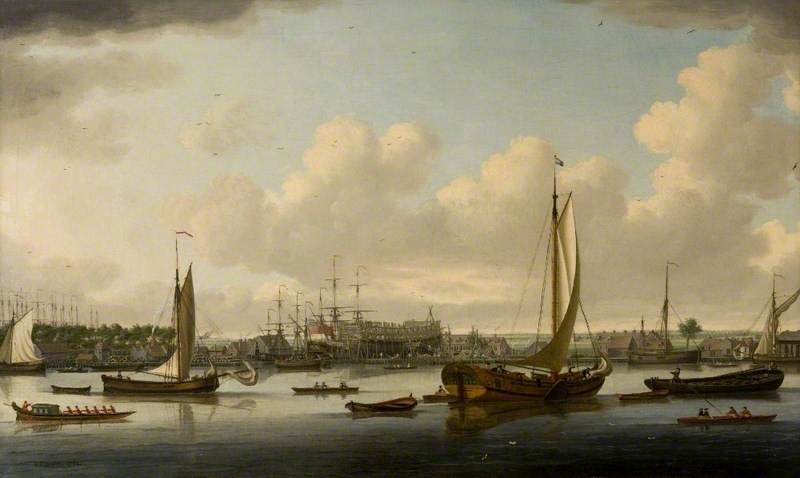
A Shipyard on the Thames
 1762
1762 56.0 x 95.0 cm
 Lire la suite
Acquérez une image numérique haute résolution et optimisée, d'une qualité bien supérieure à l'aperçu en ligne.
Chaque fichier est méticuleusement préparé par nos spécialistes internes à l'aide d'outils avancés et d'une retouche manuelle experte. Nous garantissons que chaque image possède une clarté exceptionnelle, une précision des couleurs irréprochable et un niveau de détail fin.
Le fichier final est livré par e-mail sous 72 heures, optimisé pour une utilisation immédiate dans des contextes professionnels, éditoriaux et d'impression. Il offre la même qualité de confiance que celle utilisée par les plus grands studios de création, éditeurs et galeries.
Image numérique
Téléchargez un fichier haute résolution pour votre usage personnel, l'impression et vos projets créatifs. ( Commander l'impression Commander la reproduction peinte à la main)
Inclus avec chaque commande d'image numérique
Livraison numérique experte, garantie.
En choisissant OriginalUniqueArt.com, vous n'obtenez pas seulement une simple image : vous recevez une œuvre numérique sublimée avec professionnalisme, conçue avec précision et accompagnée d'une garantie de satisfaction. Voici tout ce qui accompagne automatiquement votre commande :

Envoi rapide par e-mail
Votre fichier d'image numérique haute résolution vous sera envoyé par e-mail sous 72 heures après votre commande — prêt à un usage immédiat.

Fichier numérique optimisé par l'IA
Votre œuvre d'art bénéficie d'une optimisation professionnelle grâce à des outils d'IA avancés et une retouche manuelle, garantissant un niveau maximal de détail, de clarté et de fidélité chromatique.

Réexpédition gratuite à vie
Vous avez accidentellement supprimé ou perdu votre fichier ? Pas d'inquiétude — nous vous le renverrons gratuitement, quand vous le souhaitez.

Aucuns frais de douane — À jamais
Profitez de votre œuvre d'art instantanément sans frais de douane ni de livraison — les téléchargements numériques sont toujours exonérés de taxes.

Garantie de fidélité des couleurs
Nous garantissons que votre image numérique reproduit les couleurs de l'original aussi fidèlement que possible grâce à des outils professionnels et une gestion rigoureuse des couleurs.

Garantie satisfaction 60 jours
Si vous n'êtes pas satisfait de votre image numérique, nous la retoucherons ou vous rembourserons 100% sous 60 jours — sans poser de questions.

Garantie de remboursement à 100%
Pas satisfait ? Obtenez un remboursement intégral dans les 60 jours suivant la réception de votre fichier numérique — sans aucune question posée.

Réductions sur les commandes groupées
Achetez 3 images, économisez 10% - Achetez 5, économisez 15% - Achetez 10+, économisez 20%. Idéal pour les projets créatifs, les galeries et les agences.
Biographie de l'artiste
The Shipwright of the Canvas: The Life of John Cleveley the Elder
In the heart of eighteenth-century London, amidst the rhythmic sounds of hammers and the scent of fresh timber at the Deptford Dockyard, a unique artistic vision was being forged. John Cleveley the Elder (c. 1712 – 1777) did not emerge from the polished studios of fine art academies, but rather from the practical, gritty reality of a shipwright’s workshop. Born in Southwark, his early life was defined by the tactile mastery of wood and iron. As a carpenter belonging to His Majesty’s Navy, Cleveley possessed an intimate, structural understanding of the vessels that dominated the seas of his era. This foundational knowledge would later become the very soul of his artistry, allowing him to transcend mere illustration and achieve a profound level of maritime realism that few of his contemporaries could replicate.
Cleveley’s journey is a testament to the power of observation. Without formal academic training, he relied on an innate ability to translate the technical complexities of naval architecture into evocative oil paintings. His dual vocation—working as a carpenter while developing his painterly hand—meant that every line of a hull and every tension in a mast was informed by firsthand experience. When one gazes upon his depictions of ships under construction, such as the celebrated Sixth-Rate on the Stocks, one does not merely see a painting; one witnesses the meticulous precision of a man who understood the weight, the grain, and the engineering of the maritime world.
A Mastery of Light, Sea, and Motion
The brilliance of Cleveley’s work lies in his ability to marry technical accuracy with an atmospheric sensitivity. While his compositions are anchored by the rigid geometry of naval construction, they are brought to life through a masterful use of light and shadow. He possessed a rare talent for capturing the mercurial nature of the sea—the way sunlight dances upon a cresting wave or how a heavy mist might shroud a distant frigate. In works like The Royal Caroline, painted in 1750, Cleveley demonstrates an extraordinary command over movement; the sails are not static objects but living entities, caught in a moment of energetic propulsion across the canvas.
His stylistic development allowed him to navigate various maritime themes, from the serene majesty of royal yachts to the visceral drama of naval engagements. He could pivot from the quiet, industrious atmosphere of the dockyards to the chaotic, salt-sprayed intensity of a storm. This versatility ensured his relevance among a wide range of patrons, including naval officers who sought accurate records of their vessels and collectors enamored by the romanticism of the high seas. His brushwork often balanced the fine detail required for ship portraits with a broader, more expressive touch when rendering the elements, creating a sense of depth and dimensionality that pulls the viewer into the very heart of the ocean.
Legacy and Historical Significance
The historical significance of John Cleveley the Elder extends far beyond his individual canvases. He was a pioneer of a genre that would come to define British visual identity during an age of naval supremacy. By documenting the evolution of shipbuilding and the grandeur of the Royal Navy, he provided a vital visual record of Britain's maritime ascendancy. His influence also echoed through his family; his son, John Cleveley the Younger, and his nephew, Robert Cleveley, continued this tradition of marine excellence, further cementing the Cleveley name as a cornerstone of British maritime art.
Today, the works of Cleveley the Elder serve as much more than historical artifacts. They are emotive windows into a vanished era of sail and timber. His ability to blend the technical precision of a craftsman with the poetic vision of an artist ensures that his legacy remains vibrant. Through his eyes, we do not just observe the ships of the eighteenth century; we feel the spray of the Atlantic, sense the tension of the rigging, and respect the enduring majesty of the sea.

john cleveley the elder
1712 - 1777
En bref
- Artistic Movement Or Style: Marine Art
- Artists Or Movements Influenced By This Artist: ['Romanticism']
- Artists Who Influenced This Artist: ['Paul Sandby']
- Date Of Death: 1777
- Full Name: John Cleveley the Elder
- Nationality: English
- Notable Artworks:
- Sixth-Rate on the Stocks
- The Royal Yacht Caroline
- HMS Brune
- Cambridge
- Place Of Birth: Southwark, England

