Passer au format impression
 Lire la suite







































 Pour les œuvres ou reproductions dont un côté mesure plus de 105 cm (environ 41 pouces), le cadre sera expédié sous forme de kit démonté. Cette méthode garantit une livraison sécurisée et prévient tout dommage pendant le transport.


Sant Ramon Mont-roig : A Dreamscape of Faith and Catalan Identity
Joan Miró’s Sant Ramon Mont-roig, painted in 1918, isn't merely a depiction of a mountain landscape; it’s a vibrant portal into the artist’s subconscious, a distillation of his early artistic explorations. This captivating work, created during a pivotal period of experimentation for Miró, embodies the confluence of Fauvism, Cubism, and nascent Surrealism – a potent blend that would define his unique visual language. The painting immediately draws the eye with its audacious color palette: fiery reds and oranges clash playfully with cool blues and greens, creating an atmosphere both dreamlike and intensely energetic. Bold geometric shapes—towering rock formations, simplified trees, and abstracted figures—dance across the canvas, suggesting a world unbound by conventional representation.
At the heart of the composition stands the imposing figure of Sant Ramon, the patron saint of Mont-roig del Camp. Miró doesn’t offer a realistic portrayal; instead, he presents a stylized, almost mythical presence, rendered in simplified forms and imbued with an aura of quiet authority. The church itself, nestled within this fantastical landscape, is not depicted with meticulous detail but rather as a symbolic anchor—a representation of faith and spirituality deeply rooted in the Catalan identity. The surrounding fields and mountains aren’t simply geographical features; they are imbued with a sense of timelessness, suggesting the passage of time and the enduring connection between humanity and nature.
Early Miró: A Fusion of Influences
To understand Sant Ramon Mont-roig, it's crucial to recognize the artistic currents swirling around Miró during this period. His early work was profoundly influenced by Fauvism, particularly the expressive use of color championed by Matisse and Derain. However, he quickly moved beyond mere imitation, incorporating elements of Cubism’s fragmented forms and multiple perspectives—a technique he would later master. The painting demonstrates a nascent Surrealist sensibility as well, with its dreamlike quality and symbolic imagery. Miró himself described his approach as an “assassination of painting,” rejecting traditional methods in favor of creating images that tapped into the subconscious.
The choice of Mont-roig del Camp as the subject is deeply significant. The artist’s childhood memories, his family's farm (Mas Miró), and the local landscape—particularly the iconic rock formation known as La Roca—provided a constant source of inspiration. This personal connection imbues the painting with a powerful sense of place and belonging. The rugged terrain, the ancient church, and the simple rural life all contribute to a feeling of nostalgia and a celebration of Catalan heritage.
Symbolism and Emotional Resonance
Beyond its formal qualities, Sant Ramon Mont-roig is rich in symbolism. The rock formation, resembling a towering fortress or even a stylized human figure, represents strength, resilience, and the enduring spirit of the region. The church symbolizes faith, community, and tradition—elements vital to Catalan identity. Miró’s use of simplified forms and bold colors creates an emotional intensity that transcends mere representation. The painting evokes a sense of wonder, mystery, and perhaps even a touch of melancholy – reflecting the artist's own complex relationship with his homeland and his artistic vision.
The overall effect is not one of straightforward depiction but rather of evocative suggestion. Miró invites the viewer to participate in the creation of meaning, allowing their own experiences and associations to shape their interpretation of this extraordinary work. It’s a testament to the power of art to transport us beyond the confines of reality and into a realm of dreams and imagination.
Questions et réponses
Quelle pièce s'accorde avec les couleurs de «Sant Ramon Mont-roig» de Joan Miró ?
Grâce à sa palette de couleurs Tons terreux, l'œuvre « Sant Ramon Mont-roig » s'intègre parfaitement dans une Salon.
L'œuvre « Sant Ramon Mont-roig » présente-t-elle des contrastes ombre et lumière marqués ?
Le contraste clair-obscur de « Sant Ramon Mont-roig » est évalué à Niveau de contraste. Le contraste décrit l'intensité de la différence entre les zones claires et les zones sombres.
Quelles sont les couleurs dominantes de «Sant Ramon Mont-roig» de Joan Miró ?
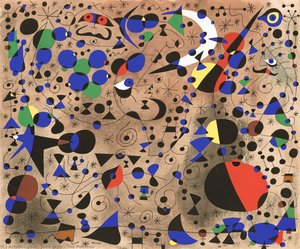
L'identité chromatique de «Sant Ramon Mont-roig» de Joan Miró : une palette Tons terreux, dominée par le Grège (#cac8bb).
 Aperçu en situation
 Envoyer
 Partager
 Détails de l'œuvre
 Guide
Guide

 Télécharger l'image
 Articles similaires
 Radiographie
 Diaporama
 Q&A
Q&A Statistiques