
 Aperçu en situation
 Envoyer
 Partager
 Détails de l'œuvre
 Guide
Guide

 Télécharger l'image
 Articles similaires
 Radiographie
 Diaporama
 Questions et réponses
 Statistiques
Kul-e Farah open-air sanctuary


 Lire la suite
L’œuvre d'art présentée sur cette page est protégée par le droit d'auteur, ce qui signifie que nous ne pouvons légalement créer ou vendre de reproduction identique. Cette protection est appliquée en vertu d'accords internationaux tels que la Convention de Berne et par les lois nationales, notamment celles énoncées par le Loi américaine sur le droit d'auteur - Titre 17.
Cette méthode est pleinement conforme aux réglementations sur le droit d'auteur car elle ne repose pas sur la copie ou la duplication de l'œuvre protégée. Il s'agit plutôt d'une réinterprétation créative — une nouvelle peinture qui s'inspire de l'original sans pour autant lui être identique.
Giclées et impressions d'art
Impressions giclées ou sur toile de qualité musée, avec une production rapide et des finitions au choix. ( Commander la reproduction peinte à la main Passer au format numérique)




P118B €10

P118H €10

P118W €10

P438Z €10

P508JH €12

P508YH €12

P805H €10

P805Z €10

P919BZ €10

P919G €10

P919XJ €10

P959ZH €10

P968JZ €12

W106C €8

W218G €10

W218JH €8

W218Y €10

W307PJ €10

W316G €10

W316PJ €8

W316Y €10

W398PJ €8

W4111J €10

W500HY €15

W500JH €15

W692G €12

W849H €8

W940BG €15

W953PJ €8




Choisissez parmi nos formats prédéfinis qui respectent les proportions originales de l’œuvre.

Saisissez la largeur et la hauteur souhaitées pour qu'elles s'adaptent à votre cadre ou à votre mur. Une impression peut être recadrée, mais jamais agrandie au-delà de l'image originale ; ainsi, un format de forme différente entraînera la perte d'une partie de l'image. Nous vous envoyons une maquette numérique pour approbation avant toute impression. L'image présentée sur cette page ne montre pas le recadrage réel — seule la maquette le permet.
Livraison dans le monde entier () en 2 semaines au lieu des 4/5 semaines habituelles. (8 novembre)

Livraison express gratuite dans le monde entier

Toile de lin de qualité supérieure

Assurance transport complète

Garantie de remboursement des droits de douane

Garantie de fidélité des couleurs

Politique de retour de 100 jours (uniquement en cas de défaut)

Garantie de remboursement à 100%

Offre de tarifs dégressifs
 L'option verre n'est disponible que pour les dimensions inférieures à 110 cm.

Kul-e Farah open-air sanctuary
Giclées et impressions d'art
Format de la reproduction
-


Prix total
€ 72
A Journey Through Time: The Whispers of Kul-e Farah
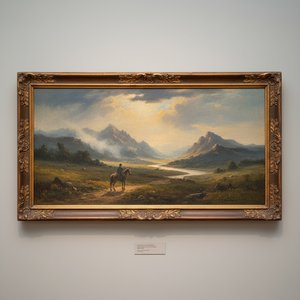
In the evocative masterpiece Kul-e Farah open-air sanctuary, the viewer is not merely looking at a landscape, but is instead transported through a portal into the ancient heart of the Near East. Created by the visionary Javier Álvarez-Mon, this work transcends the boundaries of traditional landscape painting to become a living historical reconstruction. The scene unfolds across a rugged, mountainous expanse where a winding dirt road acts as a silent guide, leading the eye through a tapestry of sun-drenched grassy fields and weathered, rocky terrain. There is a profound sense of movement within the stillness; the presence of figures scattered throughout the composition—some lingering in the foreground, others fading into the hazy distance—suggests a moment captured in the eternal flow of time. The inclusion of an animal near the center-right adds a touch of pastoral intimacy, grounding the vastness of the landscape in the humble, everyday rhythms of ancient life.
The technique employed by Álvarez-Mon is deeply informed by his unique dual identity as both an artist and a scholar of archaeology. Rather than relying solely on aesthetic impulse, he utilizes a meticulous approach that breathes life into the silent relics of the Elamite civilization. The brushwork possesses a textured, organic quality that mimics the very earth it depicts, blending the grit of the mountain paths with the softness of the highland flora. This mastery of texture allows the painting to function as a bridge between the modern observer and the Bronze and Iron Ages. For the collector or interior designer, this piece offers more than just visual beauty; it provides a tactile connection to the dust and grandeur of antiquity, making it a profound focal point for any space dedicated to contemplation and historical depth.
The Symbiosis of Archaeology and Artistry
What distinguishes this work is its deep-seated historical resonance. As a specialist in the Elamite civilization, Álvarez-Mon does not merely paint scenery; he reconstructs lost grandeur. Every element within Kul-e Farah open-air sanctuary serves as a narrative fragment of a forgotten era. The landscape itself becomes a character, embodying the resilience and the spiritual sanctity of an ancient open-air sanctuary. The symbolism of the road is particularly poignant, representing the passage of human history and the interconnectedness of civilizations that once thrived in these very mountains. There is an inherent emotional weight to the piece—a sense of peaceful solitude intertwined with the haunting realization of how much of our past remains shrouded in mystery.
For those seeking to adorn a curated collection or a sophisticated interior, this reproduction offers an unparalleled opportunity to integrate intellectual depth with aesthetic elegance. The painting’s palette, rich with earthy tones and natural light, creates an atmosphere of tranquility that can transform a room into a sanctuary of its own. It invites the viewer to pause, to wander the dirt paths of the mind, and to rediscover the beauty found in the weathered stones and ancient shadows of our shared human heritage.
Questions et réponses
Quelle émotion «Kul-e Farah open-air sanctuary» de Javier Álvarez Mon exprime-t-il au sein du mouvement Contemporary Realism ?
Au sein du mouvement Contemporary Realism, « Kul-e Farah open-air sanctuary » est empreint d'un ton Tranquil.
« Kul-e Farah open-air sanctuary » est-il représentatif de l'œuvre habituelle de Javier Álvarez Mon ?
Parmi les thèmes récurrents de Javier Álvarez Mon — ancient near east history, elamite civilization reconstruction, archaeological historical narratives, reconstructing lost grandeur, natural landscape settings — « Kul-e Farah open-air sanctuary » met l'accent sur mountains, dirt road, people, animals, grassy fields, rocky terrain.
L'œuvre «Kul-e Farah open-air sanctuary» de Javier Álvarez Mon, conservée au Macquarie University, peut-elle faire l'objet de reproductions légales ?
Le statut des droits d'auteur de «Kul-e Farah open-air sanctuary» de Javier Álvarez Mon est clair : l'œuvre est dans le toujours protégé par le droit d'auteur. Sa présence au Macquarie University ne modifie pas ce statut.
Biographie de l'artiste
Javier Álvarez Mon est un archéologue et historien espagnol, spécialisé dans l'ancien Proche-Orient. Né à Madrid en 1969, il a obtenu son doctorat en archéologie à l'Université Complutense de Madrid en 2001. Il est actuellement chercheur au Conseil National de la Recherche (CSIC) et directeur du groupe d'études élamites de l'Université de Barcelone.
Formation et carrière
La formation de Javier Álvarez Mon s'est concentrée sur l'archéлоgie et l'histoire, avec un regard porté sur l'ancien Proche-Orient. Ses recherches se sont focalisées sur la culture élamite, et il a publié de nombreux articles et ouvrages sur le sujet, notamment le monde élamite (2018) et Élam : histoire, art et archéologie (2021).Recherches et publications
Les recherches de Javier Álvarez Mon se sont centrées sur la culture élamite, et il a publié de nombreux articles et livres sur le sujet. Ses publications les plus marquantes incluent :- Le monde élamite (2018)
- Élam : histoire, art et archéologie (2021)
- La culture élamite (2015)
- Élam : une histoire de la région (2012)
Collaborations et projets
Javier Álvarez Mon a collaboré avec d'autres chercheurs et a participé à divers projets de recherche. Parmi ses projets les plus notables, on trouve :- Le projet élamite : un projet de recherche sur la culture élamite, financé par le Conseil National de la Recherche (CSIC).
- Projet de fouilles en Iran : un projet de fouilles archéologiques en Iran, financé par l'Université de Barcelone.
- Projet d'étude de la culture élamite : un projet de recherche sur la culture élamite, financé par l'Université de Barcelone.
Importance de son travail
Le travail de Javier Álvarez Mon est essentiel pour la compréhension de la culture élamite et de sa pertinence dans l'histoire de l'ancien Proche-Orient. Ses recherches ont permis d'approfondir la connaissance de cette région et ont abouti à la publication de nombreux travaux sur le sujet. Certains de ses articles et livres sont consultables sur https://OriginalUniqueArt.com, où vous pourrez trouver plus d'informations sur son travail et ses publications. Des informations sur d'autres artistes et peintres sont également disponibles via le musée de la Real Academia de Bellas Artes de San Fernando et le musée de la Chasse et de la Nature.
Javier Álvarez Mon
1969 - , Espagne
Articles connexes

Évocations de lieux : Un voyage historique à travers l'art du paysage
Explorez l'histoire fascinante de la peinture de paysage à travers les chefs-d'œuvre du Romantisme. Découvrez Friedrich, Turner et Aivazovski et laissez-vous inspirer par la beauté sauvage et le sublime. Reproduction d'art de qualité chez OriginalUniqueArt.

Les 25 chefs-d'œuvre de John Constable : l'âme du paysage anglais
Explorez les 25 chefs-d'œuvre de John Constable et l'âme du romantisme anglais. Découvrez toute la collection sur OriginalUniqueArt.com.

Les 25 chefs-d'œuvre iconiques de Katsushika Hokusai : l'art éternel du Japon
Explorez les 25 chefs-d'œuvre de Hokusai et l'âme de l'ukiyo-e. Découvrez ces trésors sur OriginalUniqueArt.com.

Les 10 Chefs-d'œuvre du Paysage Romantique : Artistes et Décor d'Intérieur
Plongez dans l'émotion du Romantisme avec les 10 plus beaux paysages de Friedrich, Turner & Delacroix. Découvrez leur histoire et trouvez l'inspiration déco idéale sur OriginalUniqueArt.com !
Anthony Vandyke Copley Fielding: Rediscovering a Master of Romantic Landscape
Discover the captivating landscapes of Anthony Vandyke Copley Fielding, a master of Romantic watercolour painting. Explore his life, technique, and legacy with OriginalUniqueArt – your source for museum-quality art reproductions & expert appraisal.