Aperçu en situation
 Envoyer
 Partager
 Détails de l'œuvre
 Guide
Guide

 Télécharger l'image
 Articles similaires
 Radiographie
 Diaporama
 Questions et réponses
 Statistiques
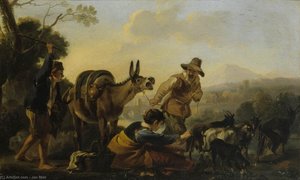
Landscape with a Battle between Two Rams

- 173.0 x 248.0 cm


 Lire la suite
Giclées et impressions d'art
Impressions giclées ou sur toile de qualité musée, avec une production rapide et des finitions au choix. ( Commander la reproduction peinte à la main Passer au format numérique)




































Choisissez parmi nos formats prédéfinis qui respectent les proportions originales de l’œuvre.

Saisissez la largeur et la hauteur souhaitées pour qu'elles s'adaptent à votre cadre ou à votre mur. Une impression peut être recadrée, mais jamais agrandie au-delà de l'image originale ; ainsi, un format de forme différente entraînera la perte d'une partie de l'image. Nous vous envoyons une maquette numérique pour approbation avant toute impression. L'image présentée sur cette page ne montre pas le recadrage réel — seule la maquette le permet.
Livraison dans le monde entier () en 2 semaines au lieu des 4/5 semaines habituelles. (10 novembre)

Livraison express gratuite dans le monde entier

Toile de lin de qualité supérieure

Assurance transport complète

Garantie de remboursement des droits de douane

Garantie de fidélité des couleurs

Politique de retour de 100 jours (uniquement en cas de défaut)

Garantie de remboursement à 100%

Offre de tarifs dégressifs
 L'option verre n'est disponible que pour les dimensions inférieures à 110 cm.

Landscape with a Battle between Two Rams
Giclées et impressions d'art
Format de la reproduction
-


Prix total
€ 73
Questions et réponses
L'image de «Landscape with a Battle between Two Rams» de Jan Miel peut-elle être librement reproduite ?
Statut des droits d'auteur pour «Landscape with a Battle between Two Rams» de Jan Miel : l'œuvre est dans le dans le domaine public - ses droits d'auteur sont tombés dans le domaine public. Cela détermine si les reproductions de l'image peuvent être réalisées librement.
Les couleurs de "Landscape with a Battle between Two Rams" sont-elles vives ou plutôt atténuées ?
Les couleurs de «Landscape with a Battle between Two Rams» de Jan Miel présentent une saturation Muted et une intensité Monochromatic.
Les couleurs de « Landscape with a Battle between Two Rams » paraissent-elles vives ou douces ?
«Landscape with a Battle between Two Rams» de Jan Miel présente une intensité de couleur Monochromatic.
Biographie de l'artiste
Jan Miel : Entre réalisme flamand et grandeur baroque
Jan Miel (1599–1663) s'impose comme une figure charnière du paysage artistique du XVIIe siècle, incarnant la confluence fascinante entre la tradition flamande et l'innovation italienne. Né à Beveren, en Belgique — bien qu'Anvers et 's-Hertogenbosch soient également pressenties comme lieux de naissance — le début de la vie de Miel demeure enveloppé d'une relative obscurité, laissant les détails biographiques bien ténus. Pourtant, ce qui émerge des recherches érudites est un parcours artistique remarquable, marqué par une évolution stylistique et des ambitions collaboratives qui ont scellé sa place au sein du milieu culturel vibrant de Rome et de Turin.
Ses années de formation furent consacrées à perfectionner son art principalement à Anvers, où il absorba les influences de maîtres flamands éminents tels qu'Anthony van Dyck. Si l'étendue précise de son apprentissage reste insaisissable, elle a sans aucun doute instillé en lui un goût pour l'observation méticuleuse et une technique raffinée, qualités qui allaient caractériser une grande partie de son œuvre ultérieure. Ce socle fondamental dans le dessin classique et le portrait lui fournit la panoplie essentielle pour une carrière qui allait, par la suite, transcender les frontières régionales.
La transformation romaine et l'esprit des Bamboccianti
L'arrivée de Miel à Rome, vers 1636, marqua un tournant transformateur dans sa trajectoire artistique. Il rejoignit rapidement les Bentvueghels, une association influente d'artistes néerlandais et flamands résidant dans la Ville Éternelle. Au sein de cette confrérie, il adopta le surnom mémorable de « bieco », un sobriquet reflétant son regard plissant caractéristique — un trait qui deviendrait indissociable de sa personnalité artistique. Cette affiliation favorisa des liens profonds avec une communauté artistique élargie, profondément marquée par le style des Bamboccianti de Pieter van Laer.
Ce mouvement se consacrait à la représentation de scènes de la vie quotidienne parmi les classes populaires de Rome et de ses environs, délaissant la grandeur idéalisée de la Haute Renaissance au profit d'une approche bien plus viscérale et immédiate. Miel embrassa pleinement cette tendance, produisant des peintures de genre captivantes qui saisissaient l'esprit de l'existence urbaine avec un réalisme et une sensibilité remarquables. Ses œuvres mettaient souvent en scène :
- Des scènes de rue animées, peuplées de voyageurs, de marchands et de travailleurs.
- Un usage magistral de la lumière pour évoquer l'atmosphère poussiéreuse et ensoleillée des ruelles romaines.
- Le jeu subtil des émotions humaines au sein de décors encombrés et chaotiques.
- Une attention méticuleuse aux textures des tissus, de la pierre et de la terre.
Évolution vers le classicisme et la grandeur de cour
Au fil de sa carrière, la vision artistique de Miel connut une métamorphose significative. Tout en demeurant un maître de la scène de genre, il commença à s'éloigner du réalisme brut des Bamboccianti pour tendre vers des peintures d'histoire plus classicisantes. Ce changement reflétait une tendance plus large dans l'art européen, où l'énergie brute du Baroque était progressivement tempérée par un désir d'ordre, de noblesse et d'allégorie classique.
Cette évolution le mena finalement à des fonctions prestigieuses, notamment celle d'artiste de cour auprès de Charles Emmanuel II, duc de Savoie. Au service de la cour de Turin, l'œuvre de Miel prit un caractère plus formel et magnifique. L'intimité de ses premières scènes romaines céda la place à des compositions d'une plus grande ampleur et complexité, conçues pour refléter la puissance et le prestige de son protecteur royal. Cette période représente l'apogée de sa réussite professionnelle, là où ses racines flamandes du détail rencontrèrent les grands récits épiques exigés par l'aristocratie européenne.
L'importance historique de Jan Miel réside dans sa capacité à naviguer entre ces mondes disparates. Il fut un artiste capable de trouver la beauté dans les luttes humbles d'un gamin des rues romaines et la dignité dans les récits épiques de l'Antiquité. En jetant un pont entre le réalisme méticuleux du Nord et le classicisme dramatique du Sud, Miel a laissé une empreinte indélébile sur le canon du XVIIe siècle, assurant son héritage en tant que véritable cosmopolite de l'ère baroque.

Jan Miel
1599 - 1663 , Belgique
L'essentiel de l'artiste
- Artistic Movement Or Style: Bamboccianti, Classicising
- Artists Or Movements Influenced By This Artist: ['Renaissance Revival']
- Artists Who Influenced This Artist:
- Anthony van Dyck
- Pieter van Laer
- Date Of Birth: 1599 Beveren Belgium
- Date Of Death: 1663
- Full Name: Jan Miel
- Nationality: Flemish
- Notable Artworks:
- Landscape with a Battle between Two Rams
- Roman Lime Kiln with Peasants Gambling
- Place Of Birth: Beveren Belgique
Articles connexes
Nicolaes Berchem: Dutch Golden Age Pastoralism & the Evolution of Landscape Painting
Explore the captivating world of Nicolaes Berchem, a leading Dutch Golden Age painter. Discover his idyllic landscapes, masterful technique & lasting influence on art history. Learn more at OriginalUniqueArt.

Golden Light & Dutch Skies: Bringing the Magic of Dutch Golden Age Landscapes into Your Home
Transform your home with the breathtaking light of Dutch Golden Age landscapes. Discover how hand-painted oil reproductions of masterworks like Ruisdael and Vermeer bring timeless elegance, atmosphere, and soulful texture to modern interiors. Elevate your space with museum-quality art.

Golden Light & Dutch Skies: The Timeless Magic of Dutch Golden Age Landscapes
Discover the breathtaking beauty of Dutch Golden Age landscapes. Explore the mastery of light, chiaroscuro, and 17th-century realism through an expert art history lens, celebrating the enduring legacy of the Dutch Masters for discerning collectors and art lovers.

L'Âge d'Or Néerlandais : Maîtrise de la Lumière et de l'Atmosphère dans le Paysage du XVIIe Siècle
Explorez la maîtrise de la lumière et du paysage au Siècle d'Or néerlandais. Plongez dans l'histoire des maîtres hollandais dès maintenant.

L'Âge d'Or Néerlandais : 10 Chefs-d'œuvre Incontournables pour Décorer avec Art et Histoire
Plongez au cœur de l'Âge d'Or néerlandais ! Découvrez 10 chefs-d'œuvre intemporels de Rembrandt, Vermeer et autres maîtres hollandais. Explorez leur histoire, technique & trouvez l'inspiration déco sur