Aperçu en situation
 Partager
 Partager
 Détails
 Guide imprimable

 Télécharger
 Articles similaires
 Radiographie
 Voir le diaporama
 Statistiques
Le thé
 Huile sur toile
- Art mural
- Realism
 1872
1872 66.0 x 48.0 cm
 Afficher la suite
Giclées et impressions d'art
Impressions giclées ou sur toile de qualité musée, avec une production rapide et des finitions au choix. ( Acheter la peinture faite à la main Passer au format image numérique)




P118B €10

P118H €10

P118W €10

P438Z €10

P508JH €12

P508YH €12

P805H €10

P805Z €10

P919BZ €10

P919G €10

P919XJ €10

P959ZH €10

P968JZ €12

W106C €8

W218G €10

W218JH €8

W218Y €10

W307PJ €10

W316G €10

W316PJ €8

W316Y €10

W398PJ €8

W4111J €10

W500HY €15

W500JH €15

W692G €12

W849H €8

W940BG €15

W953PJ €8




Choisissez parmi nos formats prédéfinis qui respectent les proportions originales de l’œuvre.

Saisissez la largeur et la hauteur souhaitées pour qu'elles s'adaptent à votre cadre ou à votre mur. Une impression ne peut être que découpée, elle ne peut jamais être agrandie au-delà de l'image originale ; ainsi, un format de forme différente entraînera la perte d'une partie de l'image. Nous vous envoyons une maquette numérique pour approbation avant toute impression. L'image présentée sur cette page ne montre pas le recadrage réel — seule la maquette le permet.
Livraison dans le monde entier () en 2 semaines au lieu des 4/5 semaines habituelles. (23 octobre)

Livraison express gratuite dans le monde entier

Toile de lin de haute qualité

Assurance transport complète

Garantie de remboursement des droits de douane

Garantie de fidélité des couleurs

Garantie de retour de 100 jours (uniquement en cas de défaut)

Garantie de remboursement à 100%

Tarifs dégressifs sur quantité
 L'option verre n'est disponible que pour les dimensions inférieures à 110 cm.

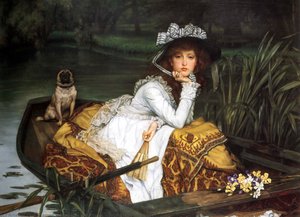
Le thé
Giclées et impressions d'art
Format de la reproduction
-


Prix total final
€ 70
Le Thé : Une Fenêtre sur l'Élégance Victorienne
La peinture "Le Thé" de James Jacques Joseph Tissot, créée en 1872, est bien plus qu’une simple œuvre d’art ; c’est une fenêtre ouverte sur les mœurs sociales raffinées et les sensibilités esthétiques de l'époque victorienne. Ce chef-d'œuvre à l'huile sur bois, aujourd'hui conservé dans la prestigieuse collection du Metropolitan Museum of Art à New York, illustre parfaitement le style signature de Tissot : un souci du détail méticuleux combiné à une représentation perspicace des interactions humaines.
Sujet et Composition
La peinture dépeint une femme élégamment vêtue, assise à une table chargée de délicates tasses et soucoupes à thé. Elle est absorbée par l'acte de siroter son thé, créant ainsi une scène de quiétude domestique et de loisir. La composition se concentre sur sa silhouette, attirant le regard du spectateur vers ses vêtements et son attitude. Plusieurs autres tasses sont présentes sur la table, suggérant un possible rassemblement ou événement social. L'arrière-plan présente un paysage urbain flou visible à travers une fenêtre, évoquant un cadre extérieur comme une véranda ou un balcon. Cette juxtaposition de tranquillité intérieure avec activité extérieure ajoute profondeur et intrigue à la scène.
Style et Technique
Le style de Tissot se caractérise par son réalisme et son attention aux détails. Il emploie magistralement la lumière et l'ombre pour créer un sentiment de profondeur et d’atmosphère, mettant en valeur les textures de l'argenterie du service à thé et les motifs complexes sur la robe de la femme. L'utilisation de glacis minces de peinture à l'huile construit la couleur et la luminosité, résultant en une expérience visuelle riche et superposée. Les lignes sont principalement droites et précises, définissant des éléments architecturaux tels que des colonnes et des cadres de fenêtres, contrastant avec les courbes plus douces de la robe de la femme. La technique révèle l'habileté de Tissot à capturer non seulement les apparences physiques, mais aussi les nuances psychologiques subtiles.
Contexte Historique et Symbolisme
"Le Thé" est profondément ancré dans la dynamique sociale de l’ère victorienne. Le thé était un rituel significatif, symbolisant l'hospitalité, le raffinement et la connexion sociale. La peinture reflète l'importance accordée à la mode et au design d'intérieur à cette époque, mettant en valeur l'élégance des vêtements et du mobilier victoriens. Le paysage urbain flou à travers la fenêtre rappelle poignamment le passage du temps et la nature changeante de la vie. Symboliquement, le service à thé en argent représente la domesticité et le raffinement, tandis que les vêtements de la femme témoignent de son statut social et de son goût. L'œuvre de Tissot offre un aperçu précieux des valeurs et de l’esthétique de la société britannique du XIXe siècle.
Impact Émotionnel
Au-delà de sa signification historique, "Le Thé" évoque un sentiment de contemplation tranquille et d'élégance discrète. L'expression de la femme est énigmatique, invitant les spectateurs à interpréter ses pensées et ses émotions. La lumière chaude crée une atmosphère réconfortante, tandis que le souci du détail attire l’œil et encourage l’observation attentive. L'effet général de la peinture est celui d'une beauté sereine et intemporelle, ce qui en fait une œuvre captivante pour les amateurs d'art et les collectionneurs.
Questions et réponses
Quel est l'usage recommandé pour une impression de « Le thé » ?
Une reproduction de «Le thé» de Jacques Joseph Tissot est recommandée pour Accent coloré. Cette suggestion découle du sujet, de l'atmosphère et des couleurs de l'œuvre.
Quelle taille est suggérée pour "Le thé" dans un(e) Salon ?
Dans une Salon, nous suggérons un format d'impression de Format moyen pour « Le thé ».
Quelle est l'intensité des couleurs de «Le thé» de Jacques Joseph Tissot ?
Les couleurs de «Le thé» de Jacques Joseph Tissot présentent une intensité Équilibré.
Biographie de l'artiste
Early Life and Artistic Beginnings
Jacques Joseph Tissot, born October 15, 1836, in Nantes, France, was destined for a life steeped in artistic passion from his earliest years. His father, Marcel Théodore Tissot, was a successful drapery merchant. His mother, Marie Durand, assisted her husband in the family business and designed hats. A devout Catholic, Tissot's formative years were marked by a deep appreciation for faith and tradition—influences that would permeate his artistic vision throughout his life. From a young age, he demonstrated an exceptional talent for drawing and painting, nurturing aspirations that defied societal expectations for men of his time. Encouraged by his parents’ unwavering support, Tissot embarked on formal artistic training at the École des Beaux-Arts in Paris—a pivotal step toward realizing his lifelong ambition to become a celebrated painter. Under the tutelage of luminaries like Ingres, Flandrin, and Lamothe, Tissot honed his skills in classical technique and composition—absorbing the stylistic precepts of the era’s most influential artists. This immersive environment fostered intellectual curiosity and propelled him toward exploring diverse artistic inspirations—ranging from medieval narratives to biblical scenes—demonstrating remarkable versatility. His early works showcased a masterful command of color and light, reflecting Impressionistic influences while maintaining a grounding in realism—a distinctive blend that would characterize his oeuvre for decades to come. The École des Beaux-Arts provided Tissot with invaluable connections within the Parisian art milieu—establishing him firmly as a rising talent poised for artistic success.The Salon Years and Recognition
Tissot’s debut at the Paris Salon in 1861 marked a transformative moment—the unveiling of “The Meeting of Faust and Marguerite,” a dramatic tableau that captivated audiences and garnered considerable acclaim from critics. This ambitious undertaking signaled Tissot's burgeoning reputation as a painter capable of capturing complex narratives and conveying profound emotion—a hallmark of his artistic style. Purchased by the state for inclusion in the Luxembourg Gallery, this monumental canvas cemented his position within the artistic establishment—establishing him as one of France’s most promising artists. Subsequent Salon exhibitions showcased his evolving technique and stylistic preferences—attracting commissions from prominent patrons and bolstering his growing fame. The critical praise he received underscored the significance of his work—demonstrating its ability to resonate with viewers on both intellectual and emotional levels. The Salon served as a crucible for artistic experimentation—allowing Tissot to refine his approach and explore new subjects—most notably the burgeoning world of Parisian high society during the Belle Époque. His meticulous attention to detail extended beyond mere visual representation; he sought to convey not only appearances but also psychological nuances—reflecting the anxieties and aspirations of his subjects with uncanny accuracy. This dedication to realism—combined with subtle Impressionistic influences—became a defining characteristic of his artistic style—establishing him as an icon of Victorian art. His paintings captured the glamour, elegance, and social rituals of the era—providing invaluable insights into the cultural landscape of late nineteenth-century France.Genre Painting and Parisian Society
Tissot’s magnum opus, “La Femme à Paris,” solidified his legacy as a painter of unparalleled observation—a series of canvases that immortalized the demi-mondaine world of Victorian London with breathtaking realism. These paintings—characterized by their luminous color palettes and masterful rendering of textures—became synonymous with capturing the allure and dynamism of Parisian high society—establishing Tissot as a pioneer in genre painting. He meticulously documented the fashions, customs, and social interactions of his subjects—creating portraits that transcended mere likeness—revealing profound psychological depth and conveying an evocative sense of atmosphere. His artistic vision was profoundly influenced by Japonisme—the fascination with Japanese art and aesthetics that swept across Europe during the Victorian era—evident in compositions infused with asymmetrical arrangements and subtle color harmonies reminiscent of Japanese prints. This stylistic fusion underscored Tissot’s intellectual curiosity and his willingness to embrace innovative artistic approaches—demonstrating a remarkable capacity for synthesizing disparate influences into a cohesive aesthetic vision. Through his canvases, Tissot captured not only the visual splendor of Victorian London but also its underlying social tensions—offering a nuanced portrayal of human experience that continues to captivate audiences today. ## Biblical Themes and Japonisme Throughout his prolific output, Tissot embraced diverse artistic inspirations—ranging from medieval narratives to biblical scenes—demonstrating remarkable versatility. His depictions of religious subjects—imbued with spiritual depth and emotional resonance—showcased his ability to elevate visual storytelling into profound contemplation—a testament to his artistic integrity and humanist convictions. He meticulously researched historical sources—incorporating accurate details into his compositions—reflecting a commitment to scholarly rigor alongside artistic creativity. His exploration of biblical themes—particularly the Passion of Christ—revealed an unwavering faith—expressed through evocative imagery and masterful technique—establishing him as one of France’s foremost religious artists. His canvases conveyed the drama, pathos, and spiritual significance of biblical narratives—inspiring viewers with their beauty and conveying a powerful message of compassion and redemption. He skillfully utilized chiaroscuro—the dramatic interplay of light and shadow—to heighten emotional impact—creating artworks that resonate with timeless artistic power. ## Later Years and Legacy Tissot served in the Franco-Prussian War—an experience that profoundly shaped his worldview—instilling him with a sense of duty and patriotism—influences that permeated his artistic output. Following the war’s conclusion, he relocated to London—where he pursued etching alongside Sir Seymour Haden—further honing his artistic skills through portrait commissions and caricatures for Vanity Fair—establishing himself as a celebrated artist recognized internationally. His relationship with Kathleen Newton blossomed into a passionate companionship—providing him with enduring inspiration for numerous paintings—a testament to the transformative power of human connection. Tragically, Newton succumbed to tuberculosis in 1882—leaving Tissot devastated—a profound loss that deeply affected his creative output—yet he persevered—producing exceptional artwork until his death in 1902—securing his place as one of France’s most distinguished artists of the nineteenth century. His enduring influence on genre painting and Impressionism continues to inspire admiration for its artistic brilliance and evocative portrayal of Victorian life and faith.
Jacques Joseph Tissot
1836 - 1902 , France
En bref
- Artistic Movement Or Style: Genre Painting
- Artists Or Movements Influenced By This Artist: ['Impressionism']
- Artists Who Influenced This Artist:
- Ingres
- Lamothe
- Date Of Birth: October 15, 1836
- Date Of Death: August 8, 1902
- Full Name: Jacques Joseph Tissot
- Nationality: French
- Notable Artworks:
- The Meeting of Faust and Marguerite
- La Femme à Paris
- Place Of Birth: Nantes, France
Articles connexes

James Abbott McNeill Whistler : Les 25 Œuvres Maîtresses d'un Précurseur de l'Art Moderne
Plongez dans l'univers de James Abbott McNeill Whistler : découvrez ses 25 œuvres les plus emblématiques, des nocturnes aux portraits saisissants. Explorez son esthétisme unique et trouvez l'inspiration déco avec OriginalUniqueArt.com.
James Sant: Capturing Victorian Childhood & the Evolving Landscape of British Genre Painting
Explore the life & art of James Sant (1820-1916), renowned Victorian portraitist to Queen Victoria. Discover his captivating depictions of childhood, landscapes, and aristocratic society. Learn about his legacy & find fine art reproductions.

The Gaze of a Changing World: Victorian Realism & Modern Life
Explore the captivating world of Victorian Realism! Discover genre painting's rise, social commentary in art, & masters like Fedotov and Wilkie. Expert analysis & high-quality reproductions at OriginalUniqueArt.

Munnings : Les 25 Œuvres Maîtresses du Cavalier Anglais | OriginalUniqueArt
Plongez dans l'univers vibrant d'Alfred Munnings ! Découvrez les 25 œuvres maîtresses du peintre anglais, icônes de l'art équestre et de l'impressionnisme britannique. Tableaux de chevaux, paysages idylliques… Trouvez votre inspiration déco sur OriginalUniqueArt.com.
Jacques Joseph Tissot: A Chronicle of Parisian Life & Narrative Evolution
Explore the captivating world of Jacques Joseph Tissot, a master painter of Belle Époque society. Discover his realism, Impressionistic style, and lasting influence on art history. Learn more at OriginalUniqueArt.