 Aperçu en situation
 Partager
 Partager
 Détails
 Guide imprimable

 Télécharger
 Articles similaires
 Radiographie
 Voir le diaporama
 Statistiques
Paradis (détail)


 Afficher la suite
Giclées et impressions d'art
Impressions giclées ou sur toile de qualité musée, avec une production rapide et des finitions au choix. ( Acheter la peinture faite à la main Passer au format image numérique)




P118B €10

P118H €10

P118W €10

P438Z €10

P508JH €12

P508YH €12

P805H €10

P805Z €10

P919BZ €10

P919G €10

P919XJ €10

P959ZH €10

P968JZ €12

W106C €8

W218G €10

W218JH €8

W218Y €10

W307PJ €10

W316G €10

W316PJ €8

W316Y €10

W398PJ €8

W4111J €10

W500HY €15

W500JH €15

W692G €12

W849H €8

W940BG €15

W953PJ €8




Choisissez parmi nos formats prédéfinis qui respectent les proportions originales de l’œuvre.

Saisissez la largeur et la hauteur souhaitées pour qu'elles s'adaptent à votre cadre ou à votre mur. Une impression ne peut être que découpée, elle ne peut jamais être agrandie au-delà de l'image originale ; ainsi, un format de forme différente entraînera la perte d'une partie de l'image. Nous vous envoyons une maquette numérique pour approbation avant toute impression. L'image présentée sur cette page ne montre pas le recadrage réel — seule la maquette le permet.
Livraison dans le monde entier () en 2 semaines au lieu des 4/5 semaines habituelles. (24 octobre)

Livraison express gratuite dans le monde entier

Toile de lin de haute qualité

Assurance transport complète

Garantie de remboursement des droits de douane

Garantie de fidélité des couleurs

Garantie de retour de 100 jours (uniquement en cas de défaut)

Garantie de remboursement à 100%

Tarifs dégressifs sur quantité
 L'option verre n'est disponible que pour les dimensions inférieures à 110 cm.

Paradis (détail)
Giclées et impressions d'art
Format de la reproduction
-


Prix total final
€ 70
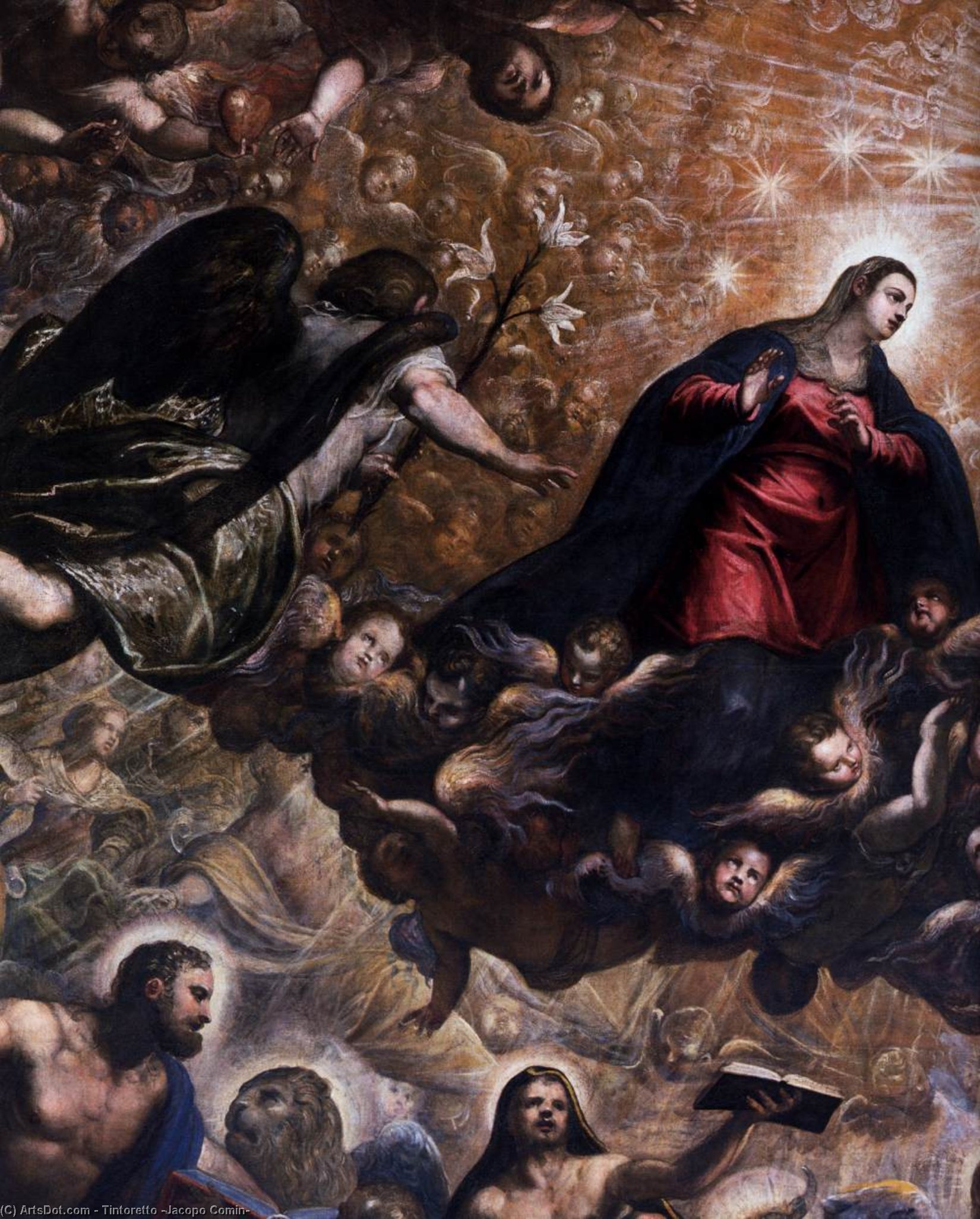
A Vision of Celestial Grandeur: Exploring Tintoretto’s *Paradise (detail)*
Jacopo Tintoretto's monumental *Paradise*, completed in 1587, stands as an unparalleled achievement of Venetian Baroque art—a testament to his mastery of composition, color, and dramatic illusion. More than just a depiction of biblical narrative, it embodies the spiritual fervor of its time, reflecting Venice’s anxieties about religious reform and cementing Tintoretto's reputation as *Il Furioso*, “the furious,” for his audacious brushwork and rapid execution. This captivating detail captures a pivotal moment within the larger fresco—a celestial visitation centered around Mary and illuminated by an overwhelming surge of divine light—offering viewers a glimpse into Tintoretto’s singular artistic vision.Subject & Historical Context
The scene portrays Mary receiving a luminous halo from Archangel Gabriel, symbolizing her sanctity and divine grace. Surrounding them are numerous angelic figures engaged in complex gestures, conveying the multifaceted nature of God's intervention in human affairs. Painted during the turbulent years following the Sack of Rome (1527), *Paradise* responded to the challenges posed by Protestant Reformation with a fervent reaffirmation of Catholic dogma. Tintoretto’s commission came from the Scuola Grande di San Rocco, a prominent Venetian confraternity dedicated to Saint Roch—a symbol of healing and protection—underscoring the artwork's significance within its religious context. The fresco was intended to inspire piety and evoke awe among worshippers, mirroring the broader artistic trends of the era which sought to elevate spiritual contemplation through visual splendor.Style & Technique
Tintoretto’s distinctive style is immediately recognizable for its dynamism and masterful use of *tenebrism*, a technique characterized by stark contrasts between light and shadow—a dramatic departure from earlier Renaissance ideals. This detail exemplifies his characteristic approach: The composition is deliberately crowded, with figures overlapping and swirling in an intricate arrangement that creates a sense of overwhelming grandeur. Visible brushstrokes contribute to a feeling of movement and immediacy, conveying the energy of divine presence. Tintoretto prioritized capturing emotion rather than meticulous realism; he achieved this through layering thin glazes of pigment—a technique perfected by Venetian artists—allowing for nuanced color blending and expressive effects. The use of oil paint on canvas ensured that the artwork retained its luminosity and textural richness over time.Symbolism & Iconography
The artwork is replete with symbolic elements reflecting Christian iconography: The halo surrounding Mary signifies her holiness, while Gabriel’s outstretched hand represents divine benevolence. The luminous glow emanating from Christ underscores his role as savior—a central motif in the fresco's narrative. Furthermore, the positioning of the angelic figures and the drapery contribute to a sense of ethereal beauty and spiritual transcendence. The multitude of faces in the background suggests universal participation in this celestial vision—a reminder of salvation and eternal life.Emotional Impact & Interpretation
*Paradise (detail)* evokes profound emotion—awe, reverence, and contemplation—drawing viewers into the scene’s dramatic atmosphere. Tintoretto's masterful manipulation of light and shadow amplifies the emotional resonance of the artwork, conveying a sense of spiritual fervor that transcends mere visual representation. For interior designers seeking to infuse their spaces with artistic grandeur and contemplative beauty, this detail – or a high-quality reproduction – serves as an exceptional focal point, embodying the spirit of Venetian Baroque art and inspiring a deeper appreciation for its enduring legacy. It speaks to those who cherish art that stimulates intellect and stirs the soul.Questions et réponses
Où devrait être accrochée une reproduction de «Paradis (détail)» de Jacopo Tintoretto ?
Le format Format portrait de «Paradis (détail)» de Jacopo Tintoretto est recommandé pour une Espaces de vie. Le format et l'espace guident ensemble l'emplacement d'une reproduction.
Avec quelle technique «Paradis (détail)» de Jacopo Tintoretto est-elle réalisée ?
Le médium de «Paradis (détail)» de Jacopo Tintoretto est Huile sur toile. Les reproductions visent à restituer l'aspect de cette technique.
Où puis-je voir l'original de «Paradis (détail)» de Jacopo Tintoretto ?
L'original de «Paradis (détail)» de Jacopo Tintoretto est conservé au Palazzo Ducale, Venise, Italie. Une reproduction permet d'exposer l'œuvre chez soi.
Biographie de l'artiste
Jacopo Tintoretto (1518-1594)
Jeunesse et Formation
- Né Jacopo Robusti à Venise vers fin septembre ou début octobre 1518.
- Son père, Battista Robusti, était teinturier – d'où le surnom “Tintoretto” (“le petit teinturier”).
- Les détails de sa formation formelle sont rares ; les témoignages suggèrent un bref et infructueux apprentissage avec Titien.
- Il s’est probablement auto-enseigné, étudiant l'anatomie par dissection et dessin à partir de moulages et de reliefs.
Développement Artistique & Style
- Le style de Tintoretto est caractérisé par des compositions dramatiques, des figures énergiques et une utilisation audacieuse de la perspective.
- Ses premières œuvres présentent un mélange d'influences, notamment Titien, Michel-Ange et autres maîtres vénitiens.
- Il a développé une technique distinctive impliquant des coups de pinceau rapides et des effets d'éclairage innovants – ce qui lui a valu le surnom “Il Furioso” (“le Fou”).
- Son travail s’est orienté vers des scènes de plus en plus dynamiques et émotionnellement chargées, souvent avec des arrangements spatiaux complexes.
Œuvres Majeures & Réalisations
- Le Miracle de Saint Marc libérant l'esclave (1548): Un exemple puissant de sa composition dramatique et de ses compétences en perspective.
- Œuvres à la Scuola Grande di San Rocco, Venise : Incluant “L’Assomption de la Vierge” et de nombreuses autres peintures, mettant en valeur sa maîtrise du récit et de l'échelle.
- Le Déclin de l'Empire Romain (1592-1594): Une œuvre monumentale démontrant son approche innovante d’un sujet traditionnel.
- De nombreuses peintures religieuses et historiques pour les églises et les palais vénitiens.
Influences & Héritage
- Il a été influencé par le colorisme de Titien et le style de figures dynamiques de Michel-Ange.
- L’œuvre de Tintoretto a comblé le fossé entre l'art de la Renaissance et celui du Baroque, influençant les artistes ultérieurs avec ses compositions dramatiques et son travail de pinceau expressif.
- Son utilisation innovante de la lumière et de l'ombre a anticipé les techniques utilisées par Caravage et d’autres maîtres du Baroque.
- Il a laissé derrière lui un vaste corpus d'œuvres qui inspirent et captivent encore aujourd'hui le public.
Signification Historique
- Tintoretto était l'un des trois grands peintres vénitiens du XVIe siècle, aux côtés de Titien et de Paolo Veronese.
- Il a joué un rôle crucial dans la formation du paysage artistique de Venise au cours de la Renaissance tardive.
- Son œuvre reflète l'ardeur religieuse et les tensions politiques de son temps.
- L’héritage de Tintoretto en tant que maître de composition dramatique et de peinture expressive perdure, consolidant sa place parmi les artistes les plus importants de l'histoire.

Jacopo Tintoretto
1518 - 1594 , Italie
En bref
- Artistes Influents:
- Tiziano Vecellio
- Michel-Ange
- Date De Décès: 1594
- Date De Naissance: 1518
- Influences Artistiques:
- Caravage
- Baroque
- Lieu De Naissance: Venise, Italie
- Mouvement Artistique: Manierisme, Renaissance
- Nationalité: Vénitienne
- Nom Complet: Jacopo Tintoretto
- Oeuvres Notables:
- Le Miracle de St Marc
- L'Assomption de la Vierge
- La Cène (San Giorgio)
- Déscente de croix
Articles connexes

Baroque Classicism: The Grandeur of Order and Drama in 17th-Century Art History
Explore the profound elegance of Baroque Classicism. Discover how 17th-century masters synthesized dramatic emotion with classical order through the lens of the Counter-Reformation and the works of legends like Carlo Maratta and Andrea Sacchi.

Le Drame Baroque : L'Art qui Apporte la Splendeur dans Votre Intérieur
Plongez dans l'univers somptueux du baroque ! Découvrez son histoire, comment l'intégrer à votre intérieur et les œuvres incontournables. : reproductions d'art de qualité supérieure.

Les 10 Chefs-d'œuvre Baroques qui ont Révolutionné l'Art |
Plongez au cœur du baroque avec les 10 chefs-d'œuvre de Caravaggio, Rembrandt et Rubens. Découvrez l'histoire fascinante de ces artistes et leurs tableaux célèbres. Reproductions d'art de qualité muséale sur – Explorez la collection !

The Dramatic Flourish: Exploring the Baroque Movement's Enduring Legacy in Art History
Explore the dramatic world of Baroque art! Discover iconic artists like Caravaggio & Rubens, defining techniques, and its lasting impact on art history. Expert insights for collectors & enthusiasts at OriginalUniqueArt.

Jacopo Tintoretto : Les 25 Chefs-d'œuvre du Maître Vénitien | OriginalUniqueArt
Plongez dans l'univers dramatique de Jacopo Tintoretto ! Découvrez les 25 œuvres incontournables du maître vénitien, ses techniques uniques et son style baroque. Reproductions de qualité muséale sur OriginalUniqueArt.com.