 Aperçu en situation
 Partager
 Partager
 Détails
 Guide imprimable

 Télécharger
 Articles similaires
 Radiographie
 Voir le diaporama
 Statistiques
St. Sebastian


 Afficher la suite
Giclées et impressions d'art
Impressions giclées ou sur toile de qualité musée, avec une production rapide et des finitions au choix. ( Acheter la peinture faite à la main Passer au format image numérique)




P118B €10

P118H €10

P118W €10

P438Z €10

P508JH €12

P508YH €12

P805H €10

P805Z €10

P919BZ €10

P919G €10

P919XJ €10

P959ZH €10

P968JZ €12

W106C €8

W218G €10

W218JH €8

W218Y €10

W307PJ €10

W316G €10

W316PJ €8

W316Y €10

W398PJ €8

W4111J €10

W500HY €15

W500JH €15

W692G €12

W849H €8

W940BG €15

W953PJ €8




Choisissez parmi nos formats prédéfinis qui respectent les proportions originales de l’œuvre.

Saisissez la largeur et la hauteur souhaitées pour qu'elles s'adaptent à votre cadre ou à votre mur. Une impression ne peut être que découpée, elle ne peut jamais être agrandie au-delà de l'image originale ; ainsi, un format de forme différente entraînera la perte d'une partie de l'image. Nous vous envoyons une maquette numérique pour approbation avant toute impression. L'image présentée sur cette page ne montre pas le recadrage réel — seule la maquette le permet.
Livraison dans le monde entier () en 2 semaines au lieu des 4/5 semaines habituelles. (24 octobre)

Livraison express gratuite dans le monde entier

Toile de lin de haute qualité

Assurance transport complète

Garantie de remboursement des droits de douane

Garantie de fidélité des couleurs

Garantie de retour de 100 jours (uniquement en cas de défaut)

Garantie de remboursement à 100%

Tarifs dégressifs sur quantité
 L'option verre n'est disponible que pour les dimensions inférieures à 110 cm.

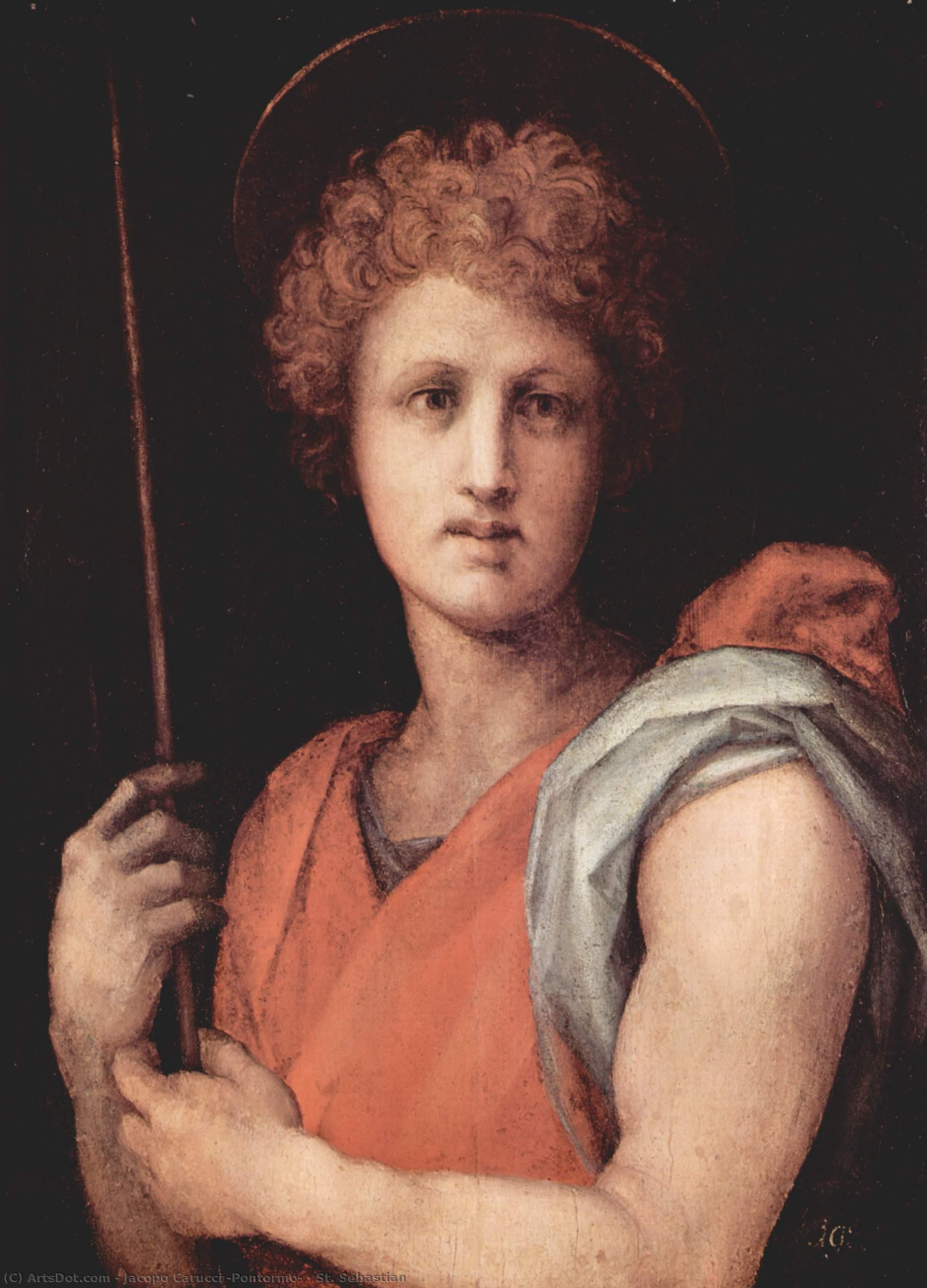
St. Sebastian
Giclées et impressions d'art
Format de la reproduction
-


Prix total final
€ 70
A Portrait of Spiritual Anguish: Unveiling Jacopo Pontormo’s St. Sebastian
Jacopo Pontormo's 1515 depiction of Saint Sebastian is not merely a portrait; it’s an immersion into the heart of Mannerist emotion, a profound exploration of faith, suffering, and the human condition. Painted during a period of artistic upheaval—a deliberate departure from the idealized beauty of the High Renaissance—Pontormo crafted a work that anticipates the dramatic intensity of the Baroque while retaining a distinctly personal and haunting quality. The painting immediately commands attention with its stark contrast: a dark, almost impenetrable background against which the figure of St. Sebastian is rendered in rich, warm hues, creating an immediate sense of isolation and vulnerability.
The composition itself is meticulously constructed, adhering to the pyramidal structure favored by Renaissance artists but imbued with a subtle instability that speaks to the era’s fascination with ambiguity. St. Sebastian's head, centrally positioned, dominates the canvas, his gaze direct and unwavering – an invitation, perhaps, or a plea for understanding. The crossed arms, a gesture of both defense and acceptance, suggest a man caught between earthly suffering and divine grace. The halo encircling his head is not a symbol of triumphant victory but rather a quiet acknowledgment of his martyrdom, a subtle reminder of the spiritual weight he carries.
The Language of Mannerism: Color, Line, and Emotion
Pontormo’s masterful use of color is central to the painting's emotional impact. The dominant palette—deep reds, oranges, and earthy terracotta tones—evokes a sense of warmth and vitality, yet this is immediately tempered by the surrounding darkness. These warm hues are juxtaposed against cooler blues and whites in the draped fabric, creating visual tension and highlighting the figure’s isolation. The artist employs a technique known as *sfumato*, subtly blurring lines and edges to create an atmosphere of ethereal softness—a hallmark of Mannerism. Lines are deliberately soft and blended, avoiding sharp definition; this contributes significantly to the painting's overall sense of fluidity and emotional intensity.
Furthermore, Pontormo’s manipulation of light is particularly noteworthy. It isn’t a dramatic spotlight but rather a diffused illumination that seems to emanate from multiple sources, gently sculpting St. Sebastian’s form and emphasizing his face. This subtle lighting creates a sense of depth and volume while simultaneously flattening the space, drawing the viewer's attention solely to the figure himself. The textures are rendered with remarkable delicacy—the smooth skin, the flowing fabric—suggesting an almost tactile quality that invites close observation.
Symbolism and Historical Context: A Bridge Between Eras
Beyond its aesthetic qualities, St. Sebastian’s image is rich in symbolic meaning. As a martyr for his Christian faith, he represents sacrifice, endurance, and the triumph of spirit over adversity. The arrows piercing his body are not merely depictions of physical pain but potent symbols of spiritual wounds—a visual representation of the suffering endured by all believers. The painting reflects the turbulent religious climate of 16th-century Florence, a city grappling with political instability and religious reform. Pontormo’s embrace of Mannerism can be seen as a response to the perceived rigidity of the High Renaissance, a willingness to explore subjective experience and emotional intensity.
Born Jacopo Carucci in Pontorme, Tuscany, around 1494, Pontormo was a pivotal figure bridging the Renaissance and Baroque eras. His life was marked by both artistic brilliance and personal tragedy – a loss of his wife and children profoundly impacting his work. This experience undoubtedly contributed to the melancholic tone that permeates St. Sebastian, transforming it into a timeless meditation on grief, faith, and the enduring power of the human spirit.
A Timeless Masterpiece: Reproduction and Beyond
Reproductions of Jacopo Pontormo’s *St. Sebastian* offer an exceptional opportunity to experience this profoundly moving work firsthand. The meticulous detail, evocative color palette, and masterful composition are faithfully captured in high-quality reproductions, allowing viewers to appreciate the artist's genius from any vantage point. Whether adorning a grand salon or a more intimate space, this painting continues to resonate with its powerful message of resilience and spiritual depth.
Questions et réponses
À quel âge Jacopo Pontormo a-t-il créé « St. Sebastian » ?
Lorsque « St. Sebastian » a été créé en 1515, Jacopo Pontormo — né(e) en 1494 — était âgé(e) de 21 ans.
Puis-je voir une vue aux rayons X de «St. Sebastian» de Jacopo Pontormo ?
La page Rayons X de «St. Sebastian» de Jacopo Pontormo est un visionneur interactif qui vous permet de parcourir onze couches optiques de l'image de l'œuvre, incluant une vue de style radiographie.
Quelle place occupe « St. Sebastian » dans l'œuvre de Jacopo Pontormo ?
Dans l'œuvre de Jacopo Pontormo, « St. Sebastian » s'inscrit dans le style Mannerist Painting, tout en abordant les thèmes de renaissance mannerism, emotional intensity, christian martyrdom, spiritual themes, religious iconography, symbolism rich, pontormo’s unique style, innovation”.
Biographie de l'artiste
Le Visionnaire Mélancolique : La Vie et l'Héritage de Jacopo Pontormo
Jacopo Carucci, connu de l'histoire sous le surnom évocateur de Pontormo, était un artiste dont le pinceau a capturé l'essence même de la transition. Né dans le petit village toscan de Pontorme vers 1494, sa jeunesse fut marquée par un profond sentiment de solitude et de mélancolie, des qualités qui allaient plus tard infuser ses toiles d'une profondeur psychologique inégalée. En tant que jeune apprenti à Florence, il évolua dans un monde de paradigmes artistiques mouvants, pour finalement s'imposer comme une figure centrale du mouvement maniériste florentin. Contrairement aux maîtres de la Haute Renaissance qui rechercha bien la perfection à travers l'équilibre et l'harmonie mathématique, Pontormo regardait vers l'intérieur, cherchant à exprimer les complexités turbulentes et souvent troublantes de l'âme humaine. Ses années de formation furent façonnées par l'ombre des géants. Sous la tutelle de Domenico del Pollaiuolo et l'influence monumentale de Michelangelo Buonarroti, il maîtrisa la précision anatomique exigée d'un maître de la Renaissance, tout en possédant un désir irrépressible de déformer cette réalité même pour produire un effet émotionnel. Il puisa son inspiration non seulement dans le poids sculptural de Michel-Ange, mais aussi dans les gravures complexes et émouvantes d'Albrecht Dürer. Cette synthèse unique entre la forme italienne et le détail expressif d'Europe du Nord lui permit de pionner un style où les figures semblaient perdre leur attache à la gravité, dérivant à travers des espaces ambigus et oniriques.L'Architecture du Maniérisme : Style et Innovation
Contempler une peinture de Pontormo, c'est entrer dans un royaume où les lois familières de la physique et de la perspective sont suspendues. Son œuvre représente un départ délibéré de la sérénité et de la régularité perspective de ses prédécesseurs. Dans des chefs-d'œuvre tels que sa "Visitation" ou sa hantante "Déposition," on observe les marques distinctives de son esthétique maniériste révolutionnaire : des membres allongés, des poses entrelacées et peu naturelles, ainsi qu'une palette de couleurs vibrantes, presque acides, qui s'entrechoquent et scintillent d'une lumière surnaturelle. Il remplaça les compositions triangulaires stables de la Renaissance par des arrangements tourbillonnants et encombrés, évoquant un sentiment d'énergie fébrile et d'agitation spirituelle. Le génie technique de Pontormo résidait dans sa capacité à utiliser la couleur et la forme comme des outils psychologiques. Ses figures semblent souvent flotter au sein d'environnements incertains, affranchies de tout poids, créant un sentiment de profonde instabilité. Il ne s'agissait pas d'un simple artifice ; c'était une tentative délibérée de transmettre les angoisses spirituelles d'une époque prise entre les certitudes de la Renaissance et le drame imminent du Baroque. Que ce soit à travers la lumière dramatique de son "Souper à Emmaüs" ou l'intensité émotive et brute trouvée dans ses études du Christ, Pontormo utilisait chaque coup de pinceau pour explorer les thèmes du chagrin, de la dévotion et du divin.Une Empreinte Durable sur l'Histoire de l'Art
L'importance historique de Jacopo Pontormo ne peut être surestimée. Il a servi de pont vital, traduisant les idéaux classiques du XVe siècle dans le langage expressif et théâtral qui allait définir une grande partie de l'art du XVIe siècle. Son influence s'est propagée à travers l'École florentine, façonnant les œuvres de successeurs comme Bronzino et garantissant que la tension entre beauté et artifice demeure un dialogue central dans la peinture européenne. Son œuvre demeure un témoignage de la puissance de la vision individuelle face à la tradition. À travers ses portraits, tels que le majestueux "Cosimo I de' Medici," et ses œuvres religieuses profondément symboliques, il a démontré que l'art pouvait être plus qu'un miroir de la réalité ; il pouvait être une fenêtre ouverte sur le subconscient. Bien que sa vie ait souvent été assombrie par le chagrin personnel, l'éclat de sa couleur et la complexité de ses compositions continuent de captiver, invitant chaque spectateur à se perdre dans le monde magnifique, déformé et profondément humain du maître florentin.
Jacopo Pontormo
1494 - 1557 , Italie
En bref
- Artistic Movement Or Style: Mannerism
- Artists Or Movements Influenced By This Artist: ['Michelangelo']
- Artists Who Influenced This Artist:
- Leonardo da Vinci
- Andrea del Sarto
- Date Of Birth: 1494
- Full Name: Jacopo Pontormo
- Nationality: Italian
- Notable Artworks:
- Visitation
- Deposition
- Place Of Birth: Pontorme, Italy
Articles connexes

The Enduring Legacy of Oil on Canvas: Technique, History & Aesthetic Impact
Explore the rich history & techniques of oil painting – from Renaissance masters to Impressionism. Discover pigments, layering methods, and why this timeless medium endures. Expert insights for artists & art enthusiasts.

El Greco : Les 25 Chefs-d'Œuvre Incontournables pour une Décoration d'Exception
Plongez dans l'univers spirituel d'El Greco ! Découvrez les 25 œuvres incontournables du maître espagnol, de *L'Enterrement du Comte d'Orgaz* à ses portraits saisissants. Inspirez votre décoration intérieure avec des reproductions d'art exceptionnelles sur OriginalUniqueArt.com.
Beyond Perfection: The Dramatic Elegance and Intellectual Tension of Renaissance Mannerism
Explore the captivating world of Renaissance Mannerism. Discover how artists moved beyond High Renaissance harmony into a realm of elegant distortion, psychological tension, and dramatic beauty that bridged the gap to the Baroque era.

The Enduring Power of Painting: A Historical & Contemporary Exploration of Form and Emotion
Explore the rich history & enduring techniques of oil painting with OriginalUniqueArt. Discover masterpieces, learn about art collecting, and find authentic handmade reproductions crafted by skilled artists.

L'Huile sur Toile : Exploration Historique et Technique d'un Médium Artistique Intemporel
Explorez l'histoire fascinante de la peinture à l'huile, des techniques ancestrales aux maîtres flamands comme Van Eyck. Découvrez les secrets des pigments, liants et glacis pour comprendre cet art intemporel.