

 Aperçu en situation
 Envoyer
 Partager
 Détails de l'œuvre
 Guide
Guide

 Télécharger l'image
 Articles similaires
 Radiographie
 Diaporama
 Statistiques
Nombre 12, 1949


 Lire la suite
Giclées et impressions d'art
Impressions giclées ou sur toile de qualité musée, avec une production rapide et des finitions au choix. ( Commander la reproduction peinte à la main Passer au format numérique)




P118B €10

P118H €10

P118W €10

P438Z €10

P508JH €12

P508YH €12

P805H €10

P805Z €10

P919BZ €10

P919G €10

P919XJ €10

P959ZH €10

P968JZ €12

W106C €8

W218G €10

W218JH €8

W218Y €10

W307PJ €10

W316G €10

W316PJ €8

W316Y €10

W398PJ €8

W4111J €10

W500HY €15

W500JH €15

W692G €12

W849H €8

W940BG €15

W953PJ €8




Choisissez parmi nos formats prédéfinis qui respectent les proportions originales de l’œuvre.

Saisissez la largeur et la hauteur souhaitées pour qu'elles s'adaptent à votre cadre ou à votre mur. Une impression peut être recadrée, mais jamais agrandie au-delà de l'image originale ; ainsi, un format de forme différente entraînera la perte d'une partie de l'image. Nous vous envoyons une maquette numérique pour approbation avant toute impression. L'image présentée sur cette page ne montre pas le recadrage réel — seule la maquette le permet.
Livraison dans le monde entier () en 2 semaines au lieu des 4/5 semaines habituelles. (25 octobre)

Livraison express gratuite dans le monde entier

Toile de lin de qualité supérieure

Assurance transport complète

Garantie de remboursement des droits de douane

Garantie de fidélité des couleurs

Politique de retour de 100 jours (uniquement en cas de défaut)

Garantie de remboursement à 100%

Offre de tarifs dégressifs
 L'option verre n'est disponible que pour les dimensions inférieures à 110 cm.

Nombre 12, 1949
Giclées et impressions d'art
Format de la reproduction
-


Prix total
€ 70
A Universe Within: Decoding Jackson Pollock’s “Number 12, 1949”
Jackson Pollock's "Number 12, 1949" isn't simply a painting; it’s an event frozen in time – a visual record of energy, gesture, and the burgeoning anxieties of the post-war American psyche. This monumental work stands as a cornerstone of Abstract Expressionism, a movement that irrevocably altered the course of 20th-century art. It embodies the very essence of Action Painting, where the artist’s physicality becomes inseparable from the creative process itself.The Birth of Action Painting
Pollock’s revolutionary technique, often termed “drip painting,” involved abandoning traditional easel painting in favor of working on an unprimed canvas laid directly on the floor. He eschewed brushes, instead employing sticks, hardened brushes, and even syringes to *fling*, *pour*, and *splatter* paint onto the surface. This wasn’t about depicting a subject; it was about the act of painting itself – the physical manifestation of inner turmoil and creative impulse. “Number 12, 1949” exemplifies this process perfectly. The canvas becomes an arena for action, a space where Pollock's movements are directly translated into visual form. Imagine him dancing across the floor, unleashing a torrent of pigment onto the expanse of beige beneath – that’s precisely what he achieved.Deconstructing the Composition
At first glance, the painting appears chaotic – a tangled web of lines and forms in shades of black, white, yellow, and brown. However, closer inspection reveals a surprising degree of control and balance. The density of paint varies across the canvas, creating areas of intense visual activity alongside quieter, more contemplative spaces. There’s no focal point in the traditional sense; instead, the eye is invited to wander, discovering new patterns and relationships with each viewing. Consider it like an intricate fractal – endlessly complex yet governed by underlying principles. The layering of paint creates a remarkable sense of depth, despite the fundamentally two-dimensional nature of the work. It’s as if Pollock wrestled with gravity itself, attempting to capture fleeting moments of movement and transformation.Historical Context & Artistic Influences
Emerging in the aftermath of World War II, Abstract Expressionism reflected a profound shift in artistic sensibilities. Artists sought to move beyond representation and explore the realm of pure emotion and subjective experience. Pollock was influenced by Surrealist automatism – a technique aimed at unlocking the subconscious mind – as well as Native American sand painting traditions. These influences instilled in him a fascination with ritualistic processes and an understanding of how art could communicate ideas beyond rational thought. Furthermore, the burgeoning interest in psychoanalysis, particularly the work of Carl Jung, informed the movement’s exploration of archetypes and universal symbols. The painting speaks to anxieties about existential uncertainty—a feeling palpable during that era.Symbolism & Emotional Resonance
While Pollock resisted explicit interpretations of his work, “Number 12, 1949” evokes a range of powerful emotions – anxiety, energy, freedom, and even a sense of existential angst. The tangled lines can be seen as representing the complexities of the human psyche, while the dynamic interplay of light and dark suggests a constant struggle between opposing forces. Consider it like a visual embodiment of internal conflict—a battle waged on an invisible battlefield. The painting isn’t about *what* it depicts, but rather *how* it makes you feel. It invites contemplation and challenges viewers to confront their own perceptions of order and chaos.Integrating “Number 12, 1949” into Your Space
- For the Collector: A statement piece that anchors any modern or contemporary collection. Its scale demands attention and sparks conversation.
- For the Interior Designer: Its neutral palette allows for versatility, complementing a range of color schemes. The dynamic composition adds energy to minimalist spaces while providing a compelling counterpoint to more traditional interiors.
- Emotional Impact: Ideal for spaces intended for contemplation or creative work, fostering an atmosphere of innovation and introspection.
Questions et réponses
Quel usage est suggéré pour «Nombre 12, 1949» de Jackson Pollock ?
Une reproduction de «Nombre 12, 1949» de Jackson Pollock est recommandée pour Pièce maîtresse d'envergure. Cette suggestion découle du sujet, de l'atmosphère et des couleurs de l'œuvre.
Puis-je voir une vue aux rayons X de «Nombre 12, 1949» de Jackson Pollock ?
La page Radiographie de «Nombre 12, 1949» de Jackson Pollock est un visionneur interactif qui vous permet de parcourir onze couches optiques de l'image de l'œuvre, incluant une vue de style radiographie.
Quelle couleur domine la composition de «Nombre 12, 1949» de Jackson Pollock ?
Brun espresso (#382c28) est la couleur dominante de «Nombre 12, 1949» de Jackson Pollock.
Biographie de l'artiste
Early Life and the Seeds of Innovation
Paul Jackson Pollock, born in Cody, Wyoming, in 1912, was a restless spirit from the outset. His early life was marked by frequent relocation as his father pursued work as a land surveyor across the vast landscapes of the American West. This itinerant existence instilled in young Pollock a deep connection to the natural world and an exposure to diverse cultures, particularly through encounters with Native American art during those surveying trips – impressions that would subtly permeate his artistic vision later in life.
Pollock’s formal artistic training began at the Manual Arts High School in Los Angeles, followed by studies at the Art Students League of New York under the tutelage of Thomas Hart Benton. Benton, a prominent figure in the Regionalist movement, emphasized rhythmic composition and narrative themes rooted in American life. While Pollock initially absorbed these lessons, his inherent inclination leaned toward more abstract explorations. He was also profoundly impacted by Mexican muralists like José Clemente Orozco, whose powerful depictions of social struggle resonated deeply with him. These early influences laid a foundation, but it was the burgeoning world of Surrealism that truly unlocked Pollock’s artistic potential.
The Birth of Action Painting and a Revolutionary Technique
The 1930s saw Pollock experimenting with various techniques, seeking alternatives to traditional brushwork. He began pouring paint, exploring its fluidity and unpredictable nature. However, it was around 1947 that his artistic trajectory underwent a radical transformation. Abandoning the easel altogether, Pollock laid canvases directly on the floor, initiating what would become known as his “drip painting” technique.
This wasn’t merely about applying paint; it was about embodying the act of creation itself. Pollock's canvases became arenas for physical expression, capturing the immediacy of his gestures and emotions. The resulting paintings are characterized by their “all-over” composition – a lack of central focus that invites the viewer to explore the entire surface as a unified field of energy. Intricate networks of lines and colors intertwine, creating a visual complexity that is both captivating and challenging. He employed unconventional tools—sticks, knives, even syringes—to manipulate the paint in unpredictable ways, further emphasizing the spontaneous nature of his process.
This innovative approach positioned Pollock as a central figure in the burgeoning Abstract Expressionist movement, which emerged in post-World War II New York City. Abstract Expressionism prioritized spontaneous gesture, large scale, and non-representational imagery, reflecting a broader cultural shift away from traditional artistic conventions. His marriage to fellow artist Lee Krasner was also pivotal; she provided unwavering emotional support and actively encouraged his artistic development, recognizing the groundbreaking nature of his work.
Iconic Works and Lasting Legacy
Pollock’s most celebrated works—such as Number 1, 1950 (Lavender Mist), One: Number 31, 1950, Blue Poles: Number 11, 1952, and Convergence—are testaments to his revolutionary technique. These paintings are not simply images; they are records of a performance, imbued with the artist’s physical presence and emotional intensity. The dynamic energy that emanates from these canvases is palpable, drawing viewers into a world of pure abstraction.
His style transcends mere aesthetics; it's an exploration of process over product. Pollock sought to capture the immediacy of his actions and emotions on canvas, rejecting traditional notions of composition and representation. He delved into Jungian psychology, exploring archetypes and the subconscious in his art, seeking to tap into universal symbols and primal energies.
Pollock’s impact on the history of art is immeasurable. He fundamentally altered the way artists approached painting, breaking free from easel-based methods and embracing a more performative approach. His work helped solidify New York City's position as a global center for modern art, shifting the focus away from European dominance. His influence can be seen in the work of countless artists who followed, including those associated with Color Field painting and later forms of abstract expressionism.
Though initially met with mixed reviews—some critics dismissed his work as chaotic or lacking skill—Pollock’s reputation grew steadily after his untimely death in 1956 at age 44. Today, he is universally recognized as one of the most important and influential artists of the 20th century, a visionary who dared to challenge conventions and redefine the boundaries of artistic expression.

Jackson Pollock
1912 - 1956 , États-Unis
L'essentiel de l'artiste
- Artistic Movement Or Style: Abstract Expressionism
- Artists Who Influenced This Artist:
- José Clemente Orozco
- Thomas Hart Benton
- Date Of Birth: January 28, 1912
- Date Of Death: August 11, 1956
- Full Name: Paul Jackson Pollock
- Nationality: American
- Notable Artworks:
- Number 1, 1950 (Lavender Mist)
- One: Number 31, 1950
- Blue Poles: Number 11, 1952
- Convergence
- Place Of Birth: Cody, USA
Articles connexes

Expressionnisme Abstrait : Les 10 Chefs-d'Œuvre Incontournables pour Décorer avec Art et Histoire
Plongez au cœur de l'Expressionnisme Abstrait avec ! Découvrez les 10 œuvres majeures de Pollock, Rothko et De Kooning. Histoire, techniques & inspiration déco. Explorez la collection complète en ligne.

Pure Chaos & Color: The High-Voltage World of Abstract Expressionism
Dive into the high-voltage world of Abstract Expressionism. Explore the raw energy of Action Painting and the legendary masters of the New York School through a visual journey of pure chaos and color. Discover how to bring bold, high-impact abstract art into your modern space.
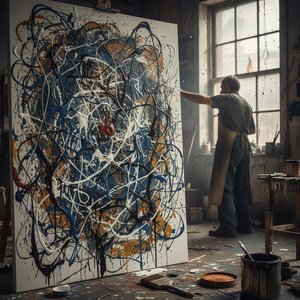
Jackson Pollock : Une Déconstruction Radicale de l'Expressionnisme Abstrait et Son Héritage Durable
Explorez l'univers révolutionnaire de Jackson Pollock et de l'expressionnisme abstrait. Découvrez son héritage, sa technique unique et l'impact durable de ce mouvement artistique majeur. Analyse approfondie pour collectionneurs avertis.
Au-Delà de la Représentation : Exploration du Paysage Émotionnel de l'Expressionnisme Abstrait
Explorez l'univers fascinant de l'Expressionnisme Abstrait avec OriginalUniqueArt. Analyse approfondie des maîtres (Pollock, Rothko, De Kooning) et conseils d'experts pour collectionner ces œuvres emblématiques. Découvrez une sélection unique.
Color Field Painting: The Emotional Power of Pure Abstraction and Chromatic Depth
Explore the profound emotional depth of Color Field painting. Discover the history of mid-century abstraction, from Rothko to Newman, and learn how pure color transforms the viewer's experience through our expert art history guide.


