Aperçu en situation
 Partager
 Partager
 Détails
 Guide imprimable

 Télécharger
 Articles similaires
 Radiographie
 Voir le diaporama
 Statistiques
La Profondeur

 Afficher la suite
Reproduction à l'huile faite à la main
Huile sur toile peinte à la main, avec cadre et dimensions personnalisés, réalisée sur commande par nos artistes. ( Passer au format impression Passer au format image numérique)




P118B €10

P118H €10

P118W €10

P438Z €10

P508JH €12

P508YH €12

P805H €10

P805Z €10

P919BZ €10

P919G €10

P919XJ €10

P959ZH €10

P968JZ €12

W106C €8

W218G €10

W218JH €8

W218Y €10

W307PJ €10

W316G €10

W316PJ €8

W316Y €10

W398PJ €8

W4111J €10

W500HY €15

W500JH €15

W692G €12

W849H €8

W940BG €15

W953PJ €8




Choisissez parmi nos formats prédéfinis qui respectent les proportions originales de l’œuvre.

Vous pouvez saisir vos propres dimensions pour l'adapter à un cadre ou à un espace spécifique. Si la taille sélectionnée ne correspond pas aux proportions de l'image d'origine, nous recadrerons l'œuvre ou prolongerons la peinture avec des éléments peints à la main supplémentaires. Une maquette numérique vous sera envoyée pour approbation avant le début de la production.
Veuillez noter que l'aperçu à l'écran ne reflète pas le recadrage ou l'extension réels. Seule la maquette montrera fidèlement la composition finale.
Bien que des tailles personnalisées soient disponibles, nous vous recommandons de sélectionner une dimension dans la liste prédéfinie afin de préserver les proportions d'origine.
Après la commande, l’équipe OriginalUniqueArt.com contactera le client par e-mail pour recueillir ses instructions et lui fournira une maquette d’aperçu
Livraison dans le monde entier () en 3 à 4 semaines au lieu des 5 semaines habituelles. (12 octobre). Aucun compromis sur la qualité.

Livraison express gratuite dans le monde entier

Toile de lin de haute qualité

Assurance transport complète

Garantie de remboursement des droits de douane

Garantie de fidélité des couleurs

Garantie de retour de 100 jours (uniquement en cas de défaut)

Garantie de remboursement à 100%

Tarifs dégressifs sur quantité
 L'option verre n'est disponible que pour les dimensions inférieures à 110 cm.

La Profondeur
Technique de reproduction
Format de la reproduction
-


Prix total final
€ 259
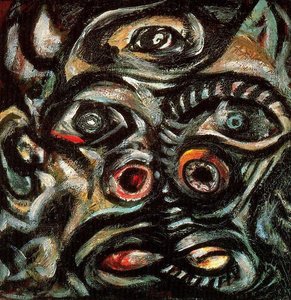
L'Oeuvre Profonde : Une Exploration de l’Abstraction et de la Lumière
Paul Jackson Pollock (1912-1956), véritable révolutionnaire de l’art américain du XXe siècle, est une figure emblématique de l’Abstract Expressionisme. Son parcours artistique débute dans les régions sauvages du Wyoming, où son père exerçait la profession de géomètre, lui offrant une connexion privilégiée avec la beauté brute et les rythmes naturels de l'Ouest américain. Cette jeunesse itinérante forgea chez lui une sensibilité particulière, une ouverture aux cultures diverses – notamment à l’art autochtone – dont il conserverait une empreinte subtile dans sa création artistique ultérieure. Bien qu’il n’ait jamais cherché à imiter directement les esthétiques indigènes, ces premières expériences nourrissaient déjà une énergie émotionnelle et une recherche d'harmonie avec le monde extérieur. Sa formation artistique officielle au Manual Arts High School de Los Angeles fut suivie par des études à l’Académie des Beaux-Arts de New York sous la direction du peintre régionaliste Thomas Hart Benton. Benton lui enseigna les principes fondamentaux de la composition dynamique et de la narration visuelle, valeurs qui influencèrent profondément son approche artistique. Cette influence est particulièrement perceptible dans ses œuvres les plus célèbres, où il privilégie une esthétique spontanée et une liberté expressive sans précédent.La Technique du Drip Painting : Une Nouvelle Voix Artistique
Pollock développa une méthode révolutionnaire qu’il baptisa « drip painting », ou peinture à gouttes. Cette technique consistait à déposer des peintures liquides sur une toile tendue au sol, laissant les pigments couler librement sous l’effet du poids de la peinture et des mouvements du peintre. Cette approche audacieuse rejetait les conventions picturales traditionnelles et ouvrait la voie à une nouvelle forme d'art où le processus créatif devenait aussi important que le résultat final. Les œuvres résultantes sont caractérisées par une texture riche et complexe, obtenue grâce à l’utilisation de pinceaux, tiges métalliques et autres outils pour projeter des éclaboussures contrôlées sur la toile. Cette méthode permettait d'obtenir des effets visuels uniques et exprimait avec puissance les émotions et les idées du peintre.Un Voyage au Cœur de l’Abstraction Emotionnelle
« The Deep », comme il est intitulé, incarne parfaitement cette philosophie artistique. Utilisant une palette monochrome dominée par le noir et le blanc, Pollock parvient à créer une profondeur visuelle remarquable et à évoquer une atmosphère mystérieuse et contemplative. Les coups de pinceau énergiques et les taches irrégulières sont disposés avec une précision calculée pour renforcer l'impact émotionnel de l’œuvre. Cette peinture est bien plus qu'une simple représentation visuelle ; elle est une véritable méditation sur la beauté et la complexité de l'expérience humaine. Elle rappelle les œuvres emblématiques telles que « Blue (Moby Dick) », « Untitled 6 » et « Number 27, 1950 », toutes explorant les mêmes thèmes d’énergie émotionnelle et de liberté artistique. Une reproduction haute qualité permettrait de capturer pleinement cette richesse esthétique et émotionnelle.Questions et réponses
Quel sujet et quelle atmosphère «La Profondeur» de Jackson Pollock associe-t-elle ?
«La Profondeur» de Jackson Pollock représente blackandwhite, drippainting, texture, emotion, composition, abstraction, brushstrokes, colorcontrast, dans une atmosphère Dramatique. Le sujet et l'ambiance définissent ensemble l'œuvre.
Puis-je voir une vue aux rayons X de «La Profondeur» de Jackson Pollock ?
La page Rayons X de «La Profondeur» de Jackson Pollock est un visionneur interactif qui vous permet de parcourir onze couches optiques de l'image de l'œuvre, incluant une vue de style radiographie.
Comment le médium et le mouvement se conjuguent-ils dans « La Profondeur » ?
«La Profondeur» de Jackson Pollock allie la technique de Huile sur toile au style Abstract Expressionism. La technique et le mouvement décrivent respectivement la réalisation et le style de l'œuvre.
L'image de «La Profondeur» de Jackson Pollock peut-elle être librement reproduite ?
«La Profondeur» de Jackson Pollock est dans le dans le domaine public - ses droits d'auteur ont expiré. Ce statut régit les modalités de reproduction de l'image de l'œuvre.
Quelle technique a été utilisée pour «La Profondeur» de Jackson Pollock ?
Le médium de «La Profondeur» de Jackson Pollock est Huile sur toile. Les reproductions visent à restituer l'aspect de cette technique.
Existe-t-il un diaporama pour «La Profondeur» de Jackson Pollock ?
Vous pouvez visionner «La Profondeur» de Jackson Pollock sous forme de diaporama sur la page Diaporama de l'œuvre.
Quelle émotion «La Profondeur» de Jackson Pollock dégage-t-il ?
«La Profondeur» de Jackson Pollock dégage un sentiment Mystérieux au sein d'une atmosphère globalement Dramatique.
Où puis-je acheter une impression de «La Profondeur» de Jackson Pollock ?
«La Profondeur» est disponible en tant que une impression d'art sur toile de coton ou sur papier canvas d'archive. Les commandes s'effectuent sur cette page, dans le format de votre choix.
Biographie de l'artiste
Early Life and the Seeds of Innovation
Paul Jackson Pollock, born in Cody, Wyoming, in 1912, was a restless spirit from the outset. His early life was marked by frequent relocation as his father pursued work as a land surveyor across the vast landscapes of the American West. This itinerant existence instilled in young Pollock a deep connection to the natural world and an exposure to diverse cultures, particularly through encounters with Native American art during those surveying trips – impressions that would subtly permeate his artistic vision later in life.
Pollock’s formal artistic training began at the Manual Arts High School in Los Angeles, followed by studies at the Art Students League of New York under the tutelage of Thomas Hart Benton. Benton, a prominent figure in the Regionalist movement, emphasized rhythmic composition and narrative themes rooted in American life. While Pollock initially absorbed these lessons, his inherent inclination leaned toward more abstract explorations. He was also profoundly impacted by Mexican muralists like José Clemente Orozco, whose powerful depictions of social struggle resonated deeply with him. These early influences laid a foundation, but it was the burgeoning world of Surrealism that truly unlocked Pollock’s artistic potential.
The Birth of Action Painting and a Revolutionary Technique
The 1930s saw Pollock experimenting with various techniques, seeking alternatives to traditional brushwork. He began pouring paint, exploring its fluidity and unpredictable nature. However, it was around 1947 that his artistic trajectory underwent a radical transformation. Abandoning the easel altogether, Pollock laid canvases directly on the floor, initiating what would become known as his “drip painting” technique.
This wasn’t merely about applying paint; it was about embodying the act of creation itself. Pollock's canvases became arenas for physical expression, capturing the immediacy of his gestures and emotions. The resulting paintings are characterized by their “all-over” composition – a lack of central focus that invites the viewer to explore the entire surface as a unified field of energy. Intricate networks of lines and colors intertwine, creating a visual complexity that is both captivating and challenging. He employed unconventional tools—sticks, knives, even syringes—to manipulate the paint in unpredictable ways, further emphasizing the spontaneous nature of his process.
This innovative approach positioned Pollock as a central figure in the burgeoning Abstract Expressionist movement, which emerged in post-World War II New York City. Abstract Expressionism prioritized spontaneous gesture, large scale, and non-representational imagery, reflecting a broader cultural shift away from traditional artistic conventions. His marriage to fellow artist Lee Krasner was also pivotal; she provided unwavering emotional support and actively encouraged his artistic development, recognizing the groundbreaking nature of his work.
Iconic Works and Lasting Legacy
Pollock’s most celebrated works—such as Number 1, 1950 (Lavender Mist), One: Number 31, 1950, Blue Poles: Number 11, 1952, and Convergence—are testaments to his revolutionary technique. These paintings are not simply images; they are records of a performance, imbued with the artist’s physical presence and emotional intensity. The dynamic energy that emanates from these canvases is palpable, drawing viewers into a world of pure abstraction.
His style transcends mere aesthetics; it's an exploration of process over product. Pollock sought to capture the immediacy of his actions and emotions on canvas, rejecting traditional notions of composition and representation. He delved into Jungian psychology, exploring archetypes and the subconscious in his art, seeking to tap into universal symbols and primal energies.
Pollock’s impact on the history of art is immeasurable. He fundamentally altered the way artists approached painting, breaking free from easel-based methods and embracing a more performative approach. His work helped solidify New York City's position as a global center for modern art, shifting the focus away from European dominance. His influence can be seen in the work of countless artists who followed, including those associated with Color Field painting and later forms of abstract expressionism.
Though initially met with mixed reviews—some critics dismissed his work as chaotic or lacking skill—Pollock’s reputation grew steadily after his untimely death in 1956 at age 44. Today, he is universally recognized as one of the most important and influential artists of the 20th century, a visionary who dared to challenge conventions and redefine the boundaries of artistic expression.

Jackson Pollock
1912 - 1956 , United States of America
En bref
- Full Name: Paul Jackson Pollock
- Nationality: American
- Date Of Birth: 1912
- Date Of Death: 1956
- Place Of Birth: Cody, United States of America
- Notable Artworks:
- Number 1, 1950 (Lavender Mist)
- One: Number 31, 1950
- Blue Poles: Number 11, 1952
- Convergence
- Artistic Movement Or Style: Abstract Expressionism
- Artists Who Influenced This Artist:
- José Clemente Orozco
- André Masson
- Max Ernst
- Thomas Hart Benton
- Artists Or Movements Influenced By This Artist:
- Color Field painting
- Abstract Expressionism