Aperçu en situation
 Envoyer
 Partager
 Détails de l'œuvre
 Guide
Guide

 Télécharger l'image
 Articles similaires
 Radiographie
 Diaporama
 Questions et réponses
 Statistiques
The Green Waterways


 Lire la suite
Giclées et impressions d'art
Impressions giclées ou sur toile de qualité musée, avec une production rapide et des finitions au choix. ( Commander la reproduction peinte à la main Passer au format numérique)




P118B €10

P118H €10

P118W €10

P438Z €10

P508JH €12

P508YH €12

P805H €10

P805Z €10

P919BZ €10

P919G €10

P919XJ €10

P959ZH €10

P968JZ €12

W106C €8

W218G €10

W218JH €8

W218Y €10

W307PJ €10

W316G €10

W316PJ €8

W316Y €10

W398PJ €8

W4111J €10

W500HY €15

W500JH €15

W692G €12

W849H €8

W940BG €15

W953PJ €8




Choisissez parmi nos formats prédéfinis qui respectent les proportions originales de l’œuvre.

Saisissez la largeur et la hauteur souhaitées pour qu'elles s'adaptent à votre cadre ou à votre mur. Une impression peut être recadrée, mais jamais agrandie au-delà de l'image originale ; ainsi, un format de forme différente entraînera la perte d'une partie de l'image. Nous vous envoyons une maquette numérique pour approbation avant toute impression. L'image présentée sur cette page ne montre pas le recadrage réel — seule la maquette le permet.
Livraison dans le monde entier () en 2 semaines au lieu des 4/5 semaines habituelles. (5 novembre)

Livraison express gratuite dans le monde entier

Toile de lin de qualité supérieure

Assurance transport complète

Garantie de remboursement des droits de douane

Garantie de fidélité des couleurs

Politique de retour de 100 jours (uniquement en cas de défaut)

Garantie de remboursement à 100%

Offre de tarifs dégressifs
 L'option verre n'est disponible que pour les dimensions inférieures à 110 cm.

The Green Waterways
Giclées et impressions d'art
Format de la reproduction
-


Prix total
€ 72
A Moment Suspended in Emerald Depths
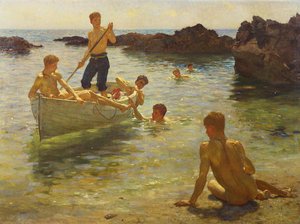
Henry Scott Tuke's The Green Waterways invites the viewer into a private, sun-dappled sanctuary where the boundary between human form and natural element dissolves. This captivating oil on canvas, painted in 1926, is more than just a depiction of leisure; it is an immersion into a moment of profound connection—both between two figures and between life itself and its aqueous cradle. The scene unfolds with remarkable balance: one figure stands anchored to the solid reality of the rocks, gazing outward or perhaps inward, while his companion drifts in the cool embrace of the water below. Tuke masterfully captures the interplay of light filtering through the surface, illuminating skin tones against the deep, verdant hues of the surrounding waterways.
Mastery of Light and Form
Technically, the painting showcases Tuke's commitment to realism, yet it breathes with the suggestive spirit of Impressionism. While his style retains a meticulous attention to detail—visible in the texture of the wet stone and the subtle musculature beneath the water’s surface—the overall effect is one of luminous immediacy. One can almost feel the cool spray on the skin and hear the gentle lapping of the current. Tuke, whose career saw him influenced by masters like Monet, translates that pioneering spirit into a more intimate, almost mythological tableau. The composition guides the eye naturally from the foreground rocks, through the verticality of the standing man, down to the mysterious depth where the second figure resides, creating an undeniable sense of perspective and depth.
Symbolism of Water and Nudity
The choice of subject matter—two nude figures in a natural waterway—lends the piece layers of symbolic resonance. Water has always been the ultimate symbol of transition, rebirth, and the subconscious mind. Here, it acts as both a physical setting and an emotional medium, suggesting vulnerability alongside profound freedom. The nudity strips away artifice, presenting the human form in its most elemental state, allowing the viewer to contemplate themes of naturalism, repose, and uninhibited connection. It speaks to a timeless human desire to return to nature's embrace.
An Echo of Artistic Tradition
To appreciate The Green Waterways is to appreciate Tuke’s place within the lineage of great British art. His work echoes the pastoral concerns of earlier masters while embracing the modern sensibility for capturing fleeting moments. For those who collect pieces that evoke a sense of serene escape, this painting offers an unparalleled depth. Whether displayed in a gallery setting or used as a focal point in a thoughtfully designed interior space, its quiet drama and rich palette promise to elevate any room with its sophisticated blend of classical subject matter and modern execution.
Questions et réponses
Quelle est l'orientation de «The Green Waterways» de Henry Scott Tuke ?
L'œuvre « The Green Waterways » est au format Square. Cette information est utile pour prévoir l'emplacement de sa reproduction.
Quelle émotion «The Green Waterways» de Henry Scott Tuke dégage-t-il ?
Dans « The Green Waterways », une atmosphère Natural accompagne une émotion Tranquil.
Qui a créé « The Green Waterways » et en quelle année ?
«The Green Waterways» a été créé par Henry Scott Tuke en 1926.
Biographie de l'artiste
Premières années et formation
Henry Scott Tuke, artiste visuel anglais de renom, est né le 12 juin 1858 à Lawrence Street, York, au sein d'une famille quaker. Son père, Daniel Hack Tuke, était un médecin spécialisé en psychiatrie. Dès son plus jeune âge, il manifesta une forte inclination pour l’art, encouragée par sa famille. Il s'inscrit à la Slade School of Art sous la direction d'Alphonse Legros et de Sir Edward Poynter en 1875. Il obtint ensuite une bourse lui permettant de poursuivre ses études à la Slade et en Italie en 1880. Son séjour à Paris, de 1881 à 1883, où il rencontra Jules Bastien-Lepage, influença sa décision de peindre en plein air.Carrière artistique
- Tuke s'est distingué par son style impressionniste.
- Il est surtout connu pour ses peintures de garçons et de jeunes hommes nus, un sujet à la fois personnel et professionnellement significatif.
- Sa carrière prolifique a donné naissance à plus de 1300 œuvres, comprenant des peintures à l'huile de jeunes hommes, des scènes maritimes et des portraits de navires de plaisance.
Œuvres notables et héritage
Parmi ses œuvres les plus remarquables figurent :- The Boy’s Dream, un exemple poignant de son style impressionniste.
- August, Blue, qui met en valeur sa capacité à capturer l'essence de la jeunesse et de la nature.
- Sailing Ships at Newlyn, soulignant son art maritime.
Vie ultérieure et décès
Tuke a subi une crise cardiaque en 1928 et est décédé le 13 mars 1929. Malgré le fait qu’il savait que son travail n’était plus à la mode vers la fin de sa vie, la générosité de Tuke envers ses modèles, dont beaucoup étaient de jeunes hommes, témoigne de son caractère.L'héritage artistique de Tuke : un mélange d'impressionnisme et d'intimité
Son œuvre, bien que souvent éclipsée par des contemporains plus flamboyants, reste un témoignage du pouvoir durable de l’art impressionniste et de la forme humaine. L’héritage de Tuke ne réside pas seulement dans ses peintures, mais aussi dans les vies qu'il a touchées, tant en tant qu'artiste que personne.
Henry Scott Tuke
1858 - 1929 , Royaume-Uni
L'essentiel de l'artiste
- Artistes Influents:
- Alphonse Legros
- Jules Bastien-Lepage
- Date De Décès: 13 mars 1929
- Date De Naissance: 12 juin 1858
- Influence Sur Les Artistes: ['École de Newlyn']
- Lieu De Naissance: York, Royaume-Uni
- Mouvement Artistique: Impressionnisme
- Nationalité: Britannique
- Nom Complet: Henry Scott Tuke
- Oeuvres Notables:
- The Boy’s Dream
- August, Blue
- Sailing Ships at Newlyn
Articles connexes

Lumière et Matière : Les Secrets de la Peinture à l'Huile sur Toile
Découvrez les secrets techniques de l'huile, du glacis à l'empâtement. Explorez la science et l'âme des maîtres dès maintenant.

Impressionistic Realism: Where Captivating Light Meets Lifelike Detail
Discover the breathtaking allure of Impressionistic Realism. Explore how master artists blend luminous light with lifelike detail to create timeless works. From iconic landscapes to bespoke oil reproductions, immerse yourself in an era where atmosphere meets exquisite craftsmanship.
Impressionist Realism: Mastering the Fusion of Vivid Light and Tactile Detail for Modern Collectors
Discover the captivating world of Impressionist Realism. Explore how masters blend vivid light with raw, tactile detail to create timeless masterpieces perfect for modern collectors seeking high-impact, museum-quality art.

Impressionistic Realism's Finest: 10 Masterpieces for Your Home | OriginalUniqueArt
Journey through Impressionistic Realism with 10 iconic masterpieces by Monet, Renoir & Van Gogh. Explore art history, techniques & find museum-quality reproductions for your home at OriginalUniqueArt.com. Discover all masterpieces online!
Fluid Reflections: Exploring Water's Symbolism in Art History – From Myth to Impressionism
Explore the rich symbolism of water in art history – from ancient myths to Impressionism's fleeting beauty. Discover masterpieces & find your perfect serene artwork with OriginalUniqueArt.com.