
 Aperçu en situation
 Envoyer
 Partager
 Détails de l'œuvre
 Guide
Guide

 Télécharger l'image
 Articles similaires
 Radiographie
 Diaporama
 Questions et réponses
 Statistiques
Mother And Child 4

 Lire la suite
L’œuvre d'art présentée sur cette page est protégée par le droit d'auteur, ce qui signifie que nous ne pouvons légalement créer ou vendre de reproduction identique. Cette protection est appliquée en vertu d'accords internationaux tels que la Convention de Berne et par les lois nationales, notamment celles énoncées par le Loi américaine sur le droit d'auteur - Titre 17.
Cette méthode est pleinement conforme aux réglementations sur le droit d'auteur car elle ne repose pas sur la copie ou la duplication de l'œuvre protégée. Il s'agit plutôt d'une réinterprétation créative — une nouvelle peinture qui s'inspire de l'original sans pour autant lui être identique.
Giclées et impressions d'art
Impressions giclées ou sur toile de qualité musée, avec une production rapide et des finitions au choix. ( Commander la reproduction peinte à la main Passer au format numérique)




P118B €10

P118H €10

P118W €10

P438Z €10

P508JH €12

P508YH €12

P805H €10

P805Z €10

P919BZ €10

P919G €10

P919XJ €10

P959ZH €10

P968JZ €12

W106C €8

W218G €10

W218JH €8

W218Y €10

W307PJ €10

W316G €10

W316PJ €8

W316Y €10

W398PJ €8

W4111J €10

W500HY €15

W500JH €15

W692G €12

W849H €8

W940BG €15

W953PJ €8




Choisissez parmi nos formats prédéfinis qui respectent les proportions originales de l’œuvre.

Saisissez la largeur et la hauteur souhaitées pour qu'elles s'adaptent à votre cadre ou à votre mur. Une impression peut être recadrée, mais jamais agrandie au-delà de l'image originale ; ainsi, un format de forme différente entraînera la perte d'une partie de l'image. Nous vous envoyons une maquette numérique pour approbation avant toute impression. L'image présentée sur cette page ne montre pas le recadrage réel — seule la maquette le permet.
Livraison dans le monde entier () en 2 semaines au lieu des 4/5 semaines habituelles. (8 novembre)

Livraison express gratuite dans le monde entier

Toile de lin de qualité supérieure

Assurance transport complète

Garantie de remboursement des droits de douane

Garantie de fidélité des couleurs

Politique de retour de 100 jours (uniquement en cas de défaut)

Garantie de remboursement à 100%

Offre de tarifs dégressifs
 L'option verre n'est disponible que pour les dimensions inférieures à 110 cm.

Mother And Child 4
Giclées et impressions d'art
Format de la reproduction
-


Prix total
€ 72
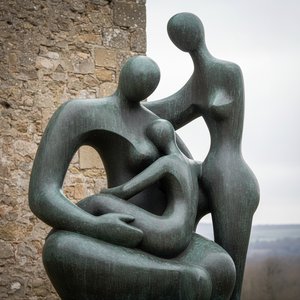
A Universal Bond: Exploring Henry Moore’s ‘Mother and Child 4’
This striking black and white photograph captures a sculpture by one of Britain's most important artists, Henry Moore. The work depicts two abstracted bird-like forms – a larger figure sheltering a smaller one – embodying the timeless theme of motherhood and familial protection. While the material is suggested to be wood or stone, its smooth, organic curves and textured surface speak to Moore’s mastery of form and his deep connection to natural materials. This particular piece, part of a prolific series exploring the mother-and-child motif, exemplifies Moore's signature style developed throughout his long career.Moore’s Sculptural Language: Form & Technique
Henry Moore is renowned for his semi-abstract sculptures, often focusing on the human figure – particularly reclining figures and *mother and child* compositions. He pioneered a technique called “direct carving,” where he worked directly with the material (often stone or wood), allowing the form to emerge organically rather than adhering strictly to a pre-conceived design. This approach is evident in ‘Mother and Child 4’ where the forms appear both monumental and intimately connected. The simplification of shapes, the emphasis on volume, and the interplay of positive and negative space are hallmarks of his style, influenced by prehistoric sculpture, African art, and the works of Michelangelo. Moore wasn't interested in literal representation; instead, he sought to capture the *essence* of form and emotion.Symbolism & Emotional Resonance
The mother-and-child theme held profound significance for Moore throughout his life. Having experienced hardship during World War I while serving as a soldier, he found solace in images of nurturing and protection. The abstracted forms in ‘Mother and Child 4’ transcend specific identities, becoming universal symbols of maternal love, vulnerability, and the enduring bond between generations. The protective gesture of the larger form enveloping the smaller one evokes feelings of safety, comfort, and unconditional care. While seemingly simple, the sculpture resonates with deep emotional power, prompting contemplation on fundamental human experiences. The use of birds as a metaphor adds another layer – suggesting freedom, fragility, and the instinct to nurture offspring.A Lasting Legacy: Moore in Context
Born in 1898, Henry Moore lived through periods of immense social and political change, which profoundly impacted his artistic vision. His work gained prominence in the post-war era, reflecting a desire for renewal and a search for universal values. Moore’s sculptures are now found in public collections and private homes worldwide, celebrated for their beauty, emotional depth, and enduring relevance. ‘Mother and Child 4’, like many of his works, continues to inspire artists and captivate audiences with its powerful simplicity and profound message. A reproduction of this sculpture would bring a sense of serenity, strength, and timeless elegance to any interior space.Questions et réponses
L'œuvre « Mother And Child 4 » de Henry Moore est-elle dans le domaine public, et pourquoi ?
«Mother And Child 4» de Henry Moore est dans le toujours protégé par le droit d'auteur. La durée du droit d'auteur court à partir du décès de l'artiste, survenu en 1986.
À quel point la palette de "Mother And Child 4" est-elle saturée ?
La palette de « Mother And Child 4 » présente une saturation Muted.
Où puis-je télécharger «Mother And Child 4» de Henry Moore ?
«Mother And Child 4» de Henry Moore peut être téléchargé depuis la page Téléchargement de l'œuvre, en tant que téléchargement d'une image numérique haute résolution.
Biographie de l'artiste
Premières années et formation
Moore est né à Castleford, dans le West Riding du Yorkshire, en Angleterre, de Mary Baker et Raymond Spencer Moore. Son père, un autodidacte passionné par la musique et la littérature, encouragea ses fils à poursuivre une éducation formelle. Henry Moore fréquenta les écoles primaires et élémentaires de Castleford, où il commença à modeler dans l'argile et à sculpter le bois.Développement artistique et style
- Les premières sculptures enregistrées de Moore, comme la plaque pour la société Scott de l'école secondaire de Castleford, datent de son adolescence.
- Il adopta plus tard la méthode de sculpture directe, qui devint une caractéristique de son style, comme on le voit dans des œuvres telles que La Vierge et l’Enfant.
- Les formes de Moore sont généralement des abstractions de la figure humaine, représentant souvent des thèmes mère-enfant ou des figures allongées. De nombreux interprètes comparent la forme ondulante de ses figures allongées aux paysages et aux collines de sa ville natale, le Yorkshire.
Œuvres notables et héritage
- Les sculptures monumentales en bronze semi-abstraites de Moore se trouvent dans le monde entier en tant qu'œuvres d'art publiques, témoignant de son talent exceptionnel et de sa contribution à la sculpture britannique moderne.
- Sa capacité à réaliser des commandes à grande échelle le rendit extrêmement riche, mais il vécut avec frugalité, la plupart de ses revenus étant consacrés à doter la Fondation Henry Moore, qui continue de soutenir l'éducation et la promotion des arts.
- Les œuvres de Moore se trouvent dans divers musées, dont la collection Ingram d’art britannique et contemporain moderne, qui présente une impressionnante gamme d’œuvres d’art britanniques modernes et contemporaines du monde entier.
Influences et évolution
Moore fut influencé par l'art précolombien, notamment les sculptures olmèques qu'il vit lors de son voyage en Amérique en 1932. Il s'inspira également des formes naturelles, comme les rochers et les paysages, pour créer ses œuvres abstraites. Son style évolua au fil du temps, passant d'abord par une représentation plus figurative avant de se tourner vers l'abstraction totale. Ses sculptures monumentales en bronze témoignent de sa maîtrise technique et de son exploration continue des formes et de l'espace.Liens vers les pages pertinentes sur OriginalUniqueArt.com
Pour en savoir plus

Henry Moore
1898 - 1986 , Royaume-Uni
L'essentiel de l'artiste
- Date De Décès: 1986
- Date De Naissance: 1898
- Lieu De Naissance: Castleford, Royaume-Uni
- Nationalité: Britannique
- Nom Complet: Henry Spencer Moore
- Oeuvres Notables:
- Torse Pointu
- Motive Vertical, Maquette n° 1
- Miroir à arête de couteau Deux pièces
- Berceuse Tête Dormante
- Style Artistique: Sculpture abstraite
Articles connexes

Les 10 Chefs-d'œuvre Bronzes Qui Ont Révolutionné la Sculpture | OriginalUniqueArt
Plongez dans l'univers fascinant des 10 sculptures en bronze les plus emblématiques de l'histoire de l'art. Rodin, Degas et autres maîtres révélés ! Découvrez leur histoire, leurs techniques et trouvez l'œuvre parfaite pour sublimer votre intérieur sur OriginalUniqueArt.com.

The Enduring Legacy of Bronze: A Historical & Artistic Exploration for the Collector
Explore the rich history & enduring appeal of bronze sculpture with expert insights for collectors at OriginalUniqueArt. Learn about casting techniques, iconic artists, collecting tips & contemporary interpretations.

Les 10 Chefs-d'œuvre en Bronze qui ont Révolutionné l'Art : Collection OriginalUniqueArt
Plongez dans l'univers fascinant des 10 chefs-d'œuvre en bronze qui ont marqué l'histoire de l'art. Découvrez Rodin, Degas et les secrets de ces sculptures iconiques. Reproductions d'art exceptionnelles sur OriginalUniqueArt.com – Explorez la collection !
Henry Moore: Sculpting Modernity – Form, Emotion & the Human Condition
Explore the revolutionary sculptures of Henry Moore – abstract forms, reclining figures & powerful expressions of the human condition. Discover his legacy & artistic process with OriginalUniqueArt.

L'Éternité du Bronze : Maîtrise de la Cire Perdue et Héritage de la Sculpture en Métal
Découvrez l'expertise technique de la cire perdue et du bronze. Explorez l'histoire des maîtres de la sculpture dès maintenant.


