Aperçu en situation
 Partager
 Partager
 Détails
 Guide imprimable

 Télécharger
 Articles similaires
 Radiographie
 Voir le diaporama
 Statistiques
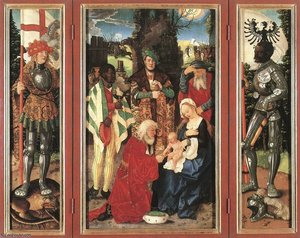
The Trinity and Mystic Pietà
 Oil On Panel
- WallArt
- Northern Renaissance
 1512
1512- Renaissance
 112.0 x 89.0 cm
 La National Gallery
 Afficher la suite
Giclées et impressions d'art
Impressions giclées ou sur toile de qualité musée, avec une production rapide et des finitions au choix. ( Acheter la peinture faite à la main Passer au format image numérique)




P118B $10

P118H $10

P118W $10

P438Z $10

P508JH $12

P508YH $12

P805H $10

P805Z $10

P919BZ $10

P919G $10

P919XJ $10

P959ZH $10

P968JZ $12

W106C $8

W218G $10

W218JH $8

W218Y $10

W307PJ $10

W316G $10

W316PJ $8

W316Y $10

W398PJ $8

W4111J $10

W500HY $15

W500JH $15

W692G $12

W849H $8

W940BG $15

W953PJ $8




Choisissez parmi nos formats prédéfinis qui respectent les proportions originales de l’œuvre.

Vous pouvez saisir vos propres dimensions pour vous adapter à un cadre ou à un espace spécifique. Si la taille sélectionnée ne correspond pas aux proportions de l'image originale, nous recadrerons l'œuvre ou étendrons l'image avec une bordure en miroir ou une couleur unie. Une maquette numérique vous sera envoyée pour approbation avant le début de la production.
Veuillez noter que l'aperçu à l'écran ne reflète pas le recadrage ou l'extension réelle. Seule la maquette montrera avec précision la composition finale.
Bien que des tailles personnalisées soient disponibles, nous vous recommandons de choisir une dimension dans la liste prédéfinie afin de préserver les proportions originales.
Livraison dans le monde entier () en 2 semaines au lieu des 4/5 semaines habituelles. (26 septembre)

Livraison express gratuite dans le monde entier

Toile de lin de haute qualité

Assurance transport complète

Garantie de remboursement des droits de douane

Garantie de fidélité des couleurs

Garantie de retour de 100 jours (uniquement en cas de défaut)

Garantie de remboursement à 100%

Tarifs dégressifs sur quantité
 L'option verre n'est disponible que pour les dimensions inférieures à 110 cm.

The Trinity and Mystic Pietà
Giclées et impressions d'art
Format de la reproduction
-


Prix total final
$ 80
A Divine Encounter: The Soul of Hans Baldung’s Masterpiece
In the quiet, contemplative corners of art history, few works command the room with as much spiritual gravity as Hans Baldung Grien’s “The Trinity and Mystic Pietà.” Completed in 1512, this monumental oil-on-oak painting serves as a profound window into the High Renaissance in Bavaria, capturing a moment where the earthly and the divine collide. At its heart, the composition is a masterclass in sacred geometry, utilizing a triangular arrangement to guide the viewer’s eye toward the wounded figure of Christ. As the light breaks through ethereal clouds, we witness God the Father supporting His son, while the Holy Spirit descends in the form of a delicate dove. This is not merely a religious icon; it is an emotional journey that invites the observer into a state of deep, meditative devotion.
The painting’s power lies in its ability to balance the monumental with the intimate. While the central figures represent the cosmic scale of the Christian Trinity, Baldung surrounds them with the raw, human reality of grief. The weeping presence of the Virgin Mary and Saint John the Evangelist provides a poignant emotional anchor, their sorrow mirroring the viewer's own capacity for empathy. For the discerning collector or interior designer, this piece offers more than just visual splendor; it brings a sense of historical weight and narrative depth to any space, acting as a focal point that encourages stillness and reflection.
The Mastery of Mannerist Technique and Light
To gaze upon this work is to witness the technical brilliance of a painter who was not afraid to embrace the unsettling. Baldung Grien, a gifted student of Albrecht Dürer, moved beyond the idealized perfection of his contemporaries to explore the expressive potential of Mannerism. He employs a sophisticated glazing technique, layering translucent pigments over opaque underlayers to create a luminous, almost supernatural glow that seems to emanate from within the figures themselves. This luminosity is heightened by his masterful use of chiaroscuro—the dramatic interplay between deep, velvety shadows and piercing highlights.
Every brushstroke serves a purpose in building the painting's psychological tension. The artist meticulously renders the intricate folds of drapery and the subtle, agonizing expressions on the faces of the mourners, ensuring that the texture of the paint contributes to the overall sense of solemnity. For those seeking a high-quality reproduction, these fine details—the way light catches a tear or the soft sheen of a saint's robe—are what make a hand-painted version so captivating. It is this meticulous attention to detail that allows the artwork to transcend its era, offering a timeless aesthetic that complements both classical and contemporary sophisticated interiors.
A Legacy of Symbolism and Spiritual Depth
Beyond its visual allure, “The Trinity and Mystic Pietà” is an intricate tapestry of theological symbolism. The inclusion of God the Father physically supporting the dead Christ is a rare and striking iconographic choice, evoking the "Mystic Pietà" theme that resonates with themes of sacrifice and eternal love. This arrangement serves as a powerful metaphor for the continuity of life and the strength found in divine providence. The presence of smaller, kneeling figures at the base of the composition suggests a bridge between the celestial realm and the human congregation, making the painting feel accessible and deeply personal.
For the art lover, this work represents the pinnacle of German Renaissance innovation. It captures a period of intense intellectual fervor, where humanist ideals began to intertwine with traditional piety. Owning or displaying a reproduction of such a significant piece is an opportunity to celebrate this historical intersection. Whether placed in a private study, a grand gallery, or a curated living space, Baldung’s masterpiece continues to provoke thought, inspire awe, and serve as a testament to the enduring power of sacred art.
Biographie de l'artiste
A Swabian Enigma: The Life and Early Influences of Hans Baldung Grien
Hans Baldung—forever distinguished as Hans Baldung Grien due to his predilection for wearing green attire—emerged from an unexpectedly scholarly lineage. Born around 1485 in the Free Imperial City of Schwäbisch Gmünd, nestled within the rolling hills of Bavaria, Germany, he was the son of Johann Baldung, a university-educated jurist who held the office of legal adviser to the Bishopric of Strasbourg, Albert of Bavaria, from 1492, and Margarethe Herlin, daughter of Arbogast Herlin. His uncle, Hieronymus Baldung, was a doctor in medicine, with a son, Pius Hieronymus, cousin of Hans, who taught law at Freiburgand became chancellor of Tyrol in 1527. The family resided in Strasbourg. He was the first male in his family to not attend university, but he was one of the earliest German artists to come from an academic family. His formative years were marked by exposure to humanist ideals and intellectual currents that shaped his worldview—a characteristic that permeated his entire oeuvre. He received his initial artistic training around 1500 in the Upper Rhineland with an artist from Strasbourg, laying the groundwork for his technical skills before he sought out more prominent masters to hone his craft. This early period instilled within him a foundation of draftsmanship and composition, preparing him for the rigorous artistic environment that awaited him in Nuremberg.Under Dürer’s Wing and Forging an Individual Style
The pivotal moment in Baldung’s development arrived in 1503 when he became an assistant in Albrecht Dürer’s workshop in Nürnberg, where he perfected his art between 1503 and 1507. This period proved profoundly formative, exposing him to the meticulous detail, intellectual rigor, and innovative printmaking techniques that defined Dürer’s style. The two artists developed a close relationship; Baldung even managed Dürer’s workshop during his master’s sojourn to Venice. However, while deeply influenced by Dürer—evident in early works showcasing precise draftsmanship and Northern realism—Baldung quickly began to forge his own artistic identity. He absorbed the lessons of the Renaissance masters but infused them with a uniquely German sensibility, characterized by expressive color, imaginative compositions, and an increasingly unsettling psychological depth. This divergence from Dürer’s more classical approach would become a hallmark of Baldung’s mature style. His time in Venice, overseeing Dürer’s affairs, also exposed him to the burgeoning Italian Renaissance art scene, broadening his artistic horizons and subtly influencing his palette and compositional choices. He returned from Italy with a heightened sense of color and a willingness to experiment with spatial arrangements that set him apart from his contemporaries.A Master of Many Mediums: Themes and Techniques
Hans Baldung Grien was an artist of remarkable versatility, proficient in painting, printmaking—particularly woodcuts and engravings—drawing, tapestry design, and even stained glass work. His paintings often feature small-scale works brimming with puzzling allegories and mythological narratives, rendered with a vibrant palette and a distinctive sense of spatial ambiguity. He excelled at portraiture, capturing the likenesses of his patrons with both realism and psychological insight. However, it is perhaps for his woodcuts that Baldung is most widely recognized today. These prints are characterized by their dramatic compositions, intricate detail, and often macabre subject matter. A recurring theme throughout his work is a fascination with witchcraft, death, and the supernatural—a reflection of the anxieties and beliefs prevalent in 16th-century Germany. His depictions of witches are particularly striking, portraying them not as stereotypical hags but as complex, even alluring figures, embodying both fear and fascination. He exploited the medium’s capacity for stark contrasts and intricate detail to create images that were both visually arresting and psychologically unsettling. ## Reformation Currents and Lasting Legacy Baldung’s career unfolded during a period of immense religious and political upheaval, marked by the rise of the Protestant Reformation. While not overtly aligned with any particular faction, his work often reflects the changing spiritual landscape of Germany. His monumental high altar for the city of Münster, completed in 1531, is a testament to this engagement, showcasing support for the reformation movement through its iconography and stylistic choices. He died in Strasbourg in September 1545, leaving behind a body of work that continues to captivate and intrigue viewers today. His influence can be seen in the works of later German artists, and his unique blend of Renaissance technique, Northern expressionism, and allegorical complexity secures his place as a significant figure in art history. He remains an artist whose work invites contemplation, challenging us to confront the darker aspects of human nature and the mysteries of the unseen world.
Hans Baldung Grien
1485 - 1545 , Allemagne
En bref
- Artistic Movement Or Style: Renaissance, Mannerism
- Artists Who Influenced This Artist: ['Albrecht Dürer']
- Date Of Birth: c. 1485
- Full Name: Hans Baldung Grien
- Nationality: German
- Notable Artworks:
- Bewitched Groom
- Allegory of Death & Beauty
- Place Of Birth: Schwäbisch Gmünd, Germany
Articles similaires
The Timeless Charm of Oil on Board: Reimagining Texture and Light through the Impressionist Lens
Discover the profound intimacy of oil on panel. Explore how Impressionist masters used rigid supports to capture light, texture, and impasto depth through exquisite, handmade oil reproductions for discerning collectors.
Oil on Panel: A Historical Survey of Technique, Support & Aesthetic Evolution
Explore the rich history of oil on panel painting! Discover Renaissance techniques, support structures & aesthetic evolution. Expert insights for art collectors and enthusiasts.
Hans Baldung Grien: A Renaissance Master of Allegory, Innovation & the Grotesque
Explore the captivating world of Hans Baldung Grien, a Renaissance master renowned for his allegorical paintings, striking woodcuts & unique depictions of mythology and the grotesque. Discover his life, works & legacy with OriginalUniqueArt.
Mastering the Surface: A Historical and Technical Guide to the Art of Oil on Panel Painting
Explore the profound history and technical brilliance of oil on panel painting. From Renaissance masters to modern techniques, discover why this rigid support offers unparalleled precision and permanence for fine art lovers and collectors.
Les 10 Chefs-d'œuvre à l'Huile sur Panneau qui ont Révolutionné l'Art |
Plongez dans l'histoire des 10 chefs-d'œuvre à l'huile sur panneau qui ont marqué l'art pour toujours. Découvrez Jan van Eyck, Botticelli et les maîtres flamands. Inspirez votre décoration intérieure avec – reproductions d'art de qualité musée.