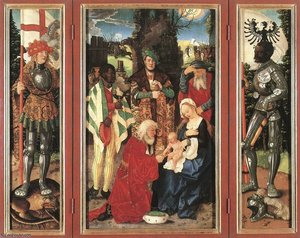
Aperçu en situation
 Envoyer
 Partager
 Détails de l'œuvre
 Guide
Guide

 Télécharger l'image
 Articles similaires
 Radiographie
 Diaporama
 Statistiques
Saint Jean à Patmos
 Huile sur panneau
- Renaissance nordique
 1515
1515- Renaissance
 75.0 x 87.0 cm
 Lire la suite
Reproduction à l'huile faite à la main
Huile sur toile peinte à la main, avec cadre et dimensions personnalisés, réalisée sur commande par nos artistes. ( Passer au format impression Passer au format numérique)




P118B €10

P118H €10

P118W €10

P438Z €10

P508JH €12

P508YH €12

P805H €10

P805Z €10

P919BZ €10

P919G €10

P919XJ €10

P959ZH €10

P968JZ €12

W106C €8

W218G €10

W218JH €8

W218Y €10

W307PJ €10

W316G €10

W316PJ €8

W316Y €10

W398PJ €8

W4111J €10

W500HY €15

W500JH €15

W692G €12

W849H €8

W940BG €15

W953PJ €8




Choisissez parmi nos formats prédéfinis qui respectent les proportions originales de l’œuvre.

Saisissez la largeur et la hauteur souhaitées, pour s'adapter à votre cadre ou à votre mur. Cette œuvre est peinte à la main ; ainsi, pour un format de forme différente, l'artiste peut peindre un peu plus autour du tableau ou réduire légèrement les bords — c'est vous qui choisissez. Nous vous envoyons une maquette numérique pour approbation avant que la peinture ne commence. L'image présentée sur cette page ne reflète pas le résultat réel — seule la maquette le fait.
Après la commande, l’équipe OriginalUniqueArt.com contactera le client par e-mail pour recueillir ses instructions et lui fournira une maquette d’aperçu
Livraison dans le monde entier () en 3 à 4 semaines au lieu des 5 semaines habituelles. (28 octobre). Aucun compromis sur la qualité.

Livraison express gratuite dans le monde entier

Toile de lin de qualité supérieure

Assurance transport complète

Garantie de remboursement des droits de douane

Garantie de fidélité des couleurs

Politique de retour de 100 jours (uniquement en cas de défaut)

Garantie de remboursement à 100%

Offre de tarifs dégressifs
 L'option verre n'est disponible que pour les dimensions inférieures à 110 cm.

Saint Jean à Patmos
Technique de reproduction
Format de la reproduction
-


Prix total
€ 264
Une vision de la révélation divine : Saint Jean à Patmos
Contempler la représentation de Saint Jean à Patmos par Hans Baldung, c'est s'immerger directement dans le creuset de l'inspiration divine. Cette huile sur bois magistrale, datant de 1515, transcende le simple portrait pour capturer un moment profond d'épiphanie spirituelle. La scène se déploie avec un poids de contemplation presque palpable alors que Saint Jean est assis sur son rocher, la tête nichée dans ses mains — une posture universelle de réflexion profonde et de réceptivité. Il est entouré par le récit sacré : Marie tenant tendrement l'enfant Jésus, sous la surveillance d'un ange céleste dont la présence suggère une sanction divine. La composition elle-même guide le regard à travers des strates de signification spirituelle, faisant de cette œuvre une pièce intensément captivante pour tout collectionneur ou admirateur de la spiritualité de la Renaissance.
La maîtrise de la technique de la Renaissance nordique
La prouesse technique de Baldung est immédiatement manifeste dès l'observation de cette œuvre. Son maniement de la peinture à l'huile permet un jeu époustouflant entre couleurs vibrantes et ombres profondes. L'artiste démontre une maîtrise remarquable de la lumière, qui semble émaner d'une source dorée invisible, illuminant les figures et les objets avec une grâce éthérée. Bien qu'ancré dans la riche tradition du détail de la Renaissance nordique — gage d'un savoir-faire méticuleux — Baldung y insuffle une tension dramatique qui laisse deviner ses influences gothiques. On peut presque ressentir la texture du bois sous la peinture, appréciant les détails complexes, des plis des draperies à la présence subtile d'un oiseau perché près de la base, le tout rendu avec un soin acharné.
Symbolisme et profondeur spirituelle
Le symbolisme tissé tout au long de Saint Jean à Patmos est riche et multidimensionnel. Au cœur du récit se trouve le livre placé près du centre de la composition ; cet objet sert de symbole puissant de la parole divine, des révél'ations qui contraignent Saint Jean à consigner ce qu'il a vu. La présence de la Vierge et l'Enfant ancre la scène dans la théologie chrétienne, tandis que les figures environnantes agissent comme témoins de cette transmission sacrée du savoir. C'est une méditation sur l'acte d'écrire, la révélation et la capacité humaine à recevoir une vérité profonde — une résonance qui traverse les siècles.
Une résonance émotionnelle pour les espaces modernes
Pour ceux qui recherchent une œuvre d'art qui ne se contente pas de décorer mais qui élève un espace, ce tableau offre une profondeur émotionnelle inégalée. Son atmosphère à la fois dramatique et sereine en fait un point focal saisissant, qu'il orne les murs d'un cabinet d'étude érudit ou ceux d'un salon élégamment aménagé. Le mélange de drame spirituel intense et de naturalisme méticuleux garantit que Saint Jean à Patmos demeure à la fois historiquement significatif et viscéralement émouvant. Posséder une reproduction permet de se connecter intimement au génie de Hans Baldung, en ramenant chez soi une pièce imprégnée de la ferveur dramatique et de la profonde contemplation du début du XVIe siècle.
Questions et réponses
Quelle intensité lumineuse les couleurs de "Saint Jean à Patmos" semblent-elles refléter ?
La luminance enregistrée pour «Saint Jean à Patmos» de Hans Baldung Grien est de Luminosité douce.
Peut-on visionner un diaporama de «Saint Jean à Patmos» de Hans Baldung Grien ?
Un diaporama est disponible : la page Diaporama de «Saint Jean à Patmos» de Hans Baldung Grien.
Qui est l'auteur de « Saint Jean à Patmos » et en quelle année a-t-elle été créée ?
Hans Baldung Grien a réalisé « Saint Jean à Patmos » en 1515.
Biographie de l'artiste
A Swabian Enigma: The Life and Early Influences of Hans Baldung Grien
Hans Baldung—forever distinguished as Hans Baldung Grien due to his predilection for wearing green attire—emerged from an unexpectedly scholarly lineage. Born around 1485 in the Free Imperial City of Schwäbisch Gmünd, nestled within the rolling hills of Bavaria, Germany, he was the son of Johann Baldung, a university-educated jurist who held the office of legal adviser to the Bishopric of Strasbourg, Albert of Bavaria, from 1492, and Margarethe Herlin, daughter of Arbogast Herlin. His uncle, Hieronymus Baldung, was a doctor in medicine, with a son, Pius Hieronymus, cousin of Hans, who taught law at Freiburgand became chancellor of Tyrol in 1527. The family resided in Strasbourg. He was the first male in his family to not attend university, but he was one of the earliest German artists to come from an academic family. His formative years were marked by exposure to humanist ideals and intellectual currents that shaped his worldview—a characteristic that permeated his entire oeuvre. He received his initial artistic training around 1500 in the Upper Rhineland with an artist from Strasbourg, laying the groundwork for his technical skills before he sought out more prominent masters to hone his craft. This early period instilled within him a foundation of draftsmanship and composition, preparing him for the rigorous artistic environment that awaited him in Nuremberg.Under Dürer’s Wing and Forging an Individual Style
The pivotal moment in Baldung’s development arrived in 1503 when he became an assistant in Albrecht Dürer’s workshop in Nürnberg, where he perfected his art between 1503 and 1507. This period proved profoundly formative, exposing him to the meticulous detail, intellectual rigor, and innovative printmaking techniques that defined Dürer’s style. The two artists developed a close relationship; Baldung even managed Dürer’s workshop during his master’s sojourn to Venice. However, while deeply influenced by Dürer—evident in early works showcasing precise draftsmanship and Northern realism—Baldung quickly began to forge his own artistic identity. He absorbed the lessons of the Renaissance masters but infused them with a uniquely German sensibility, characterized by expressive color, imaginative compositions, and an increasingly unsettling psychological depth. This divergence from Dürer’s more classical approach would become a hallmark of Baldung’s mature style. His time in Venice, overseeing Dürer’s affairs, also exposed him to the burgeoning Italian Renaissance art scene, broadening his artistic horizons and subtly influencing his palette and compositional choices. He returned from Italy with a heightened sense of color and a willingness to experiment with spatial arrangements that set him apart from his contemporaries.A Master of Many Mediums: Themes and Techniques
Hans Baldung Grien was an artist of remarkable versatility, proficient in painting, printmaking—particularly woodcuts and engravings—drawing, tapestry design, and even stained glass work. His paintings often feature small-scale works brimming with puzzling allegories and mythological narratives, rendered with a vibrant palette and a distinctive sense of spatial ambiguity. He excelled at portraiture, capturing the likenesses of his patrons with both realism and psychological insight. However, it is perhaps for his woodcuts that Baldung is most widely recognized today. These prints are characterized by their dramatic compositions, intricate detail, and often macabre subject matter. A recurring theme throughout his work is a fascination with witchcraft, death, and the supernatural—a reflection of the anxieties and beliefs prevalent in 16th-century Germany. His depictions of witches are particularly striking, portraying them not as stereotypical hags but as complex, even alluring figures, embodying both fear and fascination. He exploited the medium’s capacity for stark contrasts and intricate detail to create images that were both visually arresting and psychologically unsettling. ## Reformation Currents and Lasting Legacy Baldung’s career unfolded during a period of immense religious and political upheaval, marked by the rise of the Protestant Reformation. While not overtly aligned with any particular faction, his work often reflects the changing spiritual landscape of Germany. His monumental high altar for the city of Münster, completed in 1531, is a testament to this engagement, showcasing support for the reformation movement through its iconography and stylistic choices. He died in Strasbourg in September 1545, leaving behind a body of work that continues to captivate and intrigue viewers today. His influence can be seen in the works of later German artists, and his unique blend of Renaissance technique, Northern expressionism, and allegorical complexity secures his place as a significant figure in art history. He remains an artist whose work invites contemplation, challenging us to confront the darker aspects of human nature and the mysteries of the unseen world.
Hans Baldung Grien
1485 - 1545 , Allemagne
L'essentiel de l'artiste
- Artistic Movement Or Style: Renaissance, Mannerism
- Artists Who Influenced This Artist: ['Albrecht Dürer']
- Date Of Birth: c. 1485
- Full Name: Hans Baldung Grien
- Nationality: German
- Notable Artworks:
- Bewitched Groom
- Allegory of Death & Beauty
- Place Of Birth: Schwäbisch Gmünd, Germany
Articles connexes
Hans Baldung Grien: A Renaissance Master of Allegory, Innovation & the Grotesque
Explore the captivating world of Hans Baldung Grien, a Renaissance master renowned for his allegorical paintings, striking woodcuts & unique depictions of mythology and the grotesque. Discover his life, works & legacy with OriginalUniqueArt.

John Singer Sargent : Les 25 Œuvres Maîtresses d'un Portraitiste Éminent | OriginalUniqueArt
Plongez dans l'univers de John Singer Sargent : découvrez les 25 œuvres qui ont marqué l'histoire de l'art. Portraits impressionnants, réalisme exquis et couleurs vibrantes. Retrouvez ces chefs-d'œuvre en reproduction haute définition sur OriginalUniqueArt.com.

Giclée Prints: Archival Quality & Aesthetic Nuances for the Discerning Collector
Explore the world of giclée prints with OriginalUniqueArt. Learn about archival quality, aesthetic nuances & investment potential. Expert guidance for discerning art collectors seeking museum-quality reproductions and lasting value.

Constable : Les 25 Chefs-d'Œuvre du Maître Anglais | OriginalUniqueArt
Plongez dans l'univers de John Constable avec les 25 œuvres incontournables du maître anglais. Découvrez l'histoire, la technique et l'émotion derrière ses paysages romantiques. Reproductions de qualité muséale sur OriginalUniqueArt.com.

The Enduring Legacy of Fine Art Prints: Technique, History & Aesthetic Impact
Explore the rich history & techniques of fine art prints. Discover investment potential, assess authenticity, and learn how to preserve your collection with expert guidance. Trusted insights for discerning collectors.