 Aperçu en situation
 Envoyer
 Partager
 Détails de l'œuvre

 Télécharger
 Articles similaires
 Radiographie
 Diaporama
The Prodigal Son
 Oil On Canvas
- WallArt
- Symbolist Painting
 1890
1890- 19th Century
 115.0 x 200.0 cm
 Lire la suite
Reproduction à l'huile faite à la main
Huile sur toile peinte à la main, avec cadre et dimensions personnalisés, réalisée sur commande par nos artistes. ( Commander l'impression Acheter l'image haute résolution)




P118B $10

P118H $10

P118W $10

P438Z $10

P508JH $12

P508YH $12

P805H $10

P805Z $10

P919BZ $10

P919G $10

P919XJ $10

P959ZH $10

P968JZ $12

W106C $8

W218G $10

W218JH $8

W218Y $10

W307PJ $10

W316G $10

W316PJ $8

W316Y $10

W398PJ $8

W4111J $10

W500HY $15

W500JH $15

W692G $12

W849H $8

W940BG $15

W953PJ $8




Choisissez parmi nos formats prédéfinis qui respectent les proportions originales de l’œuvre.

Vous pouvez saisir vos propres dimensions pour l'adapter à un cadre ou à un espace spécifique. Si la taille sélectionnée ne correspond pas aux proportions de l'image d'origine, nous recadrerons l'œuvre ou prolongerons la peinture avec des éléments peints à la main supplémentaires. Une maquette numérique vous sera envoyée pour approbation avant le début de la production.
Veuillez noter que l'aperçu à l'écran ne reflète pas le recadrage ou l'extension réels. Seule la maquette montrera fidèlement la composition finale.
Bien que des tailles personnalisées soient disponibles, nous vous recommandons de sélectionner une dimension dans la liste prédéfinie afin de préserver les proportions d'origine.
Après la commande, l’équipe OriginalUniqueArt.com contactera le client par e-mail pour recueillir ses instructions et lui fournira une maquette d’aperçu
Livraison dans le monde entier () en 3 à 4 semaines au lieu des 5 semaines habituelles. (30 août). Aucun compromis sur la qualité.

Livraison express gratuite dans le monde entier

Toile de lin de qualité supérieure

Assurance transport complète

Garantie de remboursement des droits de douane

Garantie de fidélité des couleurs

Politique de retour de 60 jours (uniquement en cas de défaut)

Garantie de remboursement à 100%

Offre de tarifs dégressifs
 L'option verre n'est disponible que pour les dimensions inférieures à 110 cm.

The Prodigal Son
Technique de reproduction
Format de la reproduction
-


Prix total
$ 300
A Visionary Descent into Symbolism
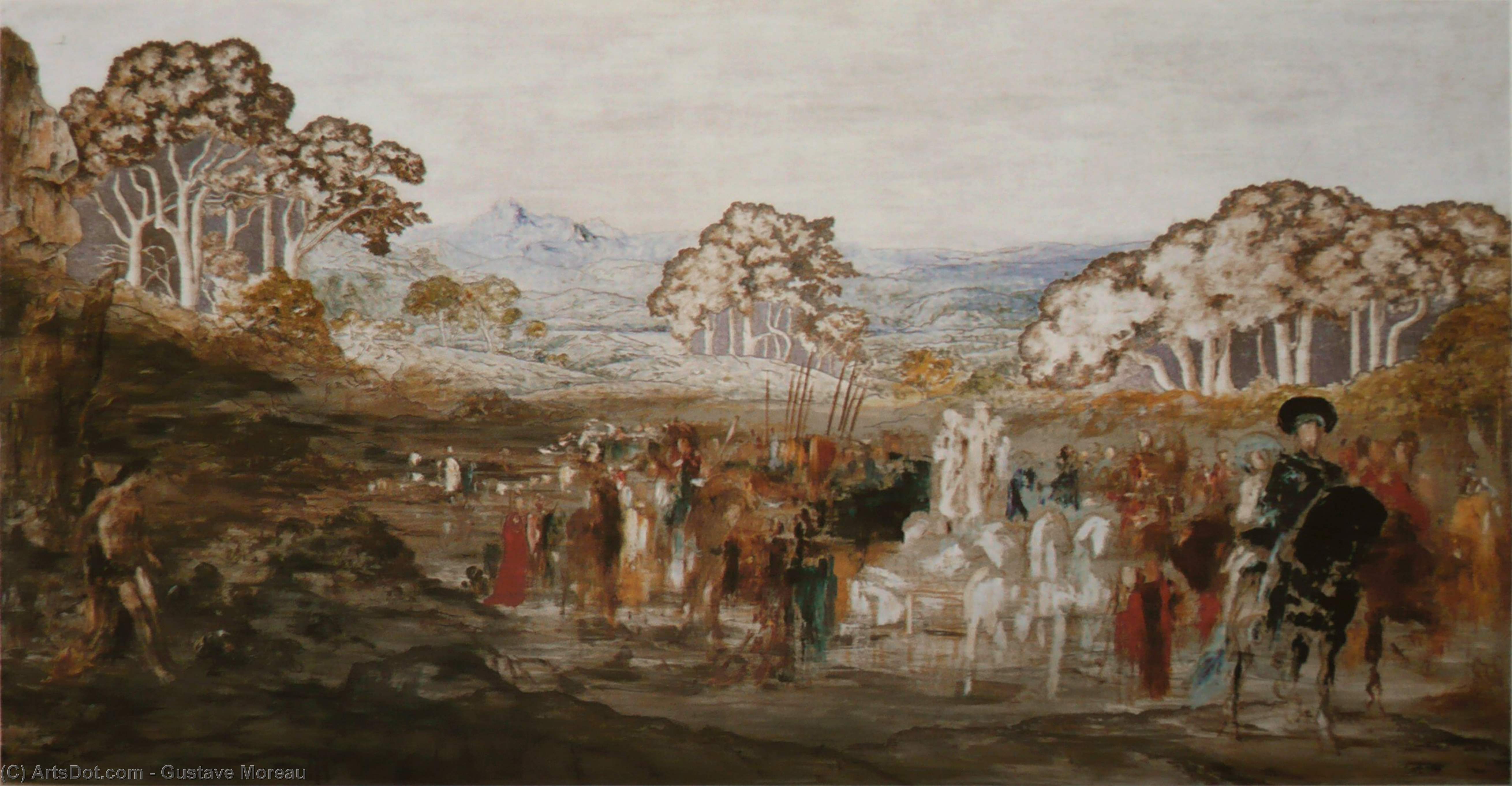
To gaze upon Gustave Moreau’s “The Prodigal Son” is to step beyond the veil of the visible world and enter a realm where the boundaries between reality and dream dissolve. Created around 1890, this masterpiece serves as a profound testament to the Symbolist movement, a period defined by an inward turn toward the mysteries of the human psyche. Moreau, often hailed as the "painter par excellence" of Symbolism, does not merely recount the biblical parable of the wayward son; he reimagines it as a haunting, psychological odyssey. The painting captures that pivotal moment of transition—the heavy weight of repentance meeting the ethereal promise of forgiveness. For the discerning collector or interior designer, this work offers more than just visual splendor; it provides a window into the spiritual anxieties and profound emotional depths that characterized the late 19th-century artistic consciousness.
The composition is a dynamic tapestry of movement and narrative tension. Within the frame, we encounter a scene teeming with life yet shrouded in an enigmatic atmosphere. A man, perhaps the son himself, is depicted in a suit atop a horse, navigating a landscape populated by a diverse assembly of figures and animals. The presence of horses and donkeys, scattered from the immediate foreground to the distant periphery, lends a sense of bustling, unfolding history to the piece. This orchestrated chaos is not random but serves to ground the allegorical weight of the story in a palpable, breathing world. The interplay between the central figures and the surrounding activity creates a rhythmic energy that draws the eye through the canvas, making the viewer an active participant in this unfolding drama of redemption.
The Alchemy of Technique and Light
Moreau’s technical mastery is evident in the luminous, almost otherworldly texture of the work. Eschewing the fleeting, light-drenched impressions of his contemporaries, Moreau utilized a more deliberate and layered approach to achieve a sense of permanence and depth. The palette is masterfully restrained, dominated by earthy, evocative tones—ochre, umber, and ivory—which coalesce to create a dreamlike, sepia-toned atmosphere. Through the careful application of oil on canvas, he achieves a remarkable luminosity, where light does not simply strike the surface but seems to emanate from within the layers themselves. This technique imbues the figures with a sculptural presence, making the textures of fabric and the musculature of the animals feel both tactile and transcendent.
For those seeking to integrate such a profound piece into a curated space, the aesthetic versatility of "The Prodigal Son" is remarkable. The muted, sophisticated color scheme allows it to serve as a soulful anchor in a room, providing a sense of historical gravity and intellectual depth. Whether placed in a contemporary gallery setting or a classic, richly textured study, the painting’s ability to command attention through subtle nuance rather than garish color makes it an exquisite choice for high-end decor. It is a work that rewards long, contemplative stares, offering new layers of detail and emotional resonance with every encounter.
A Legacy of Spiritual Resonance
Beyond its formal beauty, the true power of Moreau’s work lies in its symbolic polyvalence. As a pioneer of Symbolism, Moreau sought to express truths that words often fail to capture. In "The Prodigly Son," the physical journey of the returning traveler becomes an allegory for the soul's return to grace. Every element—from the starkness of the landscape to the weary posture of the figures—contributes to a larger meditation on morality, faith, and the enduring power of familial love. It is a painting that speaks to the universal human experience of loss and recovery, making it eternally relevant.
Owning a high-quality reproduction of this masterpiece allows one to bring this sense of spiritual inquiry into the modern home. It is an invitation to reflect, to dream, and to find beauty in the complexities of the human condition. For the art lover, it is a piece of history; for the designer, it is a cornerstone of atmosphere; and for the soul, it is a profound encounter with the sublime.
Biographie de l'artiste
**Jeunesse et Éducation**
Gustave Moreau, artiste français, est né le 6 avril 1826 à Paris. Il a reçu une formation académique traditionnelle en peinture à l’École des Beaux-Arts, démontrant un talent pour le dessin dès son plus jeune âge.**Le Mouvement Symboliste**
L'œuvre de Moreau, caractérisée par des sujets allégoriques et mythologiques, l'a positionné comme un peintre symboliste de premier plan, en particulier dans les années 1890. Son art (et le symbolisme en général) a connu une période de déclin mais a été réévalué depuis les années 1960, Moreau étant désormais considéré comme l’un des peintres symbolistes les plus importants.**Œuvres Notables et Expositions**
* Salomé dans la prison (peinture de 'Gustave Moreau') est un exemple notable de son œuvre, mettant en valeur sa maîtrise du symbolisme. * Autoportrait (peinture de 'Gustave Moreau') est une autre représentation puissante de l’artiste lui-même.**Musée Gustave Moreau**
Le Musée National Gustave-Moreau (Musée Gustave Moreau Paris, France) à Paris est dédié à l’œuvre de Moreau, abritant plus de 1 200 peintures, aquarelles et dessins. Le musée témoigne de son héritage artistique.**Héritage et Influence**
L'influence de Moreau sur le mouvement symboliste est indéniable. Il a enseigné à l’École des Beaux-Arts, influençant des artistes notables tels que Henri Matisse et Georges Rouault. Sa nature recluse n'a pas diminué son impact sur le monde de l’art.- Découvrez plus d'informations sur la vie et l'œuvre de Gustave Moreau sur OriginalUniqueArt.com
- Explorez le Musée National Gustave-Moreau et sa collection impressionnante d'œuvres d’art sur Musée Gustave Moreau Paris, France
- Apprenez-en davantage sur le mouvement symboliste et son importance dans l'histoire de l'art sur le mouvement symboliste

Gustave Moreau
1826 - 1898 , France
L'essentiel de l'artiste
- Artistes Influents:
- Eugène Delacroix
- Michelangelo
- Leonard de Vinci
- Date De Décès: 1898
- Date De Naissance: 6 avril 1826
- Influence Sur Les Artistes:
- Henri Matisse
- Georges Rouault
- Lieu De Naissance: Paris, France
- Mouvement Artistique: Symbolisme
- Nationalité: Française
- Nom Complet: Gustave Moreau
- Oeuvres Notables:
- Salomé dans la prison
- Autoportrait
- Jupiter et Sémélé
- Orphée
- L'Apparition
Articles connexes
Gustave Klimt : Les 25 Œuvres Maîtresses d'un Artiste Symboliste Incontournable | OriginalUniqueArt
Plongez dans l'univers fascinant de Gustave Klimt ! Découvrez les 25 œuvres majeures du maître symboliste : Le Baiser, Judith et bien d'autres. Inspirez votre décoration intérieure avec OriginalUniqueArt.com et trouvez la reproduction parfaite.
Gustave Moreau: Symbolism's Enigmatic Visionary & Precursors of Modern Fantasy Art
Explore the captivating world of Gustave Moreau, the leading Symbolist painter. Discover his iconic masterpieces, influences, and lasting legacy. Expert analysis for collectors & art enthusiasts.
The Noble Steed on Canvas: A Historical & Artistic Exploration of Horse Painting Across Cultures
Explore the rich history of horse painting! Discover masterpieces from Stubbs to Munnings & learn about symbolism, techniques & artists. Find museum-quality reproductions at OriginalUniqueArt.
Echoes of Olympus: Mythological Narratives in Western Art Through the Ages
Explore the captivating history of mythological narratives in Western art! From ancient Greece to modern masterpieces, discover iconic artworks & symbolism. Expert analysis and high-quality reproductions at OriginalUniqueArt.

The Equine Muse: A Historical & Artistic Exploration of Horses in Painting
Explore the captivating history of horses in painting! Discover Renaissance masterpieces, Baroque grandeur & expert insights for collecting equestrian art. Learn about symbolism, techniques & lasting value with OriginalUniqueArt.