Aperçu en situation
 Envoyer
 Partager
 Détails de l'œuvre

 Télécharger
 Articles similaires
 Radiographie
 Diaporama
Le Bon Samaritain


 Lire la suite
Reproduction à l'huile faite à la main
Huile sur toile peinte à la main, avec cadre et dimensions personnalisés, réalisée sur commande par nos artistes. ( Commander l'impression Télécharger l'image haute résolution)




P118B $10

P118H $10

P118W $10

P438Z $10

P508JH $12

P508YH $12

P805H $10

P805Z $10

P919BZ $10

P919G $10

P919XJ $10

P959ZH $10

P968JZ $12

W106C $8

W218G $10

W218JH $8

W218Y $10

W307PJ $10

W316G $10

W316PJ $8

W316Y $10

W398PJ $8

W4111J $10

W500HY $15

W500JH $15

W692G $12

W849H $8

W940BG $15

W953PJ $8




Choisissez parmi nos formats prédéfinis qui respectent les proportions originales de l’œuvre.

Vous pouvez saisir vos propres dimensions pour l'adapter à un cadre ou à un espace spécifique. Si la taille sélectionnée ne correspond pas aux proportions de l'image d'origine, nous recadrerons l'œuvre ou prolongerons la peinture avec des éléments peints à la main supplémentaires. Une maquette numérique vous sera envoyée pour approbation avant le début de la production.
Veuillez noter que l'aperçu à l'écran ne reflète pas le recadrage ou l'extension réels. Seule la maquette montrera fidèlement la composition finale.
Bien que des tailles personnalisées soient disponibles, nous vous recommandons de sélectionner une dimension dans la liste prédéfinie afin de préserver les proportions d'origine.
Après la commande, l’équipe OriginalUniqueArt.com contactera le client par e-mail pour recueillir ses instructions et lui fournira une maquette d’aperçu
Livraison dans le monde entier () en 3 à 4 semaines au lieu des 5 semaines habituelles. (21 août). Aucun compromis sur la qualité.

Livraison express gratuite dans le monde entier

Toile de lin de qualité supérieure

Assurance transport complète

Garantie de remboursement des droits de douane

Garantie de fidélité des couleurs

Politique de retour de 60 jours (uniquement en cas de défaut)

Garantie de remboursement à 100%

Offre de tarifs dégressifs
 L'option verre n'est disponible que pour les dimensions inférieures à 110 cm.

Le Bon Samaritain
Technique de reproduction
Format de la reproduction
-


Prix total
$ 300
Description de l'œuvre
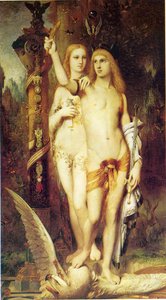
A Vision of Compassion: Exploring Gustave Moreau’s *Le Bon Samaritain*
Gustave Moreau's Le Bon Samaritain (The Good Samaritan) is not merely a depiction of a biblical scene; it’s an immersion into the artist’s intensely personal and profoundly symbolic world. Painted during his most productive period, this work exemplifies Moreau’s unique contribution to the Symbolist movement – a rejection of objective representation in favor of exploring the depths of human emotion, mythic narratives, and spiritual yearning. The painting, rendered in stark black and white, immediately draws the viewer into its dramatic landscape, dominated by imposing mountains that suggest both physical challenge and the vastness of the unknown.
- Subject Matter: The scene faithfully portrays the familiar parable of the Good Samaritan, a cornerstone of Christian morality. However, Moreau doesn’t present this story as a straightforward moral lesson.
- Composition: The central figure on horseback dominates the canvas, his posture conveying both determination and perhaps a weary burden. The two dogs, integral to the narrative, add an element of primal instinct and loyalty to the composition.
- Landscape: The mountainous backdrop isn’t simply a setting; it's a powerful symbol representing obstacles, trials, and the arduous journey of life itself.
The Symbolist Aesthetic: More Than Just Representation
Moreau was profoundly influenced by Romanticism and Pre-Raphaelitism, but he pushed beyond mere imitation. He sought to evoke moods and ideas rather than create photographic copies of reality. This is evident in his meticulous attention to detail – the texture of the horse’s coat, the folds of the man's clothing, the ruggedness of the terrain – all contribute to a heightened sense of atmosphere and emotional intensity. Moreau’s technique involved layering thin glazes of oil paint, building up depth and luminosity that is characteristic of his style. The monochrome palette amplifies this effect, focusing attention on form and texture rather than color.
- Color & Tone: The absence of color intensifies the drama and allows Moreau to explore the interplay of light and shadow with remarkable precision.
- Brushwork: Noticeable in areas such as the mountains, is a deliberate, almost sculptural brushstroke that adds to the painting's monumental quality.
Symbolism and Spiritual Yearning
Moreau’s *Le Bon Samaritain* resonates with broader Symbolist themes – the exploration of the unconscious, the power of dreams, and the search for spiritual truth. The Good Samaritan himself can be interpreted as a representation of compassion, selflessness, and the potential for redemption. The landscape, with its towering peaks, suggests a quest—a journey towards enlightenment or salvation. The inclusion of the dogs adds another layer of interpretation, perhaps representing instinctual goodness or loyalty. Moreau’s work reflects a deep engagement with religious iconography, particularly Byzantine art, which he studied extensively and incorporated into his visual vocabulary.
- Mythological Allusions: The painting subtly evokes imagery reminiscent of medieval illuminated manuscripts and the symbolic language of Christian art.
- Emotional Impact: The work’s power lies in its ability to evoke a sense of empathy, contemplation, and perhaps even a touch of melancholy – prompting viewers to consider their own roles as potential “Good Samaritans” in the world.
A Timeless Masterpiece
Gustave Moreau's *Le Bon Samaritain* stands as a testament to his artistic vision and his profound understanding of human emotion. This meticulously crafted reproduction captures the essence of the original, offering an opportunity to experience the power and beauty of Symbolist painting firsthand. Whether adorning a grand salon or a smaller interior space, this artwork will undoubtedly spark conversation and inspire reflection.
Biographie de l'artiste
**Jeunesse et Éducation**
Gustave Moreau, artiste français, est né le 6 avril 1826 à Paris. Il a reçu une formation académique traditionnelle en peinture à l’École des Beaux-Arts, démontrant un talent pour le dessin dès son plus jeune âge.**Le Mouvement Symboliste**
L'œuvre de Moreau, caractérisée par des sujets allégoriques et mythologiques, l'a positionné comme un peintre symboliste de premier plan, en particulier dans les années 1890. Son art (et le symbolisme en général) a connu une période de déclin mais a été réévalué depuis les années 1960, Moreau étant désormais considéré comme l’un des peintres symbolistes les plus importants.**Œuvres Notables et Expositions**
* Salomé dans la prison (peinture de 'Gustave Moreau') est un exemple notable de son œuvre, mettant en valeur sa maîtrise du symbolisme. * Autoportrait (peinture de 'Gustave Moreau') est une autre représentation puissante de l’artiste lui-même.**Musée Gustave Moreau**
Le Musée National Gustave-Moreau (Musée Gustave Moreau Paris, France) à Paris est dédié à l’œuvre de Moreau, abritant plus de 1 200 peintures, aquarelles et dessins. Le musée témoigne de son héritage artistique.**Héritage et Influence**
L'influence de Moreau sur le mouvement symboliste est indéniable. Il a enseigné à l’École des Beaux-Arts, influençant des artistes notables tels que Henri Matisse et Georges Rouault. Sa nature recluse n'a pas diminué son impact sur le monde de l’art.- Découvrez plus d'informations sur la vie et l'œuvre de Gustave Moreau sur OriginalUniqueArt.com
- Explorez le Musée National Gustave-Moreau et sa collection impressionnante d'œuvres d’art sur Musée Gustave Moreau Paris, France
- Apprenez-en davantage sur le mouvement symboliste et son importance dans l'histoire de l'art sur le mouvement symboliste

Gustave Moreau
1826 - 1898 , France
L'essentiel de l'artiste
- Artistes Influents:
- Eugène Delacroix
- Michelangelo
- Leonard de Vinci
- Date De Décès: 1898
- Date De Naissance: 6 avril 1826
- Influence Sur Les Artistes:
- Henri Matisse
- Georges Rouault
- Lieu De Naissance: Paris, France
- Mouvement Artistique: Symbolisme
- Nationalité: Française
- Nom Complet: Gustave Moreau
- Oeuvres Notables:
- Salomé dans la prison
- Autoportrait
- Jupiter et Sémélé
- Orphée
- L'Apparition
Articles connexes

Les 10 Chefs-d'œuvre Noirs : Peintures Célèbres et Décoration d'Intérieur
Plongez dans l'univers fascinant des 10 plus beaux tableaux noirs de l'histoire de l'art. Découvrez les secrets de Goya, Manet, Rothko et autres maîtres. Inspirez votre décoration intérieure avec !
Gustave Moreau: Symbolism's Enigmatic Visionary & Precursors of Modern Fantasy Art
Explore the captivating world of Gustave Moreau, the leading Symbolist painter. Discover his iconic masterpieces, influences, and lasting legacy. Expert analysis for collectors & art enthusiasts.
Les 10 Chefs-d'œuvre Dominés par le Noir : Art, Histoire & Décoration
Plongez dans l'univers fascinant des 10 plus beaux tableaux dominés par le noir. Découvrez les histoires, techniques et symbolisme de chefs-d'œuvre intemporels. Reproductions d'art de qualité musée sur !

Beyond Reality: A Definitive Guide to the Dreamlike World of Symbolist Painting
Explore the evocative world of Symbolist painting. Discover how masters like Gustave Moreau rejected realism to capture dreams, myths, and the subconscious through fine art history and expert analysis.
Beyond Reality: The Dreamlike Magic and Ethereal Visions of Symbolist Painting
Explore the ethereal beauty of Symbolist painting. Discover how masters like Gustave Moreau used myth and dreamlike imagery to transcend reality. A deep dive into the soulful movement that redefined art history through mystery, emotion, and the unseen.