Aperçu en situation
 Partager
 Partager
 Détails

 Télécharger
 Articles similaires
 Radiographie
 Voir le diaporama
 Statistiques
Ibis


 Afficher la suite
Giclées et impressions d'art
Impressions giclées ou sur toile de qualité musée, avec une production rapide et des finitions au choix. ( Acheter la peinture faite à la main Passer au format image numérique)




P118B $10

P118H $10

P118W $10

P438Z $10

P508JH $12

P508YH $12

P805H $10

P805Z $10

P919BZ $10

P919G $10

P919XJ $10

P959ZH $10

P968JZ $12

W106C $8

W218G $10

W218JH $8

W218Y $10

W307PJ $10

W316G $10

W316PJ $8

W316Y $10

W398PJ $8

W4111J $10

W500HY $15

W500JH $15

W692G $12

W849H $8

W940BG $15

W953PJ $8




Choisissez parmi nos formats prédéfinis qui respectent les proportions originales de l’œuvre.

Vous pouvez saisir vos propres dimensions pour vous adapter à un cadre ou à un espace spécifique. Si la taille sélectionnée ne correspond pas aux proportions de l'image originale, nous recadrerons l'œuvre ou étendrons l'image avec une bordure en miroir ou une couleur unie. Une maquette numérique vous sera envoyée pour approbation avant le début de la production.
Veuillez noter que l'aperçu à l'écran ne reflète pas le recadrage ou l'extension réelle. Seule la maquette montrera avec précision la composition finale.
Bien que des tailles personnalisées soient disponibles, nous vous recommandons de choisir une dimension dans la liste prédéfinie afin de préserver les proportions originales.
Livraison dans le monde entier () en 2 semaines au lieu des 4/5 semaines habituelles. (12 septembre)

Livraison express gratuite dans le monde entier

Toile de lin de haute qualité

Assurance transport complète

Garantie de remboursement des droits de douane

Garantie de fidélité des couleurs

Garantie de retour de 100 jours (uniquement en cas de défaut)

Garantie de remboursement à 100%

Tarifs dégressifs sur quantité
 L'option verre n'est disponible que pour les dimensions inférieures à 110 cm.

Ibis
Giclées et impressions d'art
Format de la reproduction
-


Prix total final
$ 80
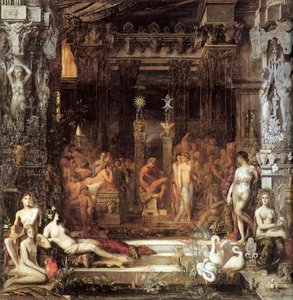
Gustave Moreau’s Ibis: A Dreamscape of Myth and Symbol
Gustave Moreau's "Ibis," painted in 1876, isn’t merely a depiction of a bird; it’s an immersion into a richly layered world of symbolism, myth, and the artist’s intensely personal vision. This captivating work, rendered in stark black and white – a deliberate choice that amplifies its dreamlike quality – embodies the core tenets of Symbolism, a movement Moreau helped define. Rather than striving for photographic realism or objective representation, Moreau sought to evoke emotions and ideas through carefully constructed forms, evocative colors (though here presented in monochrome), and allusions to ancient lore. The painting’s power lies not just in its subject matter but in the atmosphere of mystery and contemplation it generates.
Moreau's artistic journey was profoundly shaped by his upbringing within a cultured Parisian family steeped in intellectual pursuits. His father, an architect and archivist, instilled in him a deep appreciation for history, mythology, and the arts. This foundation, combined with rigorous training at the École des Beaux-Arts, provided Moreau with a solid technical base while simultaneously fueling his desire to move beyond traditional academic constraints. He was particularly drawn to the works of Dante, Ovid, and other classical authors, whose narratives offered fertile ground for symbolic exploration. The Ibis itself becomes a conduit for these ancient stories – a creature often associated with Osiris in Egyptian mythology, representing resurrection and rebirth.
The Anatomy of Symbolism: Form and Composition
Examining the painting’s composition reveals Moreau's deliberate manipulation of form to convey meaning. The ibis stands prominently on the ground, its long legs suggesting both a groundedness and an upward reach – a visual representation of striving for spiritual enlightenment. Its large beak, sharply defined against the muted background, directs our gaze, drawing us into the bird’s enigmatic presence. The artist's use of dots across the body creates a textured surface, adding to the painting’s tactile quality and hinting at the complexities hidden beneath its seemingly simple form. The monochromatic palette – predominantly orange with white accents – contributes significantly to the work’s mood, lending it an ethereal, almost otherworldly appearance. It is reminiscent of late-medieval illuminated manuscripts or the detailed drawings found in alchemical texts.
Moreau's technique is characterized by meticulous detail and a masterful command of line. He employs a precise, linear style, reminiscent of Japanese woodblock prints, to create a sense of stillness and contemplation. The sharp edges and carefully rendered feathers contrast with the softer, more diffused background, further emphasizing the ibis’s central importance within the composition. The painting's surface is not merely decorative; it’s imbued with symbolic weight, each element contributing to the overall narrative.
Mythological Echoes and Personal Resonance
Beyond its formal qualities, "Ibis" resonates deeply with themes prevalent in Moreau’s oeuvre – particularly those relating to mythology, religion, and the human psyche. The ibis, as a symbol of resurrection and transformation, connects directly to ancient Egyptian beliefs about death and rebirth. Moreau frequently explored these themes in his paintings, often depicting figures from classical mythology or biblical narratives within dreamlike landscapes. This painting can be interpreted as an allegory for the artist’s own personal journey – a quest for spiritual understanding amidst the complexities of life.
Interestingly, Moreau's fascination with symbolism extended beyond traditional mythological sources. He drew inspiration from a wide range of influences, including Japanese art, medieval manuscripts, and even alchemical texts. This eclectic approach resulted in a highly individualistic style that defied easy categorization. The painting’s ambiguity invites viewers to project their own interpretations onto the scene, fostering a sense of personal engagement with the artwork.
A Timeless Masterpiece: Reproduction and Beyond
"Ibis" by Gustave Moreau is more than just a beautiful image; it's a window into the mind of a visionary artist. OriginalUniqueArt offers meticulously crafted hand-painted reproductions that capture the essence of this iconic work, allowing you to experience its power and beauty firsthand. Our skilled artists faithfully recreate Moreau’s intricate details, color palette, and atmospheric mood, ensuring that your reproduction is a true testament to the original masterpiece. Whether displayed in a gallery, a study, or a cherished home space, this stunning artwork will undoubtedly spark conversation and inspire contemplation for years to come.
Biographie de l'artiste
**Jeunesse et Éducation**
Gustave Moreau, artiste français, est né le 6 avril 1826 à Paris. Il a reçu une formation académique traditionnelle en peinture à l’École des Beaux-Arts, démontrant un talent pour le dessin dès son plus jeune âge.**Le Mouvement Symboliste**
L'œuvre de Moreau, caractérisée par des sujets allégoriques et mythologiques, l'a positionné comme un peintre symboliste de premier plan, en particulier dans les années 1890. Son art (et le symbolisme en général) a connu une période de déclin mais a été réévalué depuis les années 1960, Moreau étant désormais considéré comme l’un des peintres symbolistes les plus importants.**Œuvres Notables et Expositions**
* Salomé dans la prison (peinture de 'Gustave Moreau') est un exemple notable de son œuvre, mettant en valeur sa maîtrise du symbolisme. * Autoportrait (peinture de 'Gustave Moreau') est une autre représentation puissante de l’artiste lui-même.**Musée Gustave Moreau**
Le Musée National Gustave-Moreau (Musée Gustave Moreau Paris, France) à Paris est dédié à l’œuvre de Moreau, abritant plus de 1 200 peintures, aquarelles et dessins. Le musée témoigne de son héritage artistique.**Héritage et Influence**
L'influence de Moreau sur le mouvement symboliste est indéniable. Il a enseigné à l’École des Beaux-Arts, influençant des artistes notables tels que Henri Matisse et Georges Rouault. Sa nature recluse n'a pas diminué son impact sur le monde de l’art.- Découvrez plus d'informations sur la vie et l'œuvre de Gustave Moreau sur OriginalUniqueArt.com
- Explorez le Musée National Gustave-Moreau et sa collection impressionnante d'œuvres d’art sur Musée Gustave Moreau Paris, France
- Apprenez-en davantage sur le mouvement symboliste et son importance dans l'histoire de l'art sur le mouvement symboliste

Gustave Moreau
1826 - 1898 , France
En bref
- Artistes Influents:
- Eugène Delacroix
- Michelangelo
- Leonard de Vinci
- Date De Décès: 1898
- Date De Naissance: 6 avril 1826
- Influence Sur Les Artistes:
- Henri Matisse
- Georges Rouault
- Lieu De Naissance: Paris, France
- Mouvement Artistique: Symbolisme
- Nationalité: Française
- Nom Complet: Gustave Moreau
- Oeuvres Notables:
- Salomé dans la prison
- Autoportrait
- Jupiter et Sémélé
- Orphée
- L'Apparition
Articles similaires

Monochrome Visions: Exploring the Aesthetic & Historical Significance of Black & White Photography
Explore the rich history & artistic power of black and white photography. From early techniques to iconic masters like Ansel Adams, discover why monochrome continues to captivate art lovers today. Expert insights for collectors.

Blancs Sublimes : Les 10 Chefs-d'œuvre de la Peinture Révélés par
Plongez dans l'univers fascinant des 10 plus beaux tableaux blancs de l'histoire de l'art ! Découvrez Monet, Whistler, Kandinsky et d'autres maîtres. Inspirez votre décoration intérieure avec : reproductions de qualité muséale en ligne.
Shadow & Soul: Why Black & White Photography Remains the Ultimate Power Move in Modern Art
Discover why black & white photography remains a powerful force in contemporary art. Explore the impact of light, shadow, and texture through a visual journey of monochrome mastery and learn how to elevate your space with timeless grayscale aesthetics.
Feathered Visions: A Historical & Artistic Exploration of Birds in Painting
Explore the rich history of birds in painting! Discover symbolism, artistic movements & master artists like Audubon. High-quality reproductions available at OriginalUniqueArt.

Les 10 Chefs-d'œuvre Noirs : Peintures Célèbres et Décoration d'Intérieur
Plongez dans l'univers fascinant des 10 plus beaux tableaux noirs de l'histoire de l'art. Découvrez les secrets de Goya, Manet, Rothko et autres maîtres. Inspirez votre décoration intérieure avec !