Menu
CONSEIL EN ART GRATUIT
PreviewPreview Commander l'impression Commander l'impressionAcheter l'image haute résolution Acheter l'image haute résolution PartagerPartager
Détails de l'œuvreDétails de l'œuvre Ajouter aux favoris Ajouter aux favoris TéléchargerTélécharger Articles similairesArticles similaires RadiographieRadiographie DiaporamaDiaporama

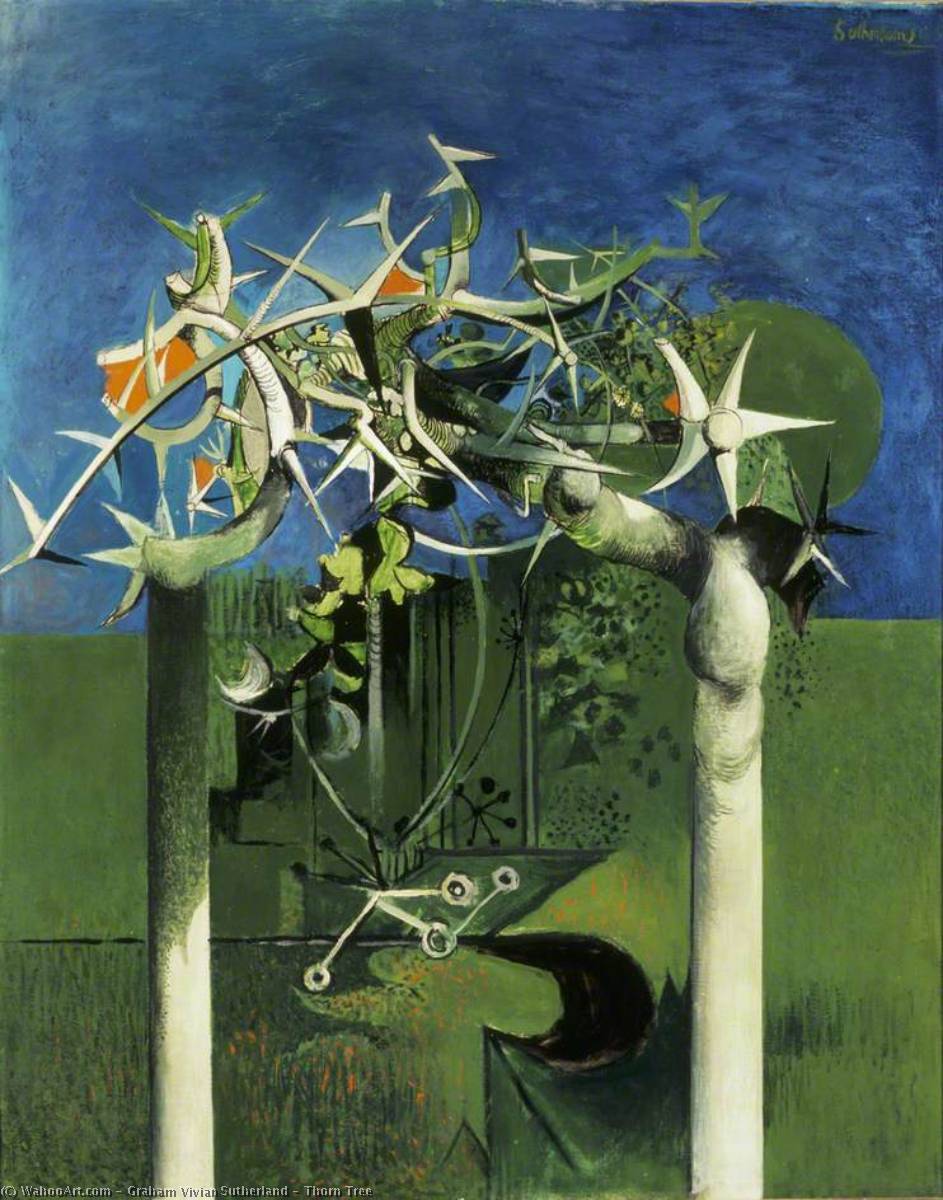
Thorn Tree

Discover 'Thorn Tree' by Graham Sutherland – a captivating oil painting of a windswept tree and birds, showcasing surreal landscapes & evocative nature scenes from 1946.

Graham Vivian Sutherland était un artiste britannique majeur reconnu pour son style surréaliste emblématique et ses peintures de paysages saisissantes, notamment celles du Parc national de Pembrokeshire. Ses œuvres marquantes incluent la conception du magnifique tapis de la Cathédrale d'Coventry et une série de portraits remarquables. Explorez l'art fascinant de ce peintre visionnaire !

Reproduction à l'huile faite à la main

Huile sur toile peinte à la main, avec cadre et dimensions personnalisés, réalisée sur commande par nos artistes.

P118B $10
P118H $10
P118W $10
P438Z $10
P508JH $12
P508YH $12
P805H $10
P805Z $10
P919BZ $10
P919G $10
P919XJ $10
P959ZH $10
P968JZ $12
W106C $8
W218G $10
W218JH $8
W218Y $10
W307PJ $10
W316G $10
W316PJ $8
W316Y $10
W398PJ $8
W4111J $10
W500HY $15
W500JH $15
W692G $12
W849H $8
W940BG $15
W953PJ $8

Standard
custom
CM
INCH

Choisissez parmi nos formats prédéfinis qui respectent les proportions originales de l’œuvre.

largeur
hauteur

Vous pouvez saisir vos propres dimensions pour l'adapter à un cadre ou à un espace spécifique. Si la taille sélectionnée ne correspond pas aux proportions de l'image d'origine, nous recadrerons l'œuvre ou prolongerons la peinture avec des éléments peints à la main supplémentaires. Une maquette numérique vous sera envoyée pour approbation avant le début de la production.
Veuillez noter que l'aperçu à l'écran ne reflète pas le recadrage ou l'extension réels. Seule la maquette montrera fidèlement la composition finale.
Bien que des tailles personnalisées soient disponibles, nous vous recommandons de sélectionner une dimension dans la liste prédéfinie afin de préserver les proportions d'origine.

Exemples de personnalisation : remplacer un visage par la photo du client ; ajouter un animal de compagnie (par exemple, remplacer un chat par un chien) ; inclure un message caché en arrière-plan ; modifier le paysage ou les éléments de l'arrière-plan.
Après la commande, l’équipe OriginalUniqueArt.com contactera le client par e-mail pour obtenir ses instructions et lui fournira une maquette d’aperçu.

Livraison dans le monde entier () en 3 à 4 semaines au lieu des 5 semaines habituelles. (26 juillet). Aucune concession sur la qualité.

why_choose_icon
Livraison express gratuite dans le monde entier
why_choose_icon
Toile de lin de haute qualité
why_choose_icon
Assurance transport complète
why_choose_icon
Garantie de remboursement des frais de douane
why_choose_icon
Garantie de fidélité des couleurs
why_choose_icon
Politique de retour de 60 jours (uniquement en cas de défaut)
why_choose_icon
Garantie de remboursement à 100%
why_choose_icon
Réduction sur les achats groupés

Prix total

-

reproduction

Thorn Tree

Technique de reproduction

Format de reproduction

-

Prix total final

-

En bref

  • Artistic style: Landscape painting
  • Year: 1946
  • Dimensions: 127 x 102 cm
  • Location: Albright-Knox Art
  • Influences:
    • Surrealism
    • Expressionism
  • Title: Thorn Tree
  • Artist: Graham Sutherland

Quiz d'art

Chaque question ne comporte qu'une seule bonne réponse.

Question 1:
What is the primary subject matter of Graham Vivian Sutherland’s painting, ‘Thorn Tree’?
Question 2:
In what year was ‘Thorn Tree’ painted?
Question 3:
Which artistic movement is most closely associated with Graham Vivian Sutherland’s style as exemplified in ‘Thorn Tree’?
Question 4:
The painting 'Thorn Tree' was created by Graham Vivian Sutherland, who is known for his work in which medium besides painting?
Question 5:
What does the presence of ‘thorns’ in the painting likely symbolize?

Description de l'œuvre

A Vision of Verdant Mystery: Graham Vivian Sutherland’s “Thorn Tree”

Graham Vivian Sutherland's "Thorn Tree," painted in 1946, isn’t merely a landscape; it’s an immersion into the heart of Pembrokeshire’s rugged beauty, filtered through the uniquely perceptive eye of one of Britain’s most significant modern artists. This oil on canvas work transcends simple representation, offering instead a deeply layered exploration of nature's inherent strangeness and the quiet drama of the natural world. Sutherland, a master of Neo-Romanticism, skillfully blends the traditional English landscape tradition with the subtle influences of Surrealism and Expressionism – a combination that resulted in powerfully evocative and often unsettling images.

The painting immediately draws the viewer into a dense, almost claustrophobic woodland scene. Towering trees dominate the composition, their branches intertwining to create a complex network of shadows and light. The leaves themselves are rendered with meticulous detail, yet they possess an unnerving quality – not quite realistic, but hinting at something beyond the purely botanical. Birds, perched precariously amongst the foliage, add to the sense of unease and suggest a hidden life within this seemingly still landscape. Sutherland’s use of color is particularly striking; predominantly greens—ranging from deep emerald to muted olive—create an atmosphere of both lushness and melancholy. Subtle hints of brown and grey ground the scene, anchoring it in the earth while simultaneously emphasizing its isolation.

The Painter's Process: Technique and Style

Sutherland’s technique is characterized by a remarkable sensitivity to light and texture. He employed a broken brushstroke method, layering thin washes of paint to build up form and create a shimmering effect that captures the dappled sunlight filtering through the trees. The canvas itself appears almost alive with movement – not in a frenetic way, but rather through the careful manipulation of color and tone. The painting’s surface is rich with impasto—thickly applied paint—particularly around the branches and leaves, giving them a tangible presence. This tactile quality invites the viewer to reach out and touch the scene, blurring the line between observation and participation.

Notably, Sutherland's work during this period reflects his deep connection to Pembrokeshire, a region he revisited repeatedly throughout his career. He wasn’t simply documenting the landscape; he was attempting to capture its essence—its mood, its mystery, and its inherent sense of solitude. The painting embodies a shift in artistic focus away from purely representational art towards a more subjective interpretation of reality.

Symbolism and Interpretation

“Thorn Tree” is rich with symbolic potential. The thorns themselves are a potent motif—representing both defense and pain, beauty and danger. They suggest a world where nature isn’t always benevolent, but rather holds its own secrets and challenges. The birds, often associated with freedom and spirituality, seem trapped within the dense foliage, hinting at a longing for escape. The overall composition can be interpreted as an allegory of the human condition—a struggle to find meaning and connection in a world that is both beautiful and unsettling.

Furthermore, the painting’s creation coincided with post-war Britain, a period marked by uncertainty and social upheaval. Sutherland's exploration of nature’s complexities can be seen as a reflection of this broader sense of disorientation—a search for stability and meaning amidst chaos. The painting’s enduring appeal lies in its ability to resonate with viewers on multiple levels, prompting contemplation about the relationship between humanity and the natural world.

A Timeless Masterpiece: Reproduction and Display

"Thorn Tree" is a captivating work that would be an exceptional addition to any art collection or interior space. Reproductions of this painting capture much of its original power, offering a way to bring Sutherland’s vision into your home. When selecting a reproduction, consider the quality of the print and the canvas material—a fine-art giclée on archival canvas will best preserve the artwork's colors and detail. The painting’s evocative atmosphere would complement a variety of interior styles, from modern minimalist spaces to more traditional settings. Its subtle color palette and complex composition create a focal point that invites contemplation and adds a touch of understated elegance to any room.


Biographie de l'artiste

Graham Vivian Sutherland (1903–1980): Un Maître Paisagiste Visionnaire

Graham Vivian Sutherland OM (24 août 1903 – 17 février 1980) fut un artiste anglais prolifique, célébré pour son style artistique distinctif qui réunissait les traditions anglaises de la peinture à la lumière du jour avec les mouvements européens avant-gardistes tels que le surréalisme et l'expressionnisme, établissant ainsi sa place parmi les artistes britanniques les plus influents du XXe siècle. Son œuvre comprenait la gravure, la conception de tapisseries, l’art du verre et la peinture à l’huile, mais ses paysages – notamment ceux représentant la beauté sauvage du Pembroke Shire au Pays de Galles – demeurent son œuvre maîtresse. ### Jeunes Enfances et Éducation Graham Sutherland naquit à Streatham, Londres, le fils aîné de George Humphrey Vivian Sutherland, avocat qui fut ensuite fonctionnaire civil au Registre foncier et au Conseil national de l’éducation, et Elsie Sutherland (née Foster). Ses deux parents avaient des inclinations artistiques, nourrissant dès son plus jeune âge la fascination de Graham pour le dessin. Il fréquenta la maison préparatoire Homefield à Sutton puis Epsom College en Surrey jusqu'à 1919, obtenant une solide formation classique. Reconnaissant son talent naturel pour les arts visuels, Sutherland suivit un apprentissage à l’usine ferroviaire Midland à Derby avant de découvrir sa véritable passion pour l’exploration artistique grâce aux études techniques qu’il poursuivit. Cette décision contint les attentes de sa famille au droit. ### Développement Artistique et Influences Sutherland débuta son parcours artistique avec la gravure et l’eau-forte, perfectionnant ses compétences à Goldsmiths' School of Art entre 1921 et 1926. Ses années formatrices furent marquées par une exposition aux paysages pastoraux de Samuel Palmer – une connexion qui influença profondément ses sensibilités esthétiques précoces. Les estampes de Sutherland reflétaient le mouvement surréaliste émergent, influencé par des artistes tels que René Magritte et Giorgio Morandi, démontrant une volonté d’expérimenter avec des techniques et des images inhabituelles. Il adopta l'abstraction comme moyen d'exprimer l'émotion et de saisir la complexité essentielle de la beauté naturelle. Parmi ses influences notables figuraient Edvard Munch et Paul Nash. ### Réalisations Majeures : Peinture Paysagiste et Tapisserie pour Cathédrale Saint-Étienne La véritable percée artistique de Sutherland eut lieu en 1938 lors de sa visite au Pembroke Shire, au Pays de Galles – une expérience transformatrice qui enflamma son dévouement sans cesse renouvelé à cette région aux paysages dramatiques. Inspiré par Edvard Munch et Paul Nash, il produisit une série de peintures à l’huile capturant la beauté éthérée du littoral gallois, caractérisée par des coups de pinceau audacieux et des palettes de couleurs évocatrices. Ces paysages sont devenus emblématiques de sa vision artistique, reflétant à la fois une profondeur psychologique et une innovation formelle. Son plus vaste accomplissement fut sans doute la conception de la grande tapisserie centrale pour Cathédrale Saint-Étienne à Coventry – un projet collaboratif symbolisant la réconciliation après les ravages de la Seconde Guerre mondiale. Cette entreprise ambitieuse témoigna du génie artistique de Sutherland en matière d’art textile et consolida son héritage en tant qu’icône culturelle. ### Portraiture et Dernières Années Sutherland continua à produire des portraits remarquables tout au long de sa carrière, notamment Winston Churchill – une représentation controversée qui provoqua un débat considérable sur l’interprétation artistique et la représentation historique. Il enseigna l'eau-forte à Chelsea School of Art et Goldsmiths College, nourrissant les talents des jeunes artistes et diffusant ses connaissances des principes artistiques. En 1955, Sutherland acheta une maison près de Nice, embrassant une vie étrangère qui lui permit de renouer avec son inspiration artistique jusqu’à sa mort en 1980, laissant derrière lui un corps d'œuvre durable célébré pour son originalité et sa profondeur émotionnelle. Il fut décoré Chevalier Ordre Mérite en 1960. Ses œuvres sont conservées dans les principales musées du monde entier. Parmi eux : Abbot Hall Art Gallery, ACGB, Bolton Art Gallery, Brighton and Hove Museums and Art Galleries, BMAG, Bristol Museum and Art Gallery, BC, Cheltenham Art Gallery, Doncaster Museum Service, Fitzwilliam Museum, Glasgow Museums, GAC, Harris Museum and Art Gallery, Hepworth Wakefield, Herbert Art Gallery, Imperial War Museum, Kirklees Museums and Galleries, Leeds Museums and Galleries, Leicester Arts and Museums Service, Museum of London, NMNI, NPG, NMW, Northampton Museum and Art Gallery, Norwich Castle Museum, Pallant House Gallery, Potteries Museum and Art Gallery, Rugby Museum and Art Gallery, Rye Art Gallery, Southampton Art Gallery, Stirling University Art Collection, Swindon Art Gallery, Tate Gallery, University of Warwick Art Collection et Whitworth Art Gallery, Manchester.


Graham Vivian Sutherland

Graham Vivian Sutherland

1903 - 1980 , Angleterre

En bref

  • Artistic Movement Or Style: Surréalisme
  • Artists Or Movements Influenced By This Artist: ['Samuel Palmer']
  • Artists Who Influenced This Artist: ['Paul Nash']
  • Date Of Birth: 24 août 1903
  • Full Name: Graham Vivian Sutherland
  • Nationality: Britannique
  • Notable Artworks:
    • Flying Bomb Depot
    • Entrance à une lane
  • Place Of Birth: Londres, Angleterre
Explorez des œuvres d'art classées par thèmes, styles et caractéristiques.