

 Aperçu en situation
 Envoyer
 Partager
 Détails de l'œuvre

 Télécharger
 Articles similaires
 Radiographie
 Diaporama
Piazza San Marco
 Huile sur toile
- Art mural
- Baroque
 1730
1730 68.0 x 112.0 cm
 Metropolitan Museum of Art
 Lire la suite
Giclées et impressions d'art
Impressions giclées ou sur toile de qualité musée, avec une production rapide et des finitions au choix. ( Commander la reproduction peinte à la main Télécharger l'image haute résolution)




P118B $10

P118H $10

P118W $10

P438Z $10

P508JH $12

P508YH $12

P805H $10

P805Z $10

P919BZ $10

P919G $10

P919XJ $10

P959ZH $10

P968JZ $12

W106C $8

W218G $10

W218JH $8

W218Y $10

W307PJ $10

W316G $10

W316PJ $8

W316Y $10

W398PJ $8

W4111J $10

W500HY $15

W500JH $15

W692G $12

W849H $8

W940BG $15

W953PJ $8




Choisissez parmi nos formats prédéfinis qui respectent les proportions originales de l’œuvre.

Vous pouvez saisir vos propres dimensions pour vous adapter à un cadre ou à un espace spécifique. Si la taille sélectionnée ne correspond pas aux proportions de l'image originale, nous recadrerons l'œuvre ou étendrons l'image avec une bordure en miroir ou une couleur unie. Une maquette numérique vous sera envoyée pour approbation avant le début de la production.
Veuillez noter que l'aperçu à l'écran ne reflète pas le recadrage ou l'extension réelle. Seule la maquette montrera avec précision la composition finale.
Bien que des tailles personnalisées soient disponibles, nous vous recommandons de choisir une dimension dans la liste prédéfinie afin de préserver les proportions originales.
Livraison dans le monde entier () en 2 semaines au lieu des 4/5 semaines habituelles. (22 août)

Livraison express gratuite dans le monde entier

Toile de lin de qualité supérieure

Assurance transport complète

Garantie de remboursement des droits de douane

Garantie de fidélité des couleurs

Politique de retour de 60 jours (uniquement en cas de défaut)

Garantie de remboursement à 100%

Offre de tarifs dégressifs
 L'option verre n'est disponible que pour les dimensions inférieures à 110 cm.

Piazza San Marco
Giclées et impressions d'art
Format de la reproduction
-


Prix total
$ 80
Description de la pièce
Piazza San Marco: A Venetian Masterpiece
The Piazza San Marco in Venice stands as an enduring testament to artistic vision and cultural grandeur—a fact eloquently captured by Giovanni Antonio Canaletto’s monumental oil painting, completed in 1730. More than just a depiction of a public space, this artwork embodies the spirit of Baroque realism, skillfully blending meticulous observation with idealized beauty to transport viewers back to the vibrant heart of Renaissance Venice.- Subject Matter: Canaletto’s canvas pulsates with life—a panorama of St Mark's Square teeming with citizens, merchants, and clergy. Dominating the scene are the iconic St Mark’s Basilica and the Campanile, rendered in breathtaking detail against a backdrop of azure sky and shimmering water reflecting the midday sun.
- Style & Technique: Canaletto adhered to the Baroque tradition's commitment to realism while subtly elevating its aesthetic qualities. Employing linear perspective—a technique pioneered by Filippo Brunelleschi—he draws the eye inward, creating a profound sense of depth and spatial illusion. The artist’s masterful brushwork contributes to textured surfaces that convey both solidity and luminosity.
- Historical Context: Created during Canaletto's prolific period in England, this painting reflects the fascination with Venetian culture prevalent among European elites. It served as a visual chronicle of Venice’s position as a leading commercial power and artistic center—a legacy that continues to inspire admiration today.
Color Palette & Composition
The artist's color palette is deliberately restrained, prioritizing muted earth tones—ochres, browns, and creams—to establish a harmonious tonal foundation. However, splashes of gold adorn the Basilica’s dome, symbolizing divine splendor and reinforcing its spiritual significance. Furthermore, subtle variations in hue capture the atmospheric effects of an overcast day, enhancing the painting's emotional resonance. The symmetrical composition underscores the Piazza’s formal elegance and reinforces its role as a locus of civic pride.Symbolism & Artistic Innovation
Beyond its visual splendor, Canaletto’s work carries symbolic weight—representing Venice’s wealth, power, and cultural heritage. Notably, his pioneering use of atmospheric perspective anticipates Impressionist principles, demonstrating an uncanny ability to convey mood and emotion through nuanced tonal gradations. The artist's meticulous attention to detail—capturing the textures of fabrics, architectural ornamentation, and human faces—elevates Canaletto’s oeuvre beyond mere topographical representation.Emotional Impact & Legacy
Viewing Canaletto’s Piazza San Marco is akin to stepping back in time—experiencing a moment frozen in Venetian history. The painting's luminous quality evokes feelings of serenity and grandeur, transporting the viewer into the bustling heart of one of Europe’s most celebrated cities. Canaletto’s enduring influence on subsequent generations of artists testifies to his mastery of technique and his profound understanding of how art can communicate emotion—a legacy that continues to captivate audiences worldwide.Biographie de l'artiste
Giovanni Antonio Canal
Giovanni Antonio Canal, commonly known as canaletto, was born in Venice on October 18, 1697, to Bernardo Canal, a painter of theatrical scene settings, and Artemisia Barbieri. He was the son of a noble family steeped in artistic tradition—Bernardo Canal himself had been a respected artist, establishing a lineage dedicated to visual representation. Canaletto’s early training commenced with his father, who instilled within him the fundamental principles of painting, shaping his formative years into an immersion in artistic craftsmanship. This familial influence would prove pivotal in nurturing his innate talent and guiding his subsequent artistic pursuits.The Making of a Master
In 1718, Canaletto embarked on a transformative journey to Rome—a city renowned for its artistic fervor and intellectual dynamism. During this period, he actively participated in the production of scenery for two operas by Alessandro Scarlatti, immersing himself in the theatrical world and honing his skills in designing immersive environments. This experience profoundly impacted his artistic development, exposing him to innovative techniques and fostering a keen understanding of visual storytelling—a cornerstone of his distinctive style. The collaboration with Scarlatti wasn’t merely professional; it was an encounter with the very essence of Baroque aesthetics. Upon returning to Venice, Canaletto swiftly established himself as a leading figure in Venetian landscape painting, adopting a technique that would soon earn him international acclaim: *veduta*. He meticulously crafted detailed depictions of the city's architectural grandeur and bustling public life—capturing not just what was seen but conveying an emotional resonance. His preparatory drawings were remarkably precise, reflecting his unwavering commitment to accuracy while simultaneously allowing for artistic interpretation. Canaletto’s method mirrored that of Giovanni Paolo Pannini, a Venetian artist who pioneered topographical art, emphasizing observation and meticulous documentation.Notable Works and Collaborations
Canaletto's oeuvre comprises numerous masterpieces that exemplify the zenith of Venetian landscape painting—a genre characterized by its luminous palette and masterful perspective. Among his most celebrated works are “The Stonemason’s Yard” (c. 1725), a captivating portrayal of Venetian craftsmanship, and “Regatta on the Grand Canal” (c. 1730), which vividly captures the splendor of Venice's ceremonial processions—a testament to Canaletto’s ability to convey both visual accuracy and emotional depth. His depiction of Eton College (1746-1756) stands as a poignant reminder of his influence in England, where he collaborated closely with Bernardo Bellotto, who became an equally accomplished artist. Together, they produced breathtaking panoramas of Dresden and Vienna—works that continue to inspire admiration for their compositional elegance and technical virtuosity.Artistic Style and Technique
Canaletto’s distinctive artistic style is inextricably linked to his pioneering use of the camera obscura—a darkened room equipped with a lens that projects an inverted image of the outside world onto a surface illuminated by candlelight. This ingenious device allowed him to achieve unparalleled topographical accuracy, ensuring that his paintings faithfully reproduced the contours and textures of Venice and London. However, Canaletto’s artistic vision extended beyond mere replication; he skillfully manipulated perspective and employed subtle tonal variations to create atmospheric effects—transforming ordinary scenes into emotionally evocative landscapes. His meticulous attention to detail—from the reflections in windows to the folds of drapery—elevated his paintings to levels of artistic sophistication rarely achieved by his contemporaries. Canaletto’s legacy resides not only in his technical prowess but also in his ability to imbue his works with a palpable sense of place and time—capturing the spirit of an era with remarkable sensitivity and artistry.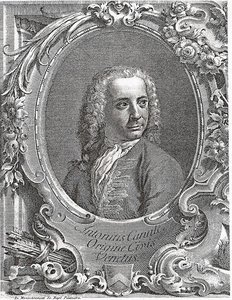
Giovanni Antonio Canal
1697 - 1768 , Italie
L'essentiel de l'artiste
- Artistic Movement Or Style: Vedute Venice
- Artists Or Movements Influenced By This Artist: ['Tintoretto']
- Artists Who Influenced This Artist: ['Giovanni Paolo Pannini']
- Date Of Birth: October 18, 1697
- Date Of Death: April 19, 1768
- Full Name: Giovanni Antonio Canal
- Nationality: Italian
- Notable Artworks:
- The Stonemason's Yard
- Regatta on the Grand Canal
- Eton College
- Place Of Birth: Venice, Italy
Articles connexes

Canaletto : Lumière, Espace et Observation Sociale dans la Venise du XVIIIe Siècle
Explorez l'œuvre de Canaletto et découvrez la magie de Venise au XVIIIe siècle. Analyse approfondie de sa technique, son observation sociale et son héritage artistique. Un voyage visuel incontournable pour les amateurs d'art.
Jacopo Tintoretto : Les 25 Chefs-d'œuvre du Maître Vénitien | OriginalUniqueArt
Plongez dans l'univers dramatique de Jacopo Tintoretto ! Découvrez les 25 œuvres incontournables du maître vénitien, ses techniques uniques et son style baroque. Reproductions de qualité muséale sur OriginalUniqueArt.com.

Pietro Longhi's Venetian Scenes: A Study of Rococo Society & Domestic Life
Explore the captivating world of Pietro Longhi's Venetian scenes! Discover insightful analysis of his Rococo masterpieces & social commentary on 18th-century life. Learn about this 'Venetian Hogarth' and his lasting artistic legacy.

Michelangelo Morlaiter: Venetian Landscapes & the Pursuit of Atmospheric Realism
Explore the captivating landscapes of Michelangelo Morlaiter, a key figure in 18th-century Venetian painting. Discover his mastery of atmospheric perspective and lasting influence on Italian art history. Learn more at OriginalUniqueArt.

Francesco Guardi: Venetian Light, Atmospheric Perspective & the Rococo to Neoclassical Transition
Explore the captivating world of Francesco Guardi, master of Venetian light and atmosphere. Discover his transition from Rococo to Neoclassicism, influence on Impressionism & investment potential with OriginalUniqueArt.



