Passer au format impression
 Lire la suite







































 Pour les œuvres ou reproductions dont un côté mesure plus de 105 cm (environ 41 pouces), le cadre sera expédié sous forme de kit démonté. Cette méthode garantit une livraison sécurisée et prévient tout dommage pendant le transport.


A Voyage Into Giorgione’s Enigma: Decoding “The Tempest”
Giorgio Barbarelli da Castelfranco, universally known as Giorgione (c. 1477–78 or 1473–74 – the precise birthdate remains debated), stands as one of the most elusive figures within Renaissance art—a painter whose life tragically curtailed at just thirty-two or thirty-three left an indelible mark on Venetian artistic heritage.
Unlike many contemporaries whose biographies unfold with relative clarity, Giorgione’s story is shrouded in mystery, pieced together from fragmentary archival records and the romanticized accounts of Giorgio Vasari. Yet, what emerges suggests a man deeply rooted in the vibrant cultural landscape of Venice—a city that simultaneously fostered artistic innovation and an appreciation for sensual beauty.
His formative years were spent under Giovanni Bellini’s tutelage, absorbing the established traditions of Venetian painting before forging his own distinctive voice. This apprenticeship instilled within him a profound understanding of color theory and compositional balance – elements that would become hallmarks of Giorgione's oeuvre.
The Painting: A Symphony of Atmosphere
"The Tempest," completed around 1505–1510, exemplifies Giorgione’s revolutionary approach to artistic representation. Departing from the prevailing conventions of disegno—precise drawing—he prioritized colore—color—as the primary vehicle for conveying emotion and capturing the essence of the scene.
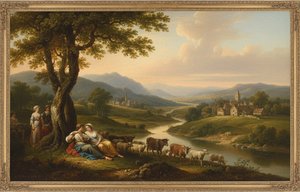
The painting depicts a woman seated beneath a tree, nursing her infant child, accompanied by a soldier carrying a staff. This seemingly simple composition belies an astonishing level of sophistication. Giorgione skillfully employs chiaroscuro—the dramatic interplay of light and shadow—to sculpt the figures’ forms and imbue them with palpable presence.
More than just aesthetically pleasing, “The Tempest” is imbued with symbolic resonance. The distant cityscape—particularly the tower bearing the emblem of Saint Mark—represents Padua, a city renowned for its humanist scholarship and artistic patronage. The stormy sky serves as a metaphor for life’s unpredictable vicissitudes, mirroring the anxieties prevalent during Giorgione's time.
A Bold Departure From Tradition
Giorgione’s decision to place his figures prominently within the landscape—rather than relegating them to a more conventional interior setting—was groundbreaking. It signaled a decisive break from the artistic conventions of Bellini and foreshadowed the stylistic innovations championed by Titian and Tintoretto.
Furthermore, Giorgione's masterful use of color—particularly the muted hues of olive green and ochre—creates an atmosphere of serene contemplation. The painting’s emotional impact is profound: it evokes feelings of tranquility, melancholy, and a subtle awareness of mortality – themes that resonate powerfully with viewers even today.
Legacy and Enduring Mystery
Despite the absence of a signature—a common practice among Renaissance artists—Giorgione's influence on Venetian painting remains undeniable. His pioneering techniques paved the way for subsequent generations of painters, establishing him as a cornerstone of High Renaissance artistic achievement.
“The Tempest” continues to fascinate art historians and critics alike, prompting ongoing debates about its iconography and emotional depth. Its enduring mystery—coupled with its breathtaking beauty—solidifies Giorgione’s place among the most celebrated artists of his era—a testament to his genius and a beacon of artistic innovation.
Questions et réponses
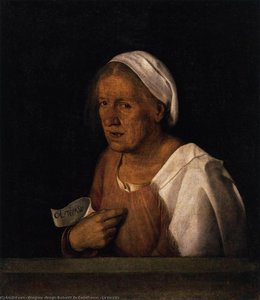
Que représente "Un Soldat" et quelle atmosphère s'en dégage ?
«Un Soldat» de Giorgione dépeint venetian painting, landscape composition, allegorical figure, pastoral scene, atmospheric color, storm imagery, renaissance art, dans une atmosphère Romantique. Le sujet et l'ambiance définissent ensemble l'œuvre.
L'œuvre « Un Soldat » est-elle restée dans le pays d'origine de son artiste ?
Non - l'œuvre est conservée à l'étranger. Giorgione est né(e) en Italie, tandis que le musée qui conserve l'original de « Un Soldat » se situe en Austria.
Puis-je commander une reproduction à l'huile de « Un Soldat » ?
«Un Soldat» est disponible en tant que une reproduction à l'huile peinte à la main sur toile de lin. Vous pouvez passer commande sur sa page Reproduction peinte à la main, avec un choix de formats disponibles.
 Aperçu en situation
 Envoyer
 Partager
 Détails de l'œuvre
 Guide
Guide

 Télécharger l'image
 Articles similaires
 Radiographie
 Diaporama
 Q&A
Q&A Statistiques