Aperçu en situation
 Envoyer
 Partager
 Détails de l'œuvre
 Guide
Guide

 Télécharger l'image
 Articles similaires
 Radiographie
 Diaporama
 Q&A
Q&A Statistiques
The Profit
 Acrylique sur toile
- Décoration murale
- Metaphysical Art
 1915
1915 89.0 x 70.0 cm
 Lire la suite
L’œuvre d'art présentée sur cette page est protégée par le droit d'auteur, ce qui signifie que nous ne pouvons légalement créer ou vendre de reproduction identique. Cette protection est appliquée en vertu d'accords internationaux tels que la Convention de Berne et par les lois nationales, notamment celles énoncées par le Loi américaine sur le droit d'auteur - Titre 17.
Cette méthode est pleinement conforme aux réglementations sur le droit d'auteur car elle ne repose pas sur la copie ou la duplication de l'œuvre protégée. Il s'agit plutôt d'une réinterprétation créative — une nouvelle peinture qui s'inspire de l'original sans pour autant lui être identique.
Giclées et impressions d'art
Impressions giclées ou sur toile de qualité musée, avec une production rapide et des finitions au choix. ( Commander la reproduction peinte à la main Passer au format numérique)




P118B €10

P118H €10

P118W €10

P438Z €10

P508JH €12

P508YH €12

P805H €10

P805Z €10

P919BZ €10

P919G €10

P919XJ €10

P959ZH €10

P968JZ €12

W106C €8

W218G €10

W218JH €8

W218Y €10

W307PJ €10

W316G €10

W316PJ €8

W316Y €10

W398PJ €8

W4111J €10

W500HY €15

W500JH €15

W692G €12

W849H €8

W940BG €15

W953PJ €8




Choisissez parmi nos formats prédéfinis qui respectent les proportions originales de l’œuvre.

Saisissez la largeur et la hauteur souhaitées pour qu'elles s'adaptent à votre cadre ou à votre mur. Une impression peut être recadrée, mais jamais agrandie au-delà de l'image originale ; ainsi, un format de forme différente entraînera la perte d'une partie de l'image. Nous vous envoyons une maquette numérique pour approbation avant toute impression. L'image présentée sur cette page ne montre pas le recadrage réel — seule la maquette le permet.
Livraison dans le monde entier () en 2 semaines au lieu des 4/5 semaines habituelles. (30 octobre)

Livraison express gratuite dans le monde entier

Toile de lin de qualité supérieure

Assurance transport complète

Garantie de remboursement des droits de douane

Garantie de fidélité des couleurs

Politique de retour de 100 jours (uniquement en cas de défaut)

Garantie de remboursement à 100%

Offre de tarifs dégressifs
 L'option verre n'est disponible que pour les dimensions inférieures à 110 cm.

The Profit
Giclées et impressions d'art
Format de la reproduction
-


Prix total
€ 71
Giorgio de Chirico’s “The Profit”: A Dreamscape of Alienation
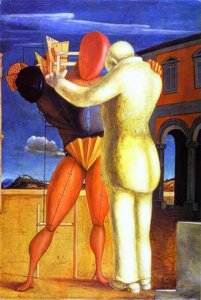
Giorgio de Chirico's "The Profit," painted in 1915, is not merely a depiction of a scene; it’s an immersion into the unsettling logic of the subconscious. This enigmatic work, measuring 89 x 70 cm, embodies the core tenets of de Chirico’s groundbreaking Metaphysical art – a movement that sought to capture the emotional and psychological realities beyond the purely visual. The painting immediately arrests the viewer with its peculiar juxtaposition of familiar elements rendered in an utterly unfamiliar light. A solitary figure, seated on a bench beneath a towering chalkboard filled with cryptic symbols, dominates the composition. This individual, deliberately devoid of identifying features, possesses a haunting stillness that speaks to a profound sense of isolation and detachment – a feeling acutely resonant within the context of World War I’s looming shadow.
De Chirico's mastery lies in his ability to construct spaces that are both recognizable and profoundly unsettling. The architecture, reminiscent of Italian squares and public spaces, is rendered with an unnerving precision, yet it feels strangely deserted and devoid of life. The perspective is deliberately skewed, creating a sense of vastness and disorientation – a key element of Metaphysical painting designed to mimic the way memories and dreams can warp our perception of reality. The muted color palette—dominated by ochres, browns, and greys—further contributes to this atmosphere of melancholy and unease, amplifying the feeling that something is fundamentally amiss.
Symbolism and Philosophical Undercurrents
“The Profit” is rich in symbolic detail, inviting endless interpretation. The figure’s mask or strange hat immediately establishes a sense of anonymity and detachment, suggesting a loss of identity within the larger world. The chalkboard itself is a crucial element, covered with symbols that defy immediate understanding – geometric shapes, letters, and diagrams that hint at a hidden language, perhaps representing the fragmented nature of thought or the complexities of human experience. The presence of two other figures in the background—one standing and another seated—adds to the sense of an incomplete narrative, suggesting a scene frozen in time, caught between past and present.
De Chirico’s artistic vision was deeply influenced by philosophical currents of his era, particularly the writings of Friedrich Nietzsche and Arthur Schopenhauer. These thinkers explored themes of existentialism, the irrationality of human desire, and the subjective nature of reality – ideas that profoundly shaped de Chirico's approach to art. The painting can be interpreted as a meditation on alienation, the loss of meaning in a rapidly changing world, and the struggle to find identity within an increasingly impersonal society. The title itself, “The Profit,” is deliberately ambiguous, prompting viewers to question what exactly is being gained or lost in this unsettling tableau.
Technique and Artistic Legacy
Painted in 1915, "The Profit" exemplifies de Chirico’s distinctive technique – a meticulous attention to detail combined with an expressive use of color and perspective. He employed oil on canvas, layering thin washes of paint to create a sense of depth and luminosity. The sharp lines and precise rendering of architectural elements contrast sharply with the hazy atmosphere, creating a compelling visual tension. De Chirico’s work profoundly influenced the development of Surrealism, paving the way for artists like René Magritte and Salvador Dalí who explored similar themes of dreamlike imagery and psychological landscapes.
Beyond its immediate aesthetic appeal, “The Profit” remains a powerful testament to de Chirico's artistic genius. It’s a painting that lingers in the mind long after it has been viewed, prompting reflection on the nature of reality, identity, and the human condition. OriginalUniqueArt offers meticulously crafted hand-painted reproductions of this iconic work, allowing art lovers to experience its haunting beauty and philosophical depth firsthand.
Questions et réponses
Où puis-je trouver des œuvres d'art similaires à «The Profit» de Giorgio de Chirico ?
La page Œuvres similaires de «The Profit» de Giorgio de Chirico présente des œuvres similaires.
À quel point la palette de "The Profit" est-elle saturée ?
La palette de « The Profit » présente une saturation Couleurs vives et nettes.
Quelle est la teinte dominante de « The Profit » ?
«The Profit» tend vers une nuance De l'ocre au sépia.
Biographie de l'artiste
jeunesse et influences
Giorgio de Chirico, artiste italien renommé, est né le 10 juillet 1888 à Volos, en Grèce, d'une mère génoise et d'un père sicilien. Sa jeunesse a été marquée par l'étude de l'art au polytechnique d'Athènes sous la direction des peintres grecs influents Georgios Roilos et Georgios Jakobides. Cette formation allait façonner son style artistique unique.le mouvement de l'art métaphysique
En 1910, de Chirico a inauguré le mouvement de l'art métaphysique, qui a profondément influencé les surréalistes. Ses œuvres de cette période, caractérisées par des atmosphères étranges et des scénarios oniriques, sont exemplifiées dans des peintures telles que les vexations du penseur (disponible sur la plateforme OriginalUniqueArt) et l'énigme de l'heure (visible sur OriginalUniqueArt). Ces œuvres évoquent un sentiment de mystère, souvent avec des contrastes nets de lumière et d'ombre.période post-métaphysique
Après 1919, l'intérêt de de Chirico s'est tourné vers les techniques de la peinture traditionnelle, adoptant un style néoclassique ou néo-baroque. Ce changement est évident dans ses œuvres ultérieures, qui, bien qu'elles ne reçoivent pas le même élan critique que ses premières pièces, démontrent une évolution mature de son approche artistique.héritage et influence
L'impact de de Chirico sur le mouvement surréaliste est indéniable, des artistes comme André Breton étant influencés par ses peintures métaphysiques. Bien que son œuvre ultérieure n'ait pas été aussi largement saluée, de Chirico reste une figure centrale dans l'histoire de l'art moderne. Son héritage continue d'inspirer, avec ses œuvres faisant partie de collections du monde entier, notamment le musée Giorgio de Chirico, qui se dresse désormais près des escaliers du marchepied à Rome.- explorez davantage les œuvres de Giorgio de Chirico sur OriginalUniqueArt
- découvrez le mouvement de l'art métaphysique et son influence sur le surréalisme grâce à cet article perspicace sur OriginalUniqueArt
- apprenez-en davantage sur la vie et les œuvres de de Chirico sur Wikipedia

Giorgio de Chirico
1888 - 1978 , Grèce
L'essentiel de l'artiste
- Artistes Influencés:
- Surréalisme
- André Breton
- Date De Naissance: 10 juillet 1888
- Influenceurs Artistiques:
- Arnold Böcklin
- Max Klinger
- Lieu De Naissance: Volos, Grèce
- Mouvement Artistique: Art métaphysique
- Nationalité: Italienne
- Nom Complet: Giorgio de Chirico
- Oeuvres Notables:
- Les Vexations du penseur
- L'Énigme de l'heure
- La Chanson d'amour
Articles connexes

Au-delà du Voile : Exploration de l'Art Métaphysique et de ses Mystères Intemporels
Explorez l'univers fascinant de la peinture métaphysique avec OriginalUniqueArt. Découvrez Giorgio de Chirico et son influence sur le surréalisme. Guide d'achat, analyses d'œuvres et conseils pour collectionneurs passionnés.
Beyond Reality: Discover the Haunting Beauty and Philosophical Depth of Metaphysical Art
Explore the haunting beauty of Metaphysical Art. Delve into Giorgio de Chirico’s dreamlike landscapes, the movement's profound connection to Surrealism, and the philosophical mysteries hidden within its eerie, silent piazzas.

À propos de nous
Découvrez notre univers artistique ! Nous mettons l’art de renommée mondiale à portée de main grâce à une sélection pointue, des créations sur mesure et des conseils personnalisés. Apprécié des particuliers et des professionnels depuis plus de 20 ans.

Goya : 25 Chefs-d'Œuvre Inoubliables d'un Maître de l'Âme
Plongez au cœur de l'œuvre inégalable de Goya ! Découvrez 25 chefs-d’œuvre emblématiques, des portraits saisissants aux scènes dramatiques. Explorez la vie et l'art du maître espagnol avec OriginalUniqueArt.com – reproductions d'art de qualité musée et inspirations déco.
Giorgio de Chirico: Metaphysical Realities & the Poetics of Absence
Explore the captivating world of Giorgio de Chirico and his groundbreaking Metaphysical painting movement. Discover the philosophical depths & surreal imagery that influenced generations of artists. Learn more at OriginalUniqueArt.