 Aperçu en situation
 Partager
 Partager
 Détails
 Guide imprimable

 Télécharger
 Articles similaires
 Radiographie
 Voir le diaporama
 Statistiques
Violon Player
 Oil On Canvas
- WallArt
- Baroque Dutch Painting
 1653
1653- Renaissance
 32.0 x 20.0 cm
 Musée de Liechtenstein
 Afficher la suite
Giclées et impressions d'art
Impressions giclées ou sur toile de qualité musée, avec une production rapide et des finitions au choix. ( Acheter la peinture faite à la main Passer au format image numérique)




P118B €10

P118H €10

P118W €10

P438Z €10

P508JH €12

P508YH €12

P805H €10

P805Z €10

P919BZ €10

P919G €10

P919XJ €10

P959ZH €10

P968JZ €12

W106C €8

W218G €10

W218JH €8

W218Y €10

W307PJ €10

W316G €10

W316PJ €8

W316Y €10

W398PJ €8

W4111J €10

W500HY €15

W500JH €15

W692G €12

W849H €8

W940BG €15

W953PJ €8




Choisissez parmi nos formats prédéfinis qui respectent les proportions originales de l’œuvre.

Type the width and the height you need, to fit your frame or your wall. A print can only be cut, never made bigger than the picture, so a size with a different shape loses a part of the image. We send you a digital mockup to approve before we print anything. The picture shown on this page does not show the real cut — only the mockup does.
Livraison dans le monde entier () en 2 semaines au lieu des 4/5 semaines habituelles. (14 octobre)

Livraison express gratuite dans le monde entier

Toile de lin de haute qualité

Assurance transport complète

Garantie de remboursement des droits de douane

Garantie de fidélité des couleurs

Garantie de retour de 100 jours (uniquement en cas de défaut)

Garantie de remboursement à 100%

Tarifs dégressifs sur quantité
 L'option verre n'est disponible que pour les dimensions inférieures à 110 cm.

Violon Player
Giclées et impressions d'art
Format de la reproduction
-


Prix total final
€ 69
Gerrit Dou’s ‘Violon Player’: A Masterclass in Dutch Golden Age Detail
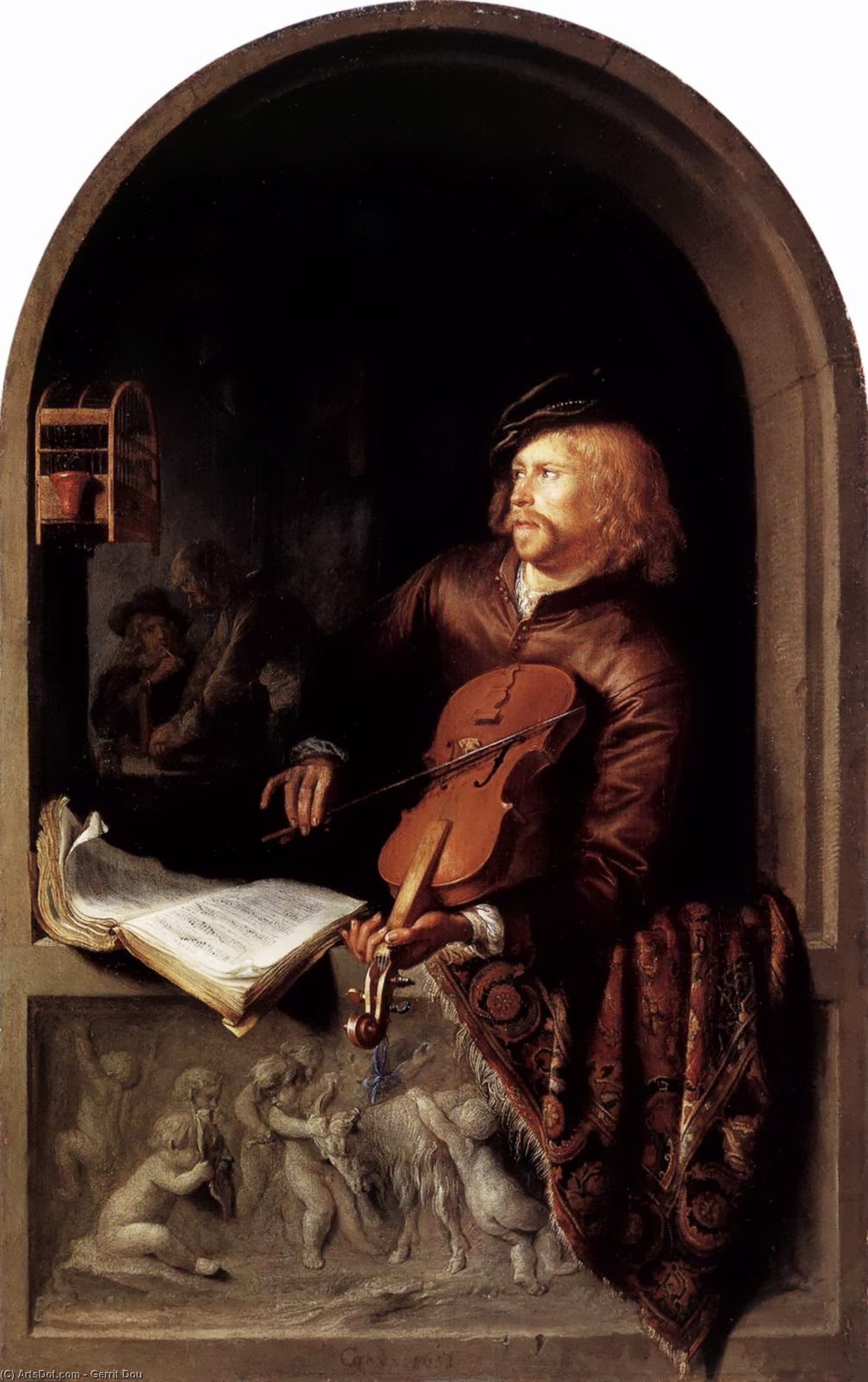
This exquisite hand-painted reproduction captures Gerrit Dou's remarkable ability to distill the essence of human experience into a single, intensely observed moment. Painted in 1653, “Violon Player” offers a poignant glimpse into the life of a musician during the Dutch Golden Age – a period defined by burgeoning commerce, artistic innovation, and a profound appreciation for leisure and refinement. The painting’s subject, a man absorbed in his violin, is rendered with an almost unsettling realism, inviting us to contemplate not just his actions but also his inner world.
- Subject & Composition: The central figure dominates the canvas, his posture suggesting both concentration and perhaps a touch of melancholy. The inclusion of indistinct figures in the background – likely members of his audience – adds depth to the scene without disrupting the focus on the musician himself. This careful composition is characteristic of Dou’s approach, prioritizing narrative suggestion over explicit storytelling.
- Style & Technique: Dou was a key figure within the Leiden Fijnschilders group, renowned for their meticulous attention to detail and mastery of *sfumato* – a technique that employs subtle gradations of light and shadow to create an atmospheric effect. Notice the incredibly detailed rendering of the violin’s varnish, the folds in the man's clothing, and the play of light on his face. This level of precision was exceptionally demanding, requiring hours of painstaking work.
Chiaroscuro and the Drama of Light
Gerrit Dou’s command of chiaroscuro – the dramatic use of light and dark – is perhaps the most striking element of “Violon Player.” He expertly manipulates light to create a sense of depth, volume, and emotional intensity. The soft glow illuminating the musician's face contrasts sharply with the darker recesses of the room, drawing our attention to his expression and intensifying the scene’s mood. This technique was particularly favored by Dou, reflecting his fascination with capturing fleeting moments of illumination – often seen in his candlelit night-scenes.
- Material & Craftsmanship: Each reproduction is created using traditional hand-painting techniques, employing archival-quality pigments and canvas to ensure lasting beauty. The meticulous brushwork and the rich color palette faithfully recreate Dou’s original vision, capturing the nuances of light and texture that are essential to his style.
Symbolism and Context
“Violon Player” transcends a simple portrait; it offers a window into 17th-century Dutch society. The musician represents a segment of the middle class, enjoying a moment of respite from their daily activities. The violin itself was a symbol of status and refinement during this era. Dou’s work reflects the growing importance of secular pursuits and leisure within the burgeoning merchant culture of Leiden. This painting aligns with the broader artistic trends of the Dutch Golden Age, where artists sought to capture not just physical likenesses but also the psychological states of their subjects.
- Historical Significance: Created in 1653, this work exemplifies Dou’s peak creative period. It provides a valuable insight into the artistic practices and aesthetic sensibilities of the Dutch Golden Age – a time when art flourished alongside economic prosperity and intellectual curiosity.
Perfect for Your Space
This stunning reproduction of Gerrit Dou's “Violon Player” is more than just a beautiful image; it’s an investment in timeless artistry. Its elegant composition, masterful technique, and evocative atmosphere make it a perfect addition to any interior space – from a formal salon to a contemporary living room. Bring the drama and sophistication of the Dutch Golden Age into your home with this exceptional hand-painted reproduction.
Questions et réponses
Quelle palette et quelle couleur dominante définissent "Violon Player" ?
«Violon Player» de Gerrit Dou utilise une palette Earthy, avec le Black (#0c0506) comme couleur dominante.
Quels sont les pseudonymes ou autres noms sous lesquels Gerrit Dou est connu ?
Gerrit Dou est également connu sous le nom de Gérard Dou, Gerard Dou, da Gerrit Dou, Gerrit (Gerard) Dou.
Quelle est la technique et les dimensions de l'original de «Violon Player» de Gerrit Dou ?
«Violon Player» a été réalisé en Oil On Canvas et mesure 32 x 20 cm dans sa forme originale.
Biographie de l'artiste
Biographie de Gerrit Dou
Gerrit (Gerard) Dou, né le 7 avril 1613 à Leyde aux Pays-Bas et décédé le 9 février 1675, est un peintre néerlandais majeur de l'âge d'or. Son œuvre, caractérisée par une finesse extrême et un rendu minutieux des détails, continue de fasciner les amateurs d’art du monde entier.
Jeunesse et Formation
- Naissance et Famille : Gerrit Dou est né dans une famille modeste à Leyde. Son père était fabricant de vitraux, ce qui a peut-être influencé sa sensibilité aux couleurs et à la lumière.
- Premiers Pas Artistiques : Il étudie le dessin sous la direction de Bartholomäus Dolendo avant d'intégrer l'atelier de Pieter Couwenhorn, où il se familiarise avec le travail du verre.
- Apprentissage auprès de Rembrandt : À l’âge de quatorze ans, Dou entre comme élève dans l'atelier de Rembrandt van Rijn (1606-1669), un des plus grands peintres de tous les temps. Il y reste pendant environ trois ans et acquiert une maîtrise des techniques du clair-obscur et de la composition.
Style Artistique et Œuvre
- Le Fijnsschilder : Dou est considéré comme l'un des principaux représentants du fijnschilder, un courant néerlandais caractérisé par une extrême finesse d’exécution et un souci du détail obsessionnel.
- Scènes de Genre et Trompe-l'œil : Ses œuvres se concentrent principalement sur les scènes de genre, représentant des intérieurs bourgeois avec une grande précision. Il est également connu pour ses peintures trompe-l’œil, créant l'illusion d'objets réels sortant de la toile.
- Maîtrise du Clair-obscur : Dou utilise magistralement le clair-obscur, notamment dans ses scènes éclairées par des bougies ou des lanternes, pour créer une atmosphère mystérieuse et captivante.
- Techniques Spécifiques : Il est réputé pour avoir utilisé des lentilles concaves et des miroirs convexes afin d'améliorer sa perception et de reproduire fidèlement les détails. On raconte qu’il passait cinq jours à peindre une seule main.
Influences et Héritage
- Rembrandt : L'influence de Rembrandt est indéniable dans ses premières œuvres, notamment dans l'utilisation du clair-obscur et des effets dramatiques.
- Élèves et Successeurs : Gerrit Dou a formé plusieurs élèves influents, dont Frans van Mieris l’Ancien et Gabriel Metsu, qui ont contribué à diffuser son style et ses techniques.
- Impact sur l'Art Néerlandais : Son travail a marqué durablement la peinture néerlandaise du XVIIe siècle, contribuant au développement du genre de la scène intérieure et influençant une génération d’artistes.
Œuvres Majeures et Collections
- L'Astronome à la Lumière des Chandelles : Cette œuvre emblématique illustre parfaitement sa maîtrise du clair-obscur et son souci du détail. Elle est visible sur OriginalUniqueArt.com.
- La Collection de Leyde, New York : Plusieurs œuvres de Dou sont conservées dans cette collection prestigieuse. Pour plus d'informations, consultez le guide complet sur OriginalUniqueArt.com.
- Musée Huis Ten Bosch (La Haye) : Ce musée abrite une importante collection d’art européen du XVIe au XVIIIe siècle, incluant des œuvres de Gerrit Dou.

Gerrit Dou
1613 - 1675 , Pays-Bas
En bref
- Artistes Influents: ['Rembrandt']
- Date De Décès: 9 février 1675
- Date De Naissance: 7 avril 1613
- Influence Sur Les Artistes:
- Frans van Mieris l'Ancien
- Gabriel Metsu
- Lieu De Naissance: Leiden, Pays-Bas
- Mouvement Artistique: Fijnschilders de Leiden
- Nationalité: Néerlandais
- Nom Complet: Gerrit (Gerard) Dou
- Œuvres Notables: ["L'astronome à la chandelle"]
Articles similaires
Gerrit Dou: Intimacy & Light in the Dutch Golden Age
Explore the exquisite world of Gerrit Dou, a master of Dutch Golden Age painting. Discover his intimate genre scenes, signature use of light, and lasting legacy. Learn about collecting Dou's works & their value.

L'Âge d'Or Néerlandais : 10 Chefs-d'œuvre Incontournables pour Décorer avec Art et Histoire
Plongez au cœur de l'Âge d'Or néerlandais ! Découvrez 10 chefs-d'œuvre intemporels de Rembrandt, Vermeer et autres maîtres hollandais. Explorez leur histoire, technique & trouvez l'inspiration déco sur

Golden Light & Dutch Skies: The Timeless Magic of Dutch Golden Age Landscapes
Discover the breathtaking beauty of Dutch Golden Age landscapes. Explore the mastery of light, chiaroscuro, and 17th-century realism through an expert art history lens, celebrating the enduring legacy of the Dutch Masters for discerning collectors and art lovers.

L'Âge d'Or Néerlandais : Splendeur Baroque et Révolution Artistique
Explorez l'Âge d'Or néerlandais : découvrez les maîtres baroques (Rembrandt, Fabritius) et leur révolution artistique. Analyse approfondie, contexte historique et héritage durable. Un voyage au cœur de la peinture du XVIIe siècle.
Illuminating Realism: Exploring the Dutch Golden Age of Painting (1600-1700)
Explore the Dutch Golden Age of painting (1600-1700) with OriginalUniqueArt. Discover Rembrandt, Vermeer & other masters. Learn about techniques, history & find museum-quality reproductions.