 Commander l'impression Acheter l'image haute résolution
 Partager
 Partager
 Détails de l'œuvre
 Ajouter aux favoris

 Télécharger
 Articles similaires
 Radiographie
 Diaporama
Strip
 Acrylic On Paper
- Other
- Op Art
 2013
2013- Contemporary
 200.0 x 1000.0 cm
 Afficher la suite
Reproduction à l'huile faite à la main
Huile sur toile peinte à la main, avec cadre et dimensions personnalisés, réalisée sur commande par nos artistes.




































Choisissez parmi nos formats prédéfinis qui respectent les proportions originales de l’œuvre.

Vous pouvez saisir vos propres dimensions pour l'adapter à un cadre ou à un espace spécifique. Si la taille sélectionnée ne correspond pas aux proportions de l'image d'origine, nous recadrerons l'œuvre ou prolongerons la peinture avec des éléments peints à la main supplémentaires. Une maquette numérique vous sera envoyée pour approbation avant le début de la production.
Veuillez noter que l'aperçu à l'écran ne reflète pas le recadrage ou l'extension réels. Seule la maquette montrera fidèlement la composition finale.
Bien que des tailles personnalisées soient disponibles, nous vous recommandons de sélectionner une dimension dans la liste prédéfinie afin de préserver les proportions d'origine.
Après la commande, l’équipe OriginalUniqueArt.com contactera le client par e-mail pour obtenir ses instructions et lui fournira une maquette d’aperçu.
Livraison dans le monde entier () en 3 à 4 semaines au lieu des 5 semaines habituelles. (22 juillet). Aucune concession sur la qualité.

Livraison express gratuite dans le monde entier

Toile de lin de haute qualité

Assurance transport complète

Garantie de remboursement des frais de douane

Garantie de fidélité des couleurs

Politique de retour de 60 jours (uniquement en cas de défaut)

Garantie de remboursement à 100%

Réduction sur les achats groupés
 L'option verre n'est disponible que pour les dimensions inférieures à 110 cm.

Strip
Technique de reproduction
Format de reproduction
-


Prix total final
-
Description de l'œuvre
The Enigmatic Strip: A Window into Richter’s World
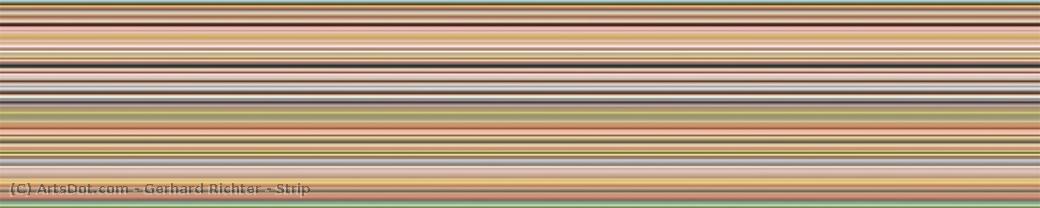
Gerhard Richter's "Strip," a monumental work from 2013, isn’t merely a painting; it’s an invitation to contemplate the very nature of perception and representation. Measuring a substantial 200 x 1000 cm, this acrylic on paper piece immediately commands attention with its bold, almost aggressively simple composition – a series of horizontal bands in varying shades of brown and orange. Yet, beneath this apparent austerity lies a complex interplay of color, texture, and the subtle suggestion of depth that speaks volumes about Richter’s signature style and his ongoing exploration of photographic source material.
The painting firmly places itself within the realm of Op Art, though Richter's approach transcends mere visual stimulation. The stripes aren’t static; they subtly shift and morph depending on the viewer’s perspective, creating a dynamic illusion that plays with our sense of space and form. This effect is achieved through careful manipulation of color intensity and value – a technique rooted in Richter’s decades-long fascination with photography and his method of layering multiple photographic sources to create abstract compositions.
A Legacy Forged in Division
Understanding "Strip" requires acknowledging the profound context of Gerhard Richter's life and career. Born in Dresden, Germany, in 1932, Richter’s early years were profoundly shaped by the political upheavals of post-war Europe. His childhood was marked by displacement and uncertainty, experiences that undoubtedly informed his artistic sensibility – a willingness to question, to deconstruct, and to embrace ambiguity. This formative period instilled within him a deep sense of questioning and a constant negotiation with the fragmented realities of his time.
Richter’s work is inextricably linked to this history of division. His exploration of memory, representation, and the photographic image can be seen as an attempt to grapple with the complexities of German identity in the aftermath of World War II and the subsequent decades of political and social transformation. The painting's restrained palette and deliberate abstraction mirror a certain emotional distance, reflecting Richter’s characteristic refusal to offer easy answers or definitive interpretations.
Decoding the Technique: Layers of Illusion
The seemingly effortless execution of "Strip" belies a meticulous process. Richter typically works with multiple photographic sources, creating composite images that are then translated into abstract paintings. In this instance, he likely employed a technique of layering and blending acrylics to achieve the subtle shifts in color and value that define the work’s visual dynamism. The textured surface – a result of these layered applications – adds another layer of complexity, inviting close inspection and encouraging viewers to lose themselves within its intricate details.
The choice of brown and orange is particularly significant. These earthy tones evoke a sense of warmth and grounding, yet their juxtaposition creates an underlying tension—a subtle discordance that mirrors the complexities of the historical context in which Richter operates. The stripes themselves act as visual anchors, guiding the eye across the canvas and creating a rhythmic pattern that simultaneously draws us in and keeps us at arm’s length.
A Reflection on Perception and Memory
Ultimately, "Strip" is more than just a visually striking composition; it's an invitation to contemplate the nature of perception and memory. Richter’s work consistently challenges our assumptions about representation, forcing us to question how we see and interpret the world around us. The painting’s ambiguous forms and shifting colors create a sense of unease—a feeling that something is just beyond our grasp. It's a testament to Richter's skill as an artist: he doesn’t offer solutions but rather presents us with questions, inviting us to engage in a dialogue with his work and with ourselves.
Biographie de l'artiste
**Jeunesse et Éducation**
Gerhard Richter, artiste visuel allemand renommé, est né le 9 février 1932 à l'hôpital de Dresde-Neustadt, à Dresde, en Saxe. Il a grandi à Reichenau, Basse Silésie (aujourd’hui Bogatynia, Pologne), et à Waltersdorf (Zittauer Gebirge), dans la campagne supérieure de Lusace. Le père de Richter, Horst Richter, était étudiant en mathématiques et en physique à l'Technische Hochschule de Dresde.**Carrière artistique**
Richter a commencé son parcours artistique comme apprenti peintre décorateur et a ensuite étudié à l’Académie des Beaux-Arts de Dresde. Ses premières œuvres ont été influencées par les styles de Picasso et Jean Arp, ce qui est évident dans ses peintures abstraites et photoréalistes. En 1957, Richter a travaillé comme stagiaire maître à l'académie, réalisant des commandes pour l'époque de la République Démocratique allemande de l’Est.**Œuvres notables et réalisations**
* Abstrait (2012) a établi un prix de vente aux enchères record pour une peinture d'un artiste vivant à 34 millions de dollars (£21 million). * Domplatz, Mailand (Place de la cathédrale, Milan) (1968) a été vendu pour 37,1 millions de dollars (£24,4 million) à New York. * Abstrait (2015) a été vendu pour 44,52 millions de dollars (£30,4 million) lors de la vente aux enchères contemporaine de Sotheby's.**Style et mouvement artistique**
Le travail de Richter est caractérisé par son éclectisme, combinant des styles abstraits et photoréalistes. Avec Sigmar Polke, il a introduit le terme Kapitalistischer Realismus (Réalisme capitaliste), un anti-style d'art qui s'approprie le langage pictural de la publicité.**Vie personnelle**
Richter a épousé Marianne Eufinger en 1957 et a eu une fille. Il a plus tard épousé Isa Genzken en 1982 et Sabine Moritz en 1995, avec qui il a eu deux fils et une fille. **Note :** Cet article est basé sur les informations fournies et peut ne pas être une biographie complète. Pour plus d’informations détaillées, veuillez consulter les sources liées.
Gerhard Richter
1932 - , Allemagne
En bref
- Artistes Influents:
- Picasso
- Jean Arp
- Date De Naissance: 9 février 1932
- Lieu De Naissance: Dresde, Allemagne
- Mouvement Artistique:
- Abstraction
- Photoréalisme
- Nationalité: Allemand
- Nom Complet: Gerhard Richter
- Oeuvres Notables:
- Abstraktes Bild (2012)
- Domplatz, Milan (1968)
- Nuages
- S. avec enfant
- Style Artistique: Réalisme capitaliste
Articles connexes

Abstraction Géométrique : Les 10 Chefs-d'œuvre qui ont Marqué l'Histoire de l'Art
Plongez au cœur de l'abstraction géométrique avec OriginalUniqueArt.com ! Découvrez les 10 œuvres majeures de Mondrian, Malevitch et Kandinsky qui ont révolutionné l'art moderne. Inspirez votre décoration intérieure avec des reproductions de tableaux exceptionnelles. Explorez la collection en ligne !

Victor Vasarely: Pioneering Op Art & Democratizing Visual Experience
Explore the revolutionary world of Victor Vasarely, father of Op Art. Discover his geometric masterpieces, artistic system, & lasting impact on modern design. A guide for discerning art collectors.

Gerhard Richter: A Retrospective on Abstraction, Memory & the Photographic Source
Explore the profound world of Gerhard Richter's abstract paintings. Discover his techniques, influences, and lasting impact on contemporary art – a guide for discerning collectors.
Top 10 des Chefs-d'œuvre à l'Acrylique qui ont Révolutionné l'Art |
Plongez dans l'univers vibrant des 10 chefs-d'œuvre à l'acrylique qui ont marqué l'histoire de l'art. Découvrez Jackson Pollock, Rothko et autres artistes emblématiques. Reproductions de qualité muséale sur . Explorez la collection !
Geometric Design in Art: A Historical Survey & Contemporary Appeal for Collectors
Explore the enduring legacy of geometric abstraction! Discover key artists, historical movements & investment insights for discerning art collectors. Expert guidance from OriginalUniqueArt.