

 Aperçu en situation
 Partager
 Partager
 Détails
 Guide imprimable

 Télécharger
 Articles similaires
 Radiographie
 Voir le diaporama
 Statistiques
Fuji


 Afficher la suite
L’œuvre d'art présentée sur cette page est protégée par le droit d'auteur, ce qui signifie que nous ne pouvons légalement créer ou vendre de reproduction identique. Cette protection est appliquée en vertu d'accords internationaux tels que la Convention de Berne et par les lois nationales, notamment celles énoncées par le Loi américaine sur le droit d'auteur - Titre 17.
En tant qu'alternative respectueuse et légale, nous proposons des œuvres d'art personnalisées, peintes à la main et inspirées de l'original. Nos artistes talentueux et professionnels étudient avec soin le style, l'ambiance et l'essence artistique de l'œuvre originale pour créer une pièce nouvelle et unique qui évoque la même émotion — tout en restant une création originale en soi.
Cette méthode est pleinement conforme aux réglementations sur le droit d'auteur car elle ne repose pas sur la copie ou la duplication de l'œuvre protégée. Il s'agit plutôt d'une réinterprétation créative — une nouvelle peinture qui s'inspire de l'original sans pour autant lui être identique.
Reproduction à l'huile faite à la main
Huile sur toile peinte à la main, avec cadre et dimensions personnalisés, réalisée sur commande par nos artistes. ( Passer au format impression Passer au format image numérique)




P118B €10

P118H €10

P118W €10

P438Z €10

P508JH €12

P508YH €12

P805H €10

P805Z €10

P919BZ €10

P919G €10

P919XJ €10

P959ZH €10

P968JZ €12

W106C €8

W218G €10

W218JH €8

W218Y €10

W307PJ €10

W316G €10

W316PJ €8

W316Y €10

W398PJ €8

W4111J €10

W500HY €15

W500JH €15

W692G €12

W849H €8

W940BG €15

W953PJ €8




Choisissez parmi nos formats prédéfinis qui respectent les proportions originales de l’œuvre.

Saisissez la largeur et la hauteur souhaitées, pour s'adapter à votre cadre ou à votre mur. Cette œuvre est peinte à la main ; ainsi, pour un format de forme différente, l'artiste peut peindre un peu plus autour du tableau ou réduire légèrement les bords — c'est vous qui choisissez. Nous vous envoyons une maquette numérique pour approbation avant que la peinture ne commence. L'image présentée sur cette page ne reflète pas le résultat réel — seule la maquette le fait.
Après la commande, l’équipe OriginalUniqueArt.com contactera le client par e-mail pour recueillir ses instructions et lui fournira une maquette d’aperçu
Livraison dans le monde entier () en 3 à 4 semaines au lieu des 5 semaines habituelles. (23 octobre). Aucun compromis sur la qualité.

Livraison express gratuite dans le monde entier

Toile de lin de haute qualité

Assurance transport complète

Garantie de remboursement des droits de douane

Garantie de fidélité des couleurs

Garantie de retour de 100 jours (uniquement en cas de défaut)

Garantie de remboursement à 100%

Tarifs dégressifs sur quantité
 L'option verre n'est disponible que pour les dimensions inférieures à 110 cm.

Fuji
Technique de reproduction
Format de la reproduction
-


Prix total final
€ 263
The Enigmatic Landscape: An Introduction to Gerhard Richter's "Fuji"
Gerhard Richter’s “Fuji,” a work that exists primarily as meticulously rendered reproductions, isn’t merely a depiction of the iconic Japanese mountain; it’s an exploration of memory, perception, and the elusive nature of reality itself. Painted in 2013, this piece embodies a core element of Richter's oeuvre – his masterful manipulation of photographic source material. Rather than striving for immediate representation, he employs a technique that deliberately obscures, inviting viewers to contemplate the process of seeing and the inherent subjectivity involved in translating an image into paint.
The painting’s palette is deceptively simple: primarily shades of red, orange, and blue, arranged within a complex network of layered brushstrokes. These aren't vibrant, assertive colors; instead, they are muted, almost melancholic, suggesting a faded memory or a dreamlike state. The composition itself is deliberately ambiguous. While the central form undeniably evokes Mount Fuji’s recognizable silhouette – its distinctive conical shape rising above a hazy backdrop – it’s rendered with an unsettling softness, as if viewed through a veil of mist or watercolor. This deliberate blurring creates a sense of detachment, pulling us away from a literal representation and into a realm of emotional resonance.
Richter's Method: Appropriation and the Illusion of Reality
Richter’s approach to painting is famously rooted in appropriation – he frequently utilizes photographs as his starting point. “Fuji” exemplifies this practice perfectly. He doesn’t attempt to recreate a photograph directly; instead, he builds upon it, adding layers of paint, manipulating textures, and subtly altering the image's tonal values. This process isn’t about deception, but rather about revealing the inherent limitations of representation. As Richter himself has stated, his goal is not to create an accurate likeness, but to capture a feeling or mood associated with the original photograph.
The technique employed in “Fuji” is particularly noteworthy. Richter utilizes a layering method, applying thin washes of color over previous layers, creating a sense of depth and translucency. The brushstrokes are often loose and gestural, suggesting movement and spontaneity – a deliberate contrast to the seemingly static nature of the subject matter. This interplay between control and chance contributes significantly to the painting’s captivating quality.
Symbolism and the Weight of History
Mount Fuji holds profound cultural significance in Japan, representing beauty, spirituality, and resilience. It's a symbol deeply intertwined with Japanese history and mythology, frequently depicted in art and literature as a sacred mountain. Richter’s choice to focus on this iconic subject is therefore laden with meaning. Considering the artist’s own background – born in Dresden during a period of immense political upheaval in Germany – “Fuji” can be interpreted as a meditation on memory, displacement, and the enduring power of nature to transcend historical trauma.
The muted color palette and the painting's overall sense of ambiguity also evoke feelings of nostalgia and loss. It’s possible that Richter is drawing upon his own experiences of displacement and uncertainty, translating them into a visual language that speaks to the broader human condition. The mountain itself, standing as a silent witness to centuries of change, becomes a potent symbol of continuity and endurance.
Collecting “Fuji”: A Window into Richter’s World
Reproductions of Gerhard Richter's "Fuji" offer an accessible entry point into the artist’s complex and rewarding body of work. OriginalUniqueArt.com provides meticulously crafted, hand-painted reproductions that capture the essence of Richter’s unique style. These aren’t simply prints; they are faithful interpretations of his layered brushwork and subtle color shifts, allowing you to experience the painting's emotional depth and intellectual richness in your own space.
Whether displayed as a statement piece in a contemporary interior or studied for its artistic merits, “Fuji” remains a compelling testament to Richter’s mastery of abstraction and his profound engagement with the complexities of perception and memory. It is an artwork that invites contemplation, sparking dialogue about art, history, and the enduring power of visual representation.
Questions et réponses
Comment puis-je découvrir des œuvres d'art proches de «Fuji» de Gerhard Richter ?
La page Œuvres similaires de «Fuji» de Gerhard Richter présente des œuvres similaires.
À quel point la palette de "Fuji" est-elle saturée ?
Les couleurs de «Fuji» de Gerhard Richter présentent une saturation Douceur équilibrée. La saturation décrit si les couleurs sont vives ou atténuées.
À quel sentiment "Fuji" est-il associé ?
«Fuji» est associé à un sentiment Réflexif. La tonalité émotionnelle décrit l'impression que dégage l'œuvre.
Biographie de l'artiste
**Jeunesse et Éducation**
Gerhard Richter, artiste visuel allemand renommé, est né le 9 février 1932 à l'hôpital de Dresde-Neustadt, à Dresde, en Saxe. Il a grandi à Reichenau, Basse Silésie (aujourd’hui Bogatynia, Pologne), et à Waltersdorf (Zittauer Gebirge), dans la campagne supérieure de Lusace. Le père de Richter, Horst Richter, était étudiant en mathématiques et en physique à l'Technische Hochschule de Dresde.**Carrière artistique**
Richter a commencé son parcours artistique comme apprenti peintre décorateur et a ensuite étudié à l’Académie des Beaux-Arts de Dresde. Ses premières œuvres ont été influencées par les styles de Picasso et Jean Arp, ce qui est évident dans ses peintures abstraites et photoréalistes. En 1957, Richter a travaillé comme stagiaire maître à l'académie, réalisant des commandes pour l'époque de la République Démocratique allemande de l’Est.**Œuvres notables et réalisations**
* Abstrait (2012) a établi un prix de vente aux enchères record pour une peinture d'un artiste vivant à 34 millions de dollars (£21 million). * Domplatz, Mailand (Place de la cathédrale, Milan) (1968) a été vendu pour 37,1 millions de dollars (£24,4 million) à New York. * Abstrait (2015) a été vendu pour 44,52 millions de dollars (£30,4 million) lors de la vente aux enchères contemporaine de Sotheby's.**Style et mouvement artistique**
Le travail de Richter est caractérisé par son éclectisme, combinant des styles abstraits et photoréalistes. Avec Sigmar Polke, il a introduit le terme Kapitalistischer Realismus (Réalisme capitaliste), un anti-style d'art qui s'approprie le langage pictural de la publicité.**Vie personnelle**
Richter a épousé Marianne Eufinger en 1957 et a eu une fille. Il a plus tard épousé Isa Genzken en 1982 et Sabine Moritz en 1995, avec qui il a eu deux fils et une fille. **Note :** Cet article est basé sur les informations fournies et peut ne pas être une biographie complète. Pour plus d’informations détaillées, veuillez consulter les sources liées.
Gerhard Richter
1932 - , Allemagne
En bref
- Artistes Influents:
- Picasso
- Jean Arp
- Date De Naissance: 9 février 1932
- Lieu De Naissance: Dresde, Allemagne
- Mouvement Artistique:
- Abstraction
- Photoréalisme
- Nationalité: Allemand
- Nom Complet: Gerhard Richter
- Oeuvres Notables:
- Abstraktes Bild (2012)
- Domplatz, Milan (1968)
- Nuages
- S. avec enfant
- Style Artistique: Réalisme capitaliste
Articles connexes

Gerhard Richter: A Retrospective on Abstraction, Memory & the Photographic Source
Explore the profound world of Gerhard Richter's abstract paintings. Discover his techniques, influences, and lasting impact on contemporary art – a guide for discerning collectors.

Expressionnisme Abstrait : Les 10 Chefs-d'Œuvre Incontournables pour Décorer avec Art et Histoire
Plongez au cœur de l'Expressionnisme Abstrait avec ! Découvrez les 10 œuvres majeures de Pollock, Rothko et De Kooning. Histoire, techniques & inspiration déco. Explorez la collection complète en ligne.

Kandinsky : Les 25 Œuvres Maîtresses d'un Pionnier de l'Art Abstrait | OriginalUniqueArt
Plongez dans l'univers vibrant de Kandinsky ! Découvrez les 25 œuvres majeures du pionnier de l'art abstrait. Explorez son expressionnisme, ses couleurs audacieuses et l'histoire fascinante derrière chaque tableau. Reproductions d'exception sur OriginalUniqueArt.com.

Abstraction Géométrique : Les 10 Chefs-d'œuvre qui ont Marqué l'Histoire de l'Art
Plongez au cœur de l'abstraction géométrique avec OriginalUniqueArt.com ! Découvrez les 10 œuvres majeures de Mondrian, Malevitch et Kandinsky qui ont révolutionné l'art moderne. Inspirez votre décoration intérieure avec des reproductions de tableaux exceptionnelles. Explorez la collection en ligne !
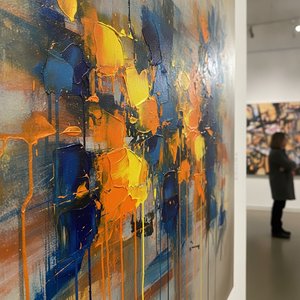
Beyond the Lines: Mastering the High-Impact World of Contemporary Abstraction
Master the high-impact world of contemporary abstraction. Discover how bold colors, textures, and modern movements like Abstract Expressionism can transform your space with premium, high-energy art curated for the design-conscious professional.


