- Accueil

- Impression sur toile
- Gérard van Honthorst
- The steadfast philosopher
 Preview
 Commander la reproduction Acheter l'image haute résolution
 Partager
 Partager
 Détails de l'œuvre
 Ajouter aux favoris

 Télécharger
 Articles similaires
 Radiographie
 Diaporama
The steadfast philosopher


 Afficher la suite
Giclée / Impression d'art
Impression giclée ou sur toile de qualité musée, avec une production rapide et des finitions au choix.




P118B $10

P118H $10

P118W $10

P438Z $10

P508JH $12

P508YH $12

P805H $10

P805Z $10

P919BZ $10

P919G $10

P919XJ $10

P959ZH $10

P968JZ $12

W106C $8

W218G $10

W218JH $8

W218Y $10

W307PJ $10

W316G $10

W316PJ $8

W316Y $10

W398PJ $8

W4111J $10

W500HY $15

W500JH $15

W692G $12

W849H $8

W940BG $15

W953PJ $8




Choisissez parmi nos formats prédéfinis qui respectent les proportions originales de l’œuvre.

Vous pouvez saisir vos propres dimensions pour vous adapter à un cadre ou à un espace spécifique. Si la taille sélectionnée ne correspond pas aux proportions de l'image originale, nous recadrerons l'œuvre ou étendrons l'image avec une bordure en miroir ou une couleur unie. Une maquette numérique vous sera envoyée pour approbation avant le début de la production.
Veuillez noter que l'aperçu à l'écran ne reflète pas le recadrage ou l'extension réelle. Seule la maquette montrera avec précision la composition finale.
Bien que des tailles personnalisées soient disponibles, nous vous recommandons de choisir une dimension dans la liste prédéfinie afin de préserver les proportions originales.
Livraison dans le monde entier () en 2 semaines au lieu des 4/5 semaines habituelles. (23 juillet)

Livraison express gratuite dans le monde entier

Toile de lin de haute qualité

Assurance transport complète

Garantie de remboursement des frais de douane

Garantie de fidélité des couleurs

Politique de retour de 60 jours (uniquement en cas de défaut)

Garantie de remboursement à 100%

Réduction sur les achats groupés
 L'option verre n'est disponible que pour les dimensions inférieures à 110 cm.

The steadfast philosopher
Giclée / Impression d'art
Format de reproduction
-


Prix total final
-
Description de l'œuvre
The Steadfast Philosopher: A Window into Honthorst's Baroque Intimacy
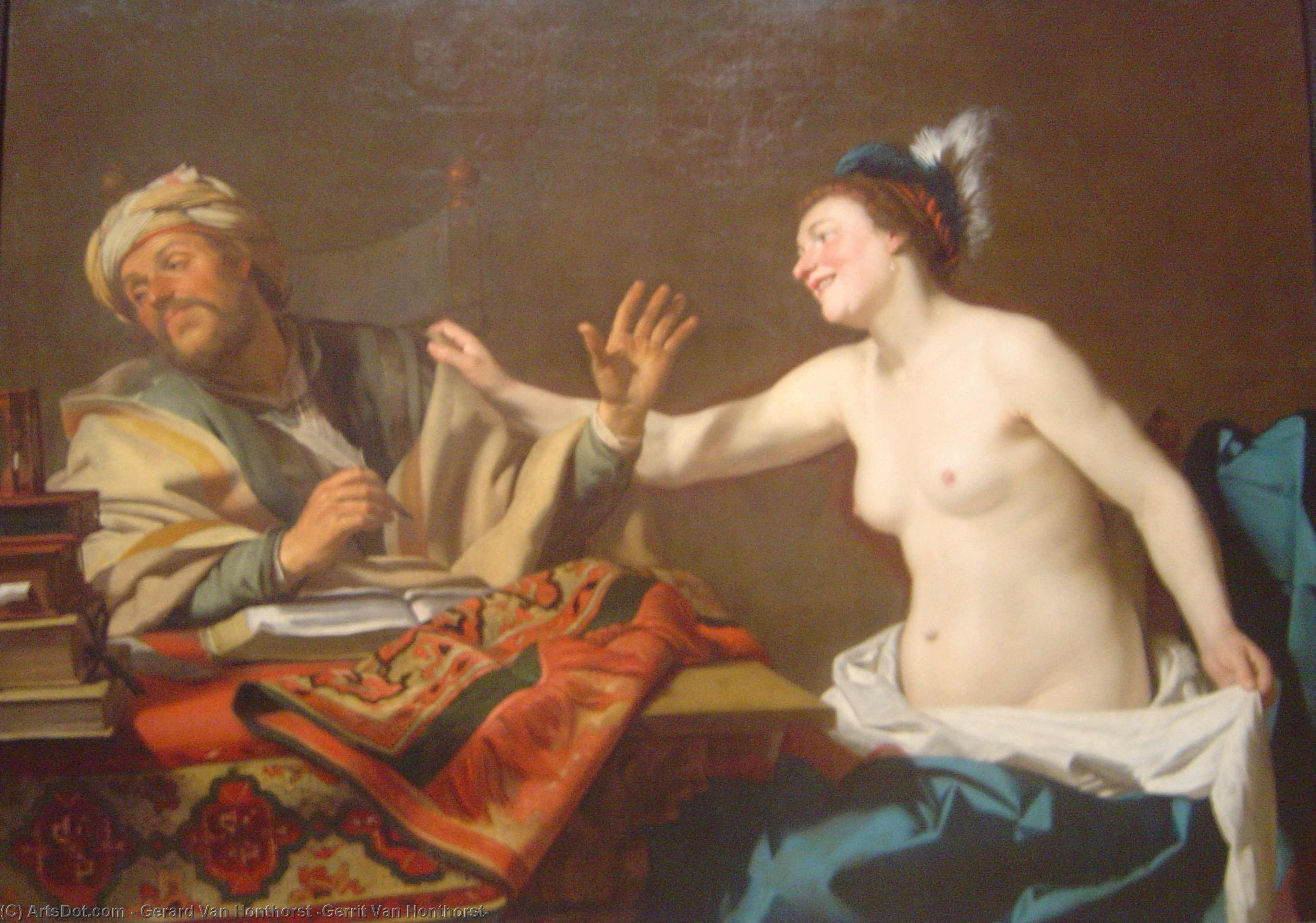
Gerard van Honthorst’s “The Steadfast Philosopher” is not merely a portrait; it’s an immersion into the heart of 17th-century Dutch life, rendered with a dramatic intensity that speaks to the era’s fascination with light and shadow – a hallmark of what became known as ‘Gherardo delle Notti,’ or Gerard of the Nights. This captivating scene depicts a private moment of intellectual exchange between a man and woman, their figures bathed in a carefully orchestrated chiaroscuro that draws the viewer into their intimate world. The painting’s power lies not just in its subject matter – a conversation potentially blossoming into something more – but in Honthorst's masterful manipulation of light to evoke a palpable sense of desire and contemplation.
Honthorst, deeply influenced by Caravaggio’s revolutionary use of tenebrism, employed this technique with precision. Notice how the strong directional light illuminates the man’s turbaned head and beard, drawing immediate attention to his intellectual presence, while simultaneously casting the woman in a softer, more ambiguous glow. This deliberate contrast heightens the scene's dramatic tension and underscores the painting’s sensual undertones. The inclusion of scattered books – open to specific pages – subtly reinforces the theme of knowledge and discourse, suggesting that this is not simply a depiction of physical attraction but also an exchange of ideas.
A Masterclass in Baroque Composition
The composition itself is meticulously constructed, reflecting the prevailing principles of Baroque art. The figures are arranged within a shallow space, creating a sense of immediacy and drawing the viewer into the scene. The table acts as a visual anchor, grounding the composition while simultaneously suggesting a space for interaction and reflection. Honthorst’s use of perspective – subtly employed to create depth – further enhances the illusion of realism, making the figures appear almost tangible. The woman's pose, with her hand resting lightly on the table, invites the viewer into this intimate tableau, fostering a sense of voyeuristic curiosity and admiration for the scene’s quiet drama.
Symbolism and Context: Utrecht Caravaggisti
“The Steadfast Philosopher” is a prime example of Honthorst's work within the Utrecht Caravaggisti school. This group, centered in Utrecht, was profoundly influenced by Caravaggio’s dramatic style, particularly his use of dark backgrounds and intense lighting. Their paintings often depicted scenes of everyday life – brothel scenes, philosophical discussions, and intimate gatherings – imbued with a heightened sense of emotion and realism. The inclusion of the blue cloth covering the woman's breasts is significant; while potentially provocative in its time, it also aligns with Baroque artistic conventions that frequently explored themes of beauty, sensuality, and the human form. The books themselves symbolize knowledge, wisdom, and perhaps even the pursuit of enlightenment – elements central to the philosophical nature of the scene.
Emotional Impact & Reproduction Value
Ultimately, “The Steadfast Philosopher” transcends a simple portrait; it’s an evocative exploration of human connection, intellectual curiosity, and the allure of the unknown. Honthorst's ability to capture such nuanced emotion through light and composition is what makes this painting so enduringly captivating. A hand-painted reproduction of this artwork offers a unique opportunity to bring this Baroque masterpiece into your home or office – a stunning addition that will undoubtedly spark conversation and inspire contemplation, mirroring the original’s profound emotional impact.
Biographie de l'artiste
Première jeunesse et formation
Gérard van Honthorst, peintre néerlandais important de l'âge d'or néerlandais, est né le 4 novembre 1590 à Utrecht. Il était le fils d’un peintre décorateur et a initialement été formé sous la direction de son père. Plus tard, il a poursuivi sa formation artistique sous Abraham Bloemaert.Carrière et influences
La carrière précoce de van Honthorst a impliqué une visite à Rome, où il a été fortement influencé par le style de Caravage. Cette influence se manifeste dans ses œuvres ultérieures, en particulier dans son utilisation de scènes éclairées artificiellement, ce qui lui a valu le surnom de « Gherardo delle Notti » ou « Gérard des nuits ». À son retour aux Pays-Bas, van Honthorst est devenu un peintre portraitiste de premier plan.Commandes notables et mécénat
Le travail de van Honthorst était très demandé, avec des mécènes notables tels que Vincenzo Giustiniani, qui l’a chargé de peindre « Christ devant le grand prêtre », exposé à la National Gallery de Londres. Il a également travaillé pour Cosme II de Médicis, grand-duc de Toscane, et était un favori auprès de la République néerlandaise et à l’étranger.Héritage et vie ultérieure
En 1620, van Honthorst est retourné à Utrecht, où il a bâti une réputation considérable. En 1623, année de son mariage, il était devenu président de la guilde Saint-Luc d’Utrecht. Son succès a conduit à des recommandations par Sir Dudley Carleton pour l'Earl of Arundel et Lord Dorchester.Œuvres clés et collaborations
- La prise du Christ, une œuvre collaborative initialement attribuée à van Honthorst, aujourd'hui reconnue comme l’œuvre d’un autre artiste.
- Christ devant le grand prêtre, commandée par Vincenzo Giustiniani, met en valeur la capacité de van Honthorst à capturer des scènes éclairées artificiellement.
- Des collaborations avec d’autres artistes, tels que Peter Paul Rubens, démontrent son influence sur le style baroque flamand.
Mouvement artistique et style
Van Honthorst faisait partie du mouvement des Utrecht Caravaggistes, caractérisé par l’utilisation d’un éclairage dramatique et d’une profondeur émotionnelle intense. Son travail reflète l’influence de la baroque italienne, tout en contribuant au développement de l'âge d'or néerlandais. Principaux liens :
Gérard van Honthorst
1590 - 1656 , Pays-Bas
En bref
- Artistic Movement Or Style: Caravagisme d'Utrecht, Baroque
- Artists Or Movements Influenced By This Artist:
- Rembrandt van Rijn
- Georges de la Tour
- Artists Who Influenced This Artist:
- Caravage
- Abraham Bloemaert
- Date Of Birth: 4 novembre 1590
- Date Of Death: 27 avril 1656
- Full Name: Gérard van Honthorst
- Nationality: Néerlandais
- Notable Artworks:
- Christ avant le grand prêtre
- La Prise du Christ
- Place Of Birth (City And Country): Utrecht, Pays-Bas