Aperçu en situation
 Partager
 Partager
 Détails
 Guide imprimable

 Télécharger
 Articles similaires
 Radiographie
 Voir le diaporama
 Statistiques
Saint Sebastian
 Acrylic On Canvas
- WallArt
- Baroque
 1623
1623 101.0 x 117.0 cm
 National Gallery
 Afficher la suite
Reproduction à l'huile faite à la main
Huile sur toile peinte à la main, avec cadre et dimensions personnalisés, réalisée sur commande par nos artistes. ( Passer au format impression Passer au format image numérique)




P118B €10

P118H €10

P118W €10

P438Z €10

P508JH €12

P508YH €12

P805H €10

P805Z €10

P919BZ €10

P919G €10

P919XJ €10

P959ZH €10

P968JZ €12

W106C €8

W218G €10

W218JH €8

W218Y €10

W307PJ €10

W316G €10

W316PJ €8

W316Y €10

W398PJ €8

W4111J €10

W500HY €15

W500JH €15

W692G €12

W849H €8

W940BG €15

W953PJ €8




Choisissez parmi nos formats prédéfinis qui respectent les proportions originales de l’œuvre.

Vous pouvez saisir vos propres dimensions pour l'adapter à un cadre ou à un espace spécifique. Si la taille sélectionnée ne correspond pas aux proportions de l'image d'origine, nous recadrerons l'œuvre ou prolongerons la peinture avec des éléments peints à la main supplémentaires. Une maquette numérique vous sera envoyée pour approbation avant le début de la production.
Veuillez noter que l'aperçu à l'écran ne reflète pas le recadrage ou l'extension réels. Seule la maquette montrera fidèlement la composition finale.
Bien que des tailles personnalisées soient disponibles, nous vous recommandons de sélectionner une dimension dans la liste prédéfinie afin de préserver les proportions d'origine.
Après la commande, l’équipe OriginalUniqueArt.com contactera le client par e-mail pour recueillir ses instructions et lui fournira une maquette d’aperçu
Livraison dans le monde entier () en 3 à 4 semaines au lieu des 5 semaines habituelles. (11 octobre). Aucun compromis sur la qualité.

Livraison express gratuite dans le monde entier

Toile de lin de haute qualité

Assurance transport complète

Garantie de remboursement des droits de douane

Garantie de fidélité des couleurs

Garantie de retour de 100 jours (uniquement en cas de défaut)

Garantie de remboursement à 100%

Tarifs dégressifs sur quantité
 L'option verre n'est disponible que pour les dimensions inférieures à 110 cm.

Saint Sebastian
Technique de reproduction
Format de la reproduction
-


Prix total final
€ 259
The Drama of Light and Shadow: Gerard van Honthorst’s Saint Sebastian
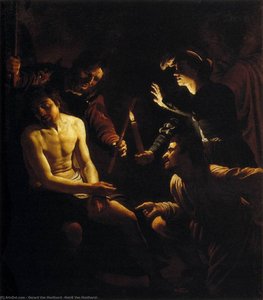
Gerard van Honthorst's 1623 depiction of Saint Sebastian is not merely a religious painting; it’s a masterclass in dramatic illumination, a testament to the artist’s profound understanding of light and shadow – a technique he famously adopted from the revolutionary Caravaggio. This arresting image transcends its biblical subject matter, becoming a study in human suffering, resilience, and the potent interplay between darkness and hope. The painting immediately commands attention with its stark contrasts, pulling the viewer into a scene of agonizing beauty, where every arrow wound is rendered with meticulous detail and imbued with an almost palpable sense of pain.
Honthorst’s Utrecht workshop produced numerous works influenced by Caravaggio's *tenebrism*, but this Saint Sebastian stands apart. Unlike earlier depictions that often focused on the saint’s idealized martyrdom, Honthorst presents a profoundly vulnerable figure. The composition is deliberately unbalanced; Sebastian, stripped of his armor and draped in simple robes, lies prone amidst a dark, undefined landscape. His body, pierced by a multitude of arrows – some still protruding, others embedded deep within his flesh – dominates the foreground, drawing our eye to the raw physicality of his ordeal. The artist doesn’t shy away from depicting the gruesome reality of Sebastian's suffering; the wounds are not softened or romanticized, but presented with unflinching honesty.
A Roman Masterpiece Rooted in Caravaggio’s Legacy
Honthorst’s journey to Rome in his youth proved transformative. He was deeply moved by Caravaggio’s radical approach to painting – the dramatic use of light and shadow, the intense realism, and the emotional depth conveyed through seemingly simple scenes. This encounter fundamentally shaped Honthorst's artistic style, leading him to prioritize creating a sense of theatricality and psychological intensity in his work. The influence is immediately apparent here; the deep shadows enveloping much of the scene create an atmosphere of suspense and foreboding, while strategically placed highlights accentuate Sebastian’s wounds and draw attention to his agonizing expression.
The painting's historical context is equally important. Sebastian was a Roman centurion martyred for his Christian faith during the reign of Diocletian. The story resonated deeply with the populace, particularly during periods of plague and unrest, and became associated with protection against disease. Honthorst’s depiction aligns perfectly with this contemporary belief; Sebastian's suffering becomes a symbol of endurance in the face of adversity, offering solace and hope to those enduring hardship. The presence of Irene, depicted tending to his wounds in later versions of the story (though not explicitly present here), further reinforces this theme of healing and divine intervention.
Symbolism and Emotional Resonance
Beyond its narrative content, Saint Sebastian is rich in symbolic meaning. The arrows themselves represent the physical and spiritual wounds inflicted upon the faithful by persecution. The stark contrast between light and shadow symbolizes the struggle between good and evil, hope and despair. Sebastian’s posture – his arms outstretched, his head bowed – conveys a profound sense of vulnerability and resignation, yet also hints at an underlying strength and unwavering faith. The artist masterfully captures the complex interplay of emotions—pain, suffering, acceptance, and ultimately, spiritual fortitude.
The painting's enduring power lies in its ability to evoke a visceral emotional response. It’s not simply a depiction of a historical event; it’s an exploration of human experience – the pain of loss, the resilience of the spirit, and the eternal struggle between darkness and light. Gerard van Honthorst’s Saint Sebastian remains a compelling testament to the artist's skill and his profound understanding of the human condition, offering viewers a timeless meditation on faith, suffering, and redemption.
Questions et réponses
Combien de personnes consultent « Saint Sebastian » ?
Les statistiques concernant «Saint Sebastian» de Gérard van Honthorst se trouvent sur la page Statistiques de l'œuvre : visites mensuelles de l'œuvre, visites des œuvres de l'artiste, ainsi que la répartition par pays et par langue des visiteurs récents.
Quelle saturation et quelle intensité «Saint Sebastian» de Gérard van Honthorst présente-t-il ?
La couleur de « Saint Sebastian » présente une saturation de Muted et une intensité de Monochromatic.
Quelle est la date de création de «Saint Sebastian» de Gérard van Honthorst ?
«Saint Sebastian» date de 1623. Cette date inscrit l'œuvre dans la carrière de Gérard van Honthorst ainsi que dans son époque.
Qui est l'artiste derrière « Saint Sebastian » ?
L'artiste à l'origine de « Saint Sebastian » est Gérard van Honthorst. L'œuvre est répertoriée sous le nom de Gérard van Honthorst.
Quelle taille de reproduction est suggérée pour «Saint Sebastian» de Gérard van Honthorst ?
La taille d'impression recommandée pour «Saint Sebastian» de Gérard van Honthorst est Medium.
Quel âge avait Gérard van Honthorst lors de la création de « Saint Sebastian » en 1623 ?
Gérard van Honthorst a réalisé « Saint Sebastian » à l'âge de 33. L'artiste est né en 1590 et l'œuvre date de 1623.
Quelle ambiance "Saint Sebastian" apporterait-elle à une pièce ?
«Saint Sebastian» de Gérard van Honthorst possède une atmosphère Dramatic et est recommandé pour une Living Room. L'ambiance correspond à ce que l'œuvre apporte à l'espace qui l'entoure.
Biographie de l'artiste
Première jeunesse et formation
Gérard van Honthorst, peintre néerlandais important de l'âge d'or néerlandais, est né le 4 novembre 1590 à Utrecht. Il était le fils d’un peintre décorateur et a initialement été formé sous la direction de son père. Plus tard, il a poursuivi sa formation artistique sous Abraham Bloemaert.Carrière et influences
La carrière précoce de van Honthorst a impliqué une visite à Rome, où il a été fortement influencé par le style de Caravage. Cette influence se manifeste dans ses œuvres ultérieures, en particulier dans son utilisation de scènes éclairées artificiellement, ce qui lui a valu le surnom de « Gherardo delle Notti » ou « Gérard des nuits ». À son retour aux Pays-Bas, van Honthorst est devenu un peintre portraitiste de premier plan.Commandes notables et mécénat
Le travail de van Honthorst était très demandé, avec des mécènes notables tels que Vincenzo Giustiniani, qui l’a chargé de peindre « Christ devant le grand prêtre », exposé à la National Gallery de Londres. Il a également travaillé pour Cosme II de Médicis, grand-duc de Toscane, et était un favori auprès de la République néerlandaise et à l’étranger.Héritage et vie ultérieure
En 1620, van Honthorst est retourné à Utrecht, où il a bâti une réputation considérable. En 1623, année de son mariage, il était devenu président de la guilde Saint-Luc d’Utrecht. Son succès a conduit à des recommandations par Sir Dudley Carleton pour l'Earl of Arundel et Lord Dorchester.Œuvres clés et collaborations
- La prise du Christ, une œuvre collaborative initialement attribuée à van Honthorst, aujourd'hui reconnue comme l’œuvre d’un autre artiste.
- Christ devant le grand prêtre, commandée par Vincenzo Giustiniani, met en valeur la capacité de van Honthorst à capturer des scènes éclairées artificiellement.
- Des collaborations avec d’autres artistes, tels que Peter Paul Rubens, démontrent son influence sur le style baroque flamand.
Mouvement artistique et style
Van Honthorst faisait partie du mouvement des Utrecht Caravaggistes, caractérisé par l’utilisation d’un éclairage dramatique et d’une profondeur émotionnelle intense. Son travail reflète l’influence de la baroque italienne, tout en contribuant au développement de l'âge d'or néerlandais. Principaux liens :
Gérard van Honthorst
1590 - 1656 , Pays-Bas
En bref
- Artistic Movement Or Style: Caravagisme d'Utrecht, Baroque
- Artists Or Movements Influenced By This Artist:
- Rembrandt van Rijn
- Georges de la Tour
- Artists Who Influenced This Artist:
- Caravage
- Abraham Bloemaert
- Date Of Birth: 4 novembre 1590
- Date Of Death: 27 avril 1656
- Full Name: Gérard van Honthorst
- Nationality: Néerlandais
- Notable Artworks:
- Christ avant le grand prêtre
- La Prise du Christ
- Place Of Birth (City And Country): Utrecht, Pays-Bas
Articles similaires
Sir Anthony van Dyck: Courtly Portraiture & the Shaping of Baroque Identity
Explore the life & legacy of Sir Anthony van Dyck, the leading court painter of his era. Discover his innovative portraiture, Baroque masterpieces, and investment potential for discerning collectors. Learn more at OriginalUniqueArt.
Gerard van Honthorst: Illuminating the Dutch Golden Age with Caravaggism & Courtly Grace
Explore the captivating world of Gerard van Honthorst, a Dutch Golden Age master renowned for his dramatic chiaroscuro & courtly portraits. Discover his life, art, and lasting influence on Baroque painting.

Les 10 Chefs-d'œuvre Baroques qui ont Révolutionné l'Art |
Plongez au cœur du baroque avec les 10 chefs-d'œuvre de Caravaggio, Rembrandt et Rubens. Découvrez l'histoire fascinante de ces artistes et leurs tableaux célèbres. Reproductions d'art de qualité muséale sur – Explorez la collection !

The Dramatic Flourish: Exploring the Baroque Movement's Enduring Legacy in Art History
Explore the dramatic world of Baroque art! Discover iconic artists like Caravaggio & Rubens, defining techniques, and its lasting impact on art history. Expert insights for collectors & enthusiasts at OriginalUniqueArt.

Rembrandt van Rijn : Les 25 Œuvres Maîtresses à Redécouvrir | OriginalUniqueArt
Plongez dans l'univers de Rembrandt van Rijn avec les 25 œuvres incontournables du maître baroque. Découvrez l'histoire, la technique et l'émotion derrière ses portraits célèbres et 'La Ronde de Nuit'. Reproductions tableaux haute qualité sur OriginalUniqueArt.com