Aperçu en situation
 Envoyer
 Partager
 Détails de l'œuvre

 Télécharger
 Articles similaires
 Radiographie
 Diaporama
Lute Player

 Lire la suite
Reproduction à l'huile faite à la main
Huile sur toile peinte à la main, avec cadre et dimensions personnalisés, réalisée sur commande par nos artistes. ( Commander l'impression Acheter l'image haute résolution)




P118B $10

P118H $10

P118W $10

P438Z $10

P508JH $12

P508YH $12

P805H $10

P805Z $10

P919BZ $10

P919G $10

P919XJ $10

P959ZH $10

P968JZ $12

W106C $8

W218G $10

W218JH $8

W218Y $10

W307PJ $10

W316G $10

W316PJ $8

W316Y $10

W398PJ $8

W4111J $10

W500HY $15

W500JH $15

W692G $12

W849H $8

W940BG $15

W953PJ $8




Choisissez parmi nos formats prédéfinis qui respectent les proportions originales de l’œuvre.

Vous pouvez saisir vos propres dimensions pour l'adapter à un cadre ou à un espace spécifique. Si la taille sélectionnée ne correspond pas aux proportions de l'image d'origine, nous recadrerons l'œuvre ou prolongerons la peinture avec des éléments peints à la main supplémentaires. Une maquette numérique vous sera envoyée pour approbation avant le début de la production.
Veuillez noter que l'aperçu à l'écran ne reflète pas le recadrage ou l'extension réels. Seule la maquette montrera fidèlement la composition finale.
Bien que des tailles personnalisées soient disponibles, nous vous recommandons de sélectionner une dimension dans la liste prédéfinie afin de préserver les proportions d'origine.
Après la commande, l’équipe OriginalUniqueArt.com contactera le client par e-mail pour recueillir ses instructions et lui fournira une maquette d’aperçu
Livraison dans le monde entier () en 3 à 4 semaines au lieu des 5 semaines habituelles. (7 septembre). Aucun compromis sur la qualité.

Livraison express gratuite dans le monde entier

Toile de lin de qualité supérieure

Assurance transport complète

Garantie de remboursement des droits de douane

Garantie de fidélité des couleurs

Politique de retour de 100 jours (uniquement en cas de défaut)

Garantie de remboursement à 100%

Offre de tarifs dégressifs
 L'option verre n'est disponible que pour les dimensions inférieures à 110 cm.

Lute Player
Technique de reproduction
Format de la reproduction
-


Prix total
$ 300
A Portrait of Dramatic Light: Unveiling "Lute Player"
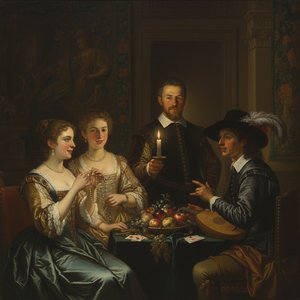
Gerard van Honthorst’s “Lute Player,” a captivating portrait dating from the mid-17th century, offers a glimpse into the opulent world of Dutch Golden Age society. The painting immediately draws the eye to its subject – a woman presented with an arresting blend of elegance and vulnerability. Dressed in a vibrant yellow gown meticulously trimmed with deep blue, she embodies the fashionable sensibilities of her era while simultaneously radiating a quiet introspection. The composition itself is carefully constructed; the lute held delicately in her hand becomes not merely an instrument but a focal point, drawing attention to her gesture and suggesting a moment of private contemplation or perhaps even performance.
The Influence of Caravaggio: Tenebrism and Emotional Intensity
Honthorst’s artistic journey was profoundly shaped by his time in Rome, where he encountered the revolutionary work of Caravaggio. This encounter ignited within him a passion for *tenebrism*, a technique characterized by dramatic contrasts between intensely dark shadows and pools of brilliant light. In “Lute Player,” this is evident in the way light dramatically illuminates the woman’s face and gown, creating a sense of theatrical depth and emphasizing her features. The darkness surrounding her isn't merely an absence of light; it actively contributes to the painting’s emotional weight, suggesting hidden depths within the subject’s character. This masterful manipulation of light and shadow is what earned Honthorst his nickname, “Gherardo delle Notti,” or Gerard of the Nights – a testament to his ability to conjure atmosphere and drama with such profound skill.
A Window into Dutch Society: Setting and Symbolism
The setting within the painting provides valuable context for understanding its place in 17th-century Dutch life. The presence of a chair and dining table hints at an aristocratic or wealthy household, suggesting that the subject is likely a member of the upper class. A book resting near her adds another layer of meaning – perhaps representing education, refinement, or even musical knowledge. The inclusion of two other figures, partially visible in the background, subtly expands the narrative, inviting the viewer to imagine the social dynamics and relationships within this domestic scene. These details are not merely decorative; they contribute significantly to the painting’s overall story.
Emotional Resonance and Artistic Legacy
"Lute Player" transcends a simple portrait; it's an exploration of human emotion and psychological depth, a hallmark of Honthorst’s style. The woman’s gentle smile, combined with the dramatic lighting and carefully considered composition, evokes a sense of quiet beauty and perhaps even melancholy. Gerard van Honthorst’s work continues to resonate today because it captures not just a likeness but an essence – a moment frozen in time that speaks to universal themes of grace, contemplation, and the power of artistic expression. OriginalUniqueArt.com is proud to offer meticulously crafted reproductions of this remarkable piece, allowing you to experience its beauty and historical significance firsthand.
Biographie de l'artiste
Première jeunesse et formation
Gérard van Honthorst, peintre néerlandais important de l'âge d'or néerlandais, est né le 4 novembre 1590 à Utrecht. Il était le fils d’un peintre décorateur et a initialement été formé sous la direction de son père. Plus tard, il a poursuivi sa formation artistique sous Abraham Bloemaert.Carrière et influences
La carrière précoce de van Honthorst a impliqué une visite à Rome, où il a été fortement influencé par le style de Caravage. Cette influence se manifeste dans ses œuvres ultérieures, en particulier dans son utilisation de scènes éclairées artificiellement, ce qui lui a valu le surnom de « Gherardo delle Notti » ou « Gérard des nuits ». À son retour aux Pays-Bas, van Honthorst est devenu un peintre portraitiste de premier plan.Commandes notables et mécénat
Le travail de van Honthorst était très demandé, avec des mécènes notables tels que Vincenzo Giustiniani, qui l’a chargé de peindre « Christ devant le grand prêtre », exposé à la National Gallery de Londres. Il a également travaillé pour Cosme II de Médicis, grand-duc de Toscane, et était un favori auprès de la République néerlandaise et à l’étranger.Héritage et vie ultérieure
En 1620, van Honthorst est retourné à Utrecht, où il a bâti une réputation considérable. En 1623, année de son mariage, il était devenu président de la guilde Saint-Luc d’Utrecht. Son succès a conduit à des recommandations par Sir Dudley Carleton pour l'Earl of Arundel et Lord Dorchester.Œuvres clés et collaborations
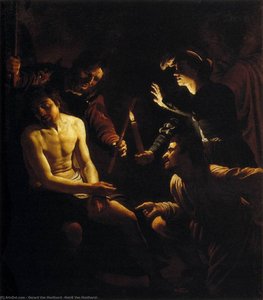
- La prise du Christ, une œuvre collaborative initialement attribuée à van Honthorst, aujourd'hui reconnue comme l’œuvre d’un autre artiste.
- Christ devant le grand prêtre, commandée par Vincenzo Giustiniani, met en valeur la capacité de van Honthorst à capturer des scènes éclairées artificiellement.
- Des collaborations avec d’autres artistes, tels que Peter Paul Rubens, démontrent son influence sur le style baroque flamand.
Mouvement artistique et style
Van Honthorst faisait partie du mouvement des Utrecht Caravaggistes, caractérisé par l’utilisation d’un éclairage dramatique et d’une profondeur émotionnelle intense. Son travail reflète l’influence de la baroque italienne, tout en contribuant au développement de l'âge d'or néerlandais. Principaux liens :
Gérard van Honthorst
1590 - 1656 , Pays-Bas
L'essentiel de l'artiste
- Artistic Movement Or Style: Caravagisme d'Utrecht, Baroque
- Artists Or Movements Influenced By This Artist:
- Rembrandt van Rijn
- Georges de la Tour
- Artists Who Influenced This Artist:
- Caravage
- Abraham Bloemaert
- Date Of Birth: 4 novembre 1590
- Date Of Death: 27 avril 1656
- Full Name: Gérard van Honthorst
- Nationality: Néerlandais
- Notable Artworks:
- Christ avant le grand prêtre
- La Prise du Christ
- Place Of Birth (City And Country): Utrecht, Pays-Bas
Articles connexes
Gerard van Honthorst: Illuminating the Dutch Golden Age with Caravaggism & Courtly Grace
Explore the captivating world of Gerard van Honthorst, a Dutch Golden Age master renowned for his dramatic chiaroscuro & courtly portraits. Discover his life, art, and lasting influence on Baroque painting.

Les 10 Chefs-d'œuvre du Baroque Néerlandais : Artistes et Décor Intemporels
Plongez au cœur du Baroque néerlandais avec les 10 œuvres incontournables de Rembrandt, Vermeer et autres maîtres hollandais. Découvrez l'histoire, la lumière et les couleurs qui ont façonné ce mouvement artistique. Reproductions d'art de qualité muséale sur OriginalUniqueArt.com

Rembrandt van Rijn : Les 25 Œuvres Maîtresses à Redécouvrir | OriginalUniqueArt
Plongez dans l'univers de Rembrandt van Rijn avec les 25 œuvres incontournables du maître baroque. Découvrez l'histoire, la technique et l'émotion derrière ses portraits célèbres et 'La Ronde de Nuit'. Reproductions tableaux haute qualité sur OriginalUniqueArt.com

Chiaroscuro and Character: A Definitive Guide to Light and Shadow in the Dutch Baroque Era
Explore the dramatic mastery of the Dutch Baroque era. Discover how masters like Rembrandt used chiaroscuro to transform everyday life into timeless art. An expert guide for collectors and enthusiasts seeking to understand the profound interplay of light and shadow.

L'Âge d'Or Néerlandais : Splendeur Baroque et Révolution Artistique
Explorez l'Âge d'Or néerlandais : découvrez les maîtres baroques (Rembrandt, Fabritius) et leur révolution artistique. Analyse approfondie, contexte historique et héritage durable. Un voyage au cœur de la peinture du XVIIe siècle.