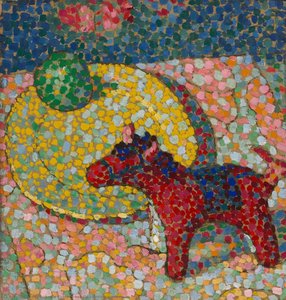
Aperçu en situation
 Partager
 Partager
 Détails
 Guide imprimable

 Télécharger
 Articles similaires
 Radiographie
 Voir le diaporama
 Statistiques
Sans titre
 Aquarelle
- Art mural
- Modernisme américain
 1915
1915- Époque moderne
 47.0 x 61.0 cm
 Amon Carter Museum of American Art
 Afficher la suite
L’œuvre d'art présentée sur cette page est protégée par le droit d'auteur, ce qui signifie que nous ne pouvons légalement créer ou vendre de reproduction identique. Cette protection est appliquée en vertu d'accords internationaux tels que la Convention de Berne et par les lois nationales, notamment celles énoncées par le Loi américaine sur le droit d'auteur - Titre 17.
Cette méthode est pleinement conforme aux réglementations sur le droit d'auteur car elle ne repose pas sur la copie ou la duplication de l'œuvre protégée. Il s'agit plutôt d'une réinterprétation créative — une nouvelle peinture qui s'inspire de l'original sans pour autant lui être identique.
Giclées et impressions d'art
Impressions giclées ou sur toile de qualité musée, avec une production rapide et des finitions au choix. ( Acheter la peinture faite à la main Passer au format image numérique)




P118B €10

P118H €10

P118W €10

P438Z €10

P508JH €12

P508YH €12

P805H €10

P805Z €10

P919BZ €10

P919G €10

P919XJ €10

P959ZH €10

P968JZ €12

W106C €8

W218G €10

W218JH €8

W218Y €10

W307PJ €10

W316G €10

W316PJ €8

W316Y €10

W398PJ €8

W4111J €10

W500HY €15

W500JH €15

W692G €12

W849H €8

W940BG €15

W953PJ €8




Choisissez parmi nos formats prédéfinis qui respectent les proportions originales de l’œuvre.

Saisissez la largeur et la hauteur souhaitées pour qu'elles s'adaptent à votre cadre ou à votre mur. Une impression ne peut être que découpée, elle ne peut jamais être agrandie au-delà de l'image originale ; ainsi, un format de forme différente entraînera la perte d'une partie de l'image. Nous vous envoyons une maquette numérique pour approbation avant toute impression. L'image présentée sur cette page ne montre pas le recadrage réel — seule la maquette le permet.
Livraison dans le monde entier () en 2 semaines au lieu des 4/5 semaines habituelles. (21 octobre)

Livraison express gratuite dans le monde entier

Toile de lin de haute qualité

Assurance transport complète

Garantie de remboursement des droits de douane

Garantie de fidélité des couleurs

Garantie de retour de 100 jours (uniquement en cas de défaut)

Garantie de remboursement à 100%

Tarifs dégressifs sur quantité
 L'option verre n'est disponible que pour les dimensions inférieures à 110 cm.

Sans titre
Giclées et impressions d'art
Format de la reproduction
-


Prix total final
€ 70
Une symphonie silencieuse de formes et de couleurs
Dans le royaume paisible du modernisme américain, peu d'œuvres capturent la tension délicate entre force et fragilité aussi poignantement que le chef-d'œuvre de 1915 de Georgia O’Keeffe, "Sans titre." Cette composition évocatrice à l'aquarelle et à la gouache sert d'exploration profonde de l'esprit essentiel de la nature, dépouillant l'inutile pour révéler une beauté squelettique. Au premier regard, le spectateur est confronté à un arbre solitaire ; pourtant, s'y attarder, c'est entrer dans un état méditatif où les frontières entre le paysage physique et le subconscient humain commencent à se brouiller. O’Keeffe ne peint pas simplement un spécimen botanique ; elle orchestre un poème visuel qui parle de résilience, de croissance et de la persistance tranquille de la vie au milieu d'un terrain accidenté.
La puissance du tableau prend racine dans son utilisation magistrale de l'expression minimaliste. Fortement influencée par les enseignements d'Arthur Wesley Dow, O’Keeffe s'est éloignée des contraintes étouffantes du réalisme photographique pour embrasser une vérité plus subjective. Dans cette œuvre, nous voyons la « ligne d'action » prendre vie à travers un tronc central imposant qui ancre la composition avec une stabilité terrestre. Pourtant, cette force est magnifiquement subvertie par une branche délicate s'élançant vers le haut et spiralant vers les cieux, parée de fleurs douces. Cette asymétrie délibérée crée un pouls rythmique au sein de la pièce, reflétant l'imprévisibilité organique du monde naturel et invitant l'œil à danser sur le papier dans une boucle continue de découverte.
Technique, texture et lumière de la mémoire
Le choix de l'aquarelle et de la gouache permet à O’Keeffe de manipuler la lumière et la translucidité avec une grâce inégalée. Elle emploie des lavis lumineux qui semblent briller de l'intérieur, particulièrement là où les roses pâles et les blancs des fleurs rencontrent les tons plus sombres et plus graves du paysage. La palette est une étude sophistiquée de l'harmonie par le contraste ; des verts feutrés et des bruns terreux évoquent les textures érodées d'une colline rocheuse, offrant une fondation lourde et tactile aux éléments floraux éthérés. Grâce à l'application habile de couches à la fois fines et aqueuses et de touches plus épaisses et opaques, elle parvient à un sentiment de profondeur qui rend la surface bidimensionnelle aussi vaste et vibrante que les paysages du Nouveau-Mexique qui définiront plus tard sa carrière.
Pour le collectionneur averti ou le décorateur d'intérieur, cette œuvre offre bien plus qu'une simple décoration ; elle constitue une ancre émotionnelle. La pièce possède une qualité intemporelle qui transcende les époques, en faisant une pièce maîtresse polyvalente pour les espaces valorisant la tranquillité, la sophistication et la profondeur intellectuelle. Qu'elle soit placée dans un studio baigné de soleil ou dans un salon contemporain et minimaliste, « Sans titre » agit comme une fenêtre sur un monde serein et contemplatif. C'est une œuvre d'une profonde résonance émotionnelle, nous rappelant que même dans les moments les plus solitaires, il existe une beauté magnifique et déployée à trouver dans les formes les plus simples de l'existence.
Questions et réponses
Que représente « Sans titre » ?
Les thèmes présents dans «Sans titre» de Georgia O'Keeffe incluent peinture de paysage, forme de l'arbre, motif en spirale, terrain rocheux, art botanique, style minimaliste. Ensemble, ils résument le sujet de l'œuvre.
L'œuvre « Sans titre » est-elle libre de droits ?
«Sans titre» de Georgia O'Keeffe est dans le toujours protégé par le droit d'auteur. Ce statut régit les modalités de reproduction de l'image de l'œuvre.
Quelle nuance dominante traverse «Sans titre» de Georgia O'Keeffe ?
La teinte dominante de «Sans titre» de Georgia O'Keeffe est De l'ocre au sépia. Cette teinte constitue la tonalité de fond de la palette.
Biographie de l'artiste
Early Life and Artistic Foundations
Georgia Totto O’Keeffe, a name synonymous with American modernism, emerged from the unassuming landscape of Sun Prairie, Wisconsin, in 1887. Born into a family of Irish and Hungarian descent engaged in dairy farming, young Georgia displayed an artistic inclination early on, deciding by age ten that she would dedicate her life to art. This determination was nurtured through lessons with local watercolorist Sara Mann, followed by formal studies at the School of the Art Institute of Chicago from 1905 to 1906 and later at the University of Virginia. However, it was her encounter with Arthur Wesley Dow’s principles – emphasizing personal expression and a harmonious balance of color and line – that truly ignited her artistic path. Dow's teachings steered O’Keeffe away from strict realism toward a more subjective and emotionally resonant approach to art, an approach that would define her career. These formative years weren’t without their challenges; periods of illness and dissatisfaction led her to temporarily abandon painting, but the creative impulse always drew her back, evolving with each new experience and influence.New York and the Stieglitz Circle
A pivotal moment arrived in 1916 when O’Keeffe’s abstract charcoal drawings were discovered by Alfred Stieglitz, a renowned photographer and art dealer. He exhibited her work without her prior knowledge, sparking a dialogue that would profoundly shape both their lives and the course of American art. Stieglitz recognized an exceptional talent in O’Keeffe, one that resonated with his own modernist sensibilities. He invited her to New York City in 1918, providing not only professional support but also fostering a deep personal connection. Their relationship blossomed into marriage in 1924, creating a dynamic artistic partnership and intellectual exchange. Stieglitz championed O’Keeffe’s work, showcasing it at his gallery “291” and promoting her as a leading figure in the American avant-garde. During this period, she began to develop her signature style – bold, simplified forms and intensely saturated colors – initially expressed through depictions of New York skyscrapers and, most famously, magnified flower paintings. These floral works, often interpreted (though consistently denied by O’Keeffe herself) as veiled representations of female anatomy, challenged conventional notions of beauty and sexuality in art.The Allure of the Southwest
While New York provided a crucial platform for her early success, it was the landscapes of the American Southwest that truly captivated O’Keeffe’s imagination and profoundly influenced her artistic vision. Her first visit to New Mexico in 1929 marked the beginning of a lifelong love affair with the region’s stark beauty, vibrant colors, and unique cultural heritage. The vastness of the desert, the dramatic rock formations, and the ancient Pueblo architecture resonated deeply within her, inspiring a new series of paintings that reflected the spirit of the land. Works like *Cow’s Skull: Red, White, and Blue* (1931) and *Summer Days* (1936) are powerful testaments to this influence, transforming seemingly mundane objects into iconic symbols of the American West. She eventually settled permanently in New Mexico in 1949 following Stieglitz’s death, establishing a home and studio in Abiquiu that became integral to her artistic process and identity.Legacy and Enduring Influence
Georgia O’Keeffe continued to paint prolifically throughout her life, experimenting with new subjects and pushing the boundaries of abstraction. Her later works included aerial views of clouds and skies, reflecting a fascination with the vastness and ethereal quality of the natural world. She remained fiercely independent and uncompromising in her artistic vision, refusing to be categorized or defined by prevailing art movements. O’Keeffe’s impact on American art is immeasurable. She paved the way for future generations of female artists, challenging societal norms and asserting her own unique voice in a male-dominated field. Her paintings continue to captivate audiences with their bold simplicity, emotional depth, and evocative power. The establishment of the Georgia O’Keeffe Museum in Santa Fe in 1997 further solidified her legacy, preserving her art and providing a space for ongoing scholarship and appreciation. O’Keeffe's influence extends beyond painting; she became an icon of American individualism and self-reliance, inspiring countless artists and admirers with her unwavering commitment to her craft and her unique perspective on the world.
Georgia O'Keeffe
1887 - 1986 , États-Unis d'Amérique
En bref
- Artistic Movement Or Style: Modernisme américain, Précisionnisme
- Artists Who Influenced This Artist: ['Alfred Stieglitz']
- Date Of Birth: 15 novembre 1887
- Date Of Death: 1986
- Full Name: Georgia O'Keeffe
- Nationality: Américaine
- Notable Artworks:
- Lumière de l'Iris
- Poppies orientaux
- Bleu et Vert Musique
- Sole pâle
- Cow's Skull Red, White & Blue
- Musique, Rose et Bleu N° 2
- Abstraction bleue
- Tête de mouton, Hibiscus blanc
- Vague bleue Maine
- Place Of Birth (City And Country): Sun Prairie, États-Unis
Articles connexes

Éphémères Visions : L'Aquarelle, Histoire et Résonance Émotionnelle d'un Art Intemporel
Explorez l'histoire fascinante de l'aquarelle, des origines à nos jours. Découvrez les techniques, les artistes emblématiques et nos conseils d'experts pour collectionner ces œuvres éphémères. OriginalUniqueArt.

L'Aquarelle : Histoire, Techniques et Nuances d'une Peinture de Lumière Éphémère
Explorez l'histoire fascinante de l'aquarelle, des techniques ancestrales aux maîtres impressionnistes. Découvrez les artistes emblématiques et nos conseils pour apprécier et collectionner cette peinture lumineuse.

Les 10 Chefs-d'œuvre de l'Aquarelle qui ont Révolutionné l'Art | OriginalUniqueArt
Plongez dans l'univers fascinant des 10 chefs-d'œuvre de l'aquarelle qui ont marqué l'histoire de l'art. Découvrez Turner, Monet, Goya et bien d'autres ! Retrouvez ces œuvres emblématiques en reproductions exceptionnelles sur OriginalUniqueArt.com.

Ephemeral Visions: Exploring the Artistic Legacy & Contemporary Practice of Watercolor Painting
Explore the captivating world of watercolor painting! Discover its rich history, essential techniques, influential artists & collecting tips. A comprehensive guide for art enthusiasts from OriginalUniqueArt.

Georgia O'Keeffe : Réinventer le modernisme américain à travers le symbolisme et les paysages
Explorez l'univers fascinant de Georgia O'Keeffe, pionnière du modernisme américain. Découvrez son symbolisme floral unique, son évolution artistique et son héritage durable. Analyse approfondie et expertise OriginalUniqueArt.