Aperçu en situation
 Envoyer
 Partager
 Détails de l'œuvre
 Guide
Guide

 Télécharger l'image
 Articles similaires
 Radiographie
 Diaporama
 Questions et réponses
 Statistiques
Odalisque


 Lire la suite
L’œuvre d'art présentée sur cette page est protégée par le droit d'auteur, ce qui signifie que nous ne pouvons légalement créer ou vendre de reproduction identique. Cette protection est appliquée en vertu d'accords internationaux tels que la Convention de Berne et par les lois nationales, notamment celles énoncées par le Loi américaine sur le droit d'auteur - Titre 17.
Cette méthode est pleinement conforme aux réglementations sur le droit d'auteur car elle ne repose pas sur la copie ou la duplication de l'œuvre protégée. Il s'agit plutôt d'une réinterprétation créative — une nouvelle peinture qui s'inspire de l'original sans pour autant lui être identique.
Giclées et impressions d'art
Impressions giclées ou sur toile de qualité musée, avec une production rapide et des finitions au choix. ( Commander la reproduction peinte à la main Passer au format numérique)




P118B €10

P118H €10

P118W €10

P438Z €10

P508JH €12

P508YH €12

P805H €10

P805Z €10

P919BZ €10

P919G €10

P919XJ €10

P959ZH €10

P968JZ €12

W106C €8

W218G €10

W218JH €8

W218Y €10

W307PJ €10

W316G €10

W316PJ €8

W316Y €10

W398PJ €8

W4111J €10

W500HY €15

W500JH €15

W692G €12

W849H €8

W940BG €15

W953PJ €8




Choisissez parmi nos formats prédéfinis qui respectent les proportions originales de l’œuvre.

Saisissez la largeur et la hauteur souhaitées pour qu'elles s'adaptent à votre cadre ou à votre mur. Une impression peut être recadrée, mais jamais agrandie au-delà de l'image originale ; ainsi, un format de forme différente entraînera la perte d'une partie de l'image. Nous vous envoyons une maquette numérique pour approbation avant toute impression. L'image présentée sur cette page ne montre pas le recadrage réel — seule la maquette le permet.
Livraison dans le monde entier () en 2 semaines au lieu des 4/5 semaines habituelles. (7 novembre)

Livraison express gratuite dans le monde entier

Toile de lin de qualité supérieure

Assurance transport complète

Garantie de remboursement des droits de douane

Garantie de fidélité des couleurs

Politique de retour de 100 jours (uniquement en cas de défaut)

Garantie de remboursement à 100%

Offre de tarifs dégressifs
 L'option verre n'est disponible que pour les dimensions inférieures à 110 cm.

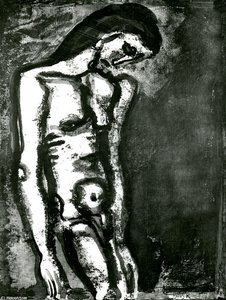
Odalisque
Giclées et impressions d'art
Format de la reproduction
-


Prix total
€ 72
Odalisque: A Window into Rouault’s Soul
Georges Rouault's "Odalisque" isn’t merely a depiction of a reclining woman; it’s a profound meditation on isolation, spirituality, and the human condition. Painted in 1906, this work exemplifies Rouault’s unique artistic vision – a stark departure from the polished surfaces of Impressionism and Fauvism, instead embracing a raw, emotionally charged realism that would later influence Expressionist movements. The painting immediately draws the viewer into a space of quiet contemplation, dominated by a palette of deep blues, blacks, and grays punctuated by flashes of red and orange – colors deliberately chosen to evoke both melancholy and a sense of hidden intensity.
Rouault’s technical mastery is evident in every brushstroke. He employs thick, deliberate lines that define the figure's form with an almost sculptural quality. These aren’t delicate lines; they possess a palpable energy, conveying a deep sense of emotional turmoil. The layering and blending of paint create areas of rich texture – visible brushstrokes suggest a surface that is both solid and vulnerable. The use of light is dramatic, casting strong shadows that obscure parts of the scene while highlighting others, contributing to the overall atmosphere of mystery and introspection. Notice how the flattened perspective, absent of traditional depth cues, forces the viewer into an almost claustrophobic relationship with the subject, mirroring perhaps the feeling of confinement often associated with isolation.
Echoes of Ingres and a Spiritual Quest
Rouault’s artistic lineage is complex and fascinating. While he was influenced by the bold color palettes and expressive lines of artists like Vincent van Gogh, his roots lie firmly in the tradition of French academic painting, particularly the work of Jean-Auguste-Dominique Ingres. “Odalisque” shares a kinship with Ingres’s own iconic "Grande Odalisque," though Rouault's interpretation is far more psychologically complex. Just as Ingres used elongated proportions to convey sensuality and beauty, Rouault employs distortion to expose the vulnerability and perhaps even despair of his subject. The influence of Mannerist painters like Parmigianino – known for their distorted figures – can be seen in the exaggerated features and unsettling gaze of the odalisque.
However, “Odalisque” transcends mere imitation. Rouault’s personal journey—a devout Catholic seeking solace and meaning amidst the hardships of Parisian life—is deeply embedded within the painting's symbolism. The obscured figures in the background could represent voyeurism or a sense of being watched, reflecting perhaps the anxieties of modern urban existence. The overall mood is undeniably melancholic, yet there’s also an undeniable strength in the odalisque’s posture – a quiet resilience that speaks to the enduring human spirit.
A Masterpiece of Emotional Resonance
“Odalisque” isn't simply a beautiful painting; it’s a powerful emotional experience. Rouault’s ability to capture the essence of human vulnerability and isolation is remarkable, making this work a timeless masterpiece. Its dark palette, distorted forms, and evocative lighting combine to create an atmosphere that is both unsettling and profoundly moving. The painting invites viewers to confront uncomfortable truths about themselves and the world around them – themes that resonate deeply with the viewer long after initial observation.
This reproduction captures Rouault’s vision with exceptional detail, allowing you to experience the full impact of this iconic artwork. It's a perfect addition to any art collection or a striking focal point for interior design, bringing a touch of emotional depth and artistic sophistication to your space.
Questions et réponses
Où peut-on acheter des reproductions peintes à la main de «Odalisque» de Georges Rouault ?
Vous pouvez commander une reproduction peinte à la main de «Odalisque» de Georges Rouault directement sur sa page Reproduction peinte à la main : une reproduction à l'huile peinte à la main sur toile de lin, réalisée sur commande.
L'œuvre « Odalisque » est-elle dans le domaine public ?
Concernant les droits d'auteur, « Odalisque » est dans le toujours protégé par le droit d'auteur.
Qui est l'auteur de "Odalisque" ?
« Odalisque » a été créé par Georges Rouault. Les informations présentes sur cette page décrivent l'œuvre originale de Georges Rouault.
Biographie de l'artiste
Premières années et formation
Georges Henri Rouault, peintre, dessinateur et graveur français, est né à Paris le 27 mai 1871, dans une famille modeste. Sa mère encouragea son amour pour les arts, et dès l'âge de 14 ans, il commença un apprentissage de verrier et restaurateur, qui dura jusqu’en 1890. Cette expérience précoce influença probablement son style pictural mature, caractérisé par des contours noirs marqués et des couleurs lumineuses, rappelant le vitrail.Carrière artistique
Pendant son apprentissage, Rouault suivit des cours du soir à l'École des Beaux-Arts puis entra à l'École des beaux-arts en 1891, où il étudia sous la direction de Gustave Moreau. Ses premières œuvres révèlent un symbolisme dans l’utilisation de la couleur, reflétant l'influence de Moreau. Après le décès de Moreau en 1898, Rouault fut nommé conservateur du musée Moreau à Paris.Fauvisme et Expressionnisme
Rouault rencontra des artistes notables tels que Henri Matisse, Albert Marquet, Henri Manguin et Charles Camoin, ce qui l'amena vers le mouvement fauviste, avec Matisse comme leader. Son utilisation de contrastes saisissants et d’émotion fut influencée par Vincent van Gogh. Ses caractérisations de personnalités grotesques exagérées inspirèrent les peintres expressionnistes.Œuvres notables et expositions
* En 1891, Rouault peignit *Le Chemin de Calvary*. * À partir de 1895, il participa à d'importantes expositions publiques, dont le Salon d’Automne qu’il contribua à fonder. * En 1907, Rouault commença une série de peintures consacrées aux tribunaux, aux clowns et aux prostituées, interprétées comme une critique morale et sociale.Héritage et vie ultérieure
À partir de 1917, Rouault se consacra à la peinture, sa foi chrétienne influençant son œuvre. Il créa des dessins pour le ballet *Le Fils prodigue* de Diaghilev en 1929. En 1930, il commença à exposer dans d'autres pays, principalement à Londres, New York et Chicago. Rouault est décédé à Paris le 13 février 1958, laissant derrière lui un héritage en tant que l’un des artistes chrétiens les plus passionnés du XXe siècle. Important : À la fin de sa vie, Rouault brûla 300 de ses tableaux, estimés aujourd'hui à plus d'un demi-milliard de francs.
Georges Rouault
1871 - 1958 , France
L'essentiel de l'artiste
- Artistes Influents:
- Gustave Moreau
- Vincent van Gogh
- Henri Matisse
- Date De Décès: 13 février 1958
- Date De Naissance: 27 mai 1871
- Influences Artistiques:
- Expressionnisme
- Fauvisme
- Lieu De Naissance: Paris, France
- Mouvement Artistique: Expressionnisme, Fauvisme
- Nationalité: Française
- Nom Complet: Georges Rouault
- Œuvres Notables:
- Le Chemin de Calvary
- Dame du Haut-Quartier
Articles connexes
Les 10 Chefs-d'œuvre Fauves qui ont Révolutionné l'Art Moderne |
Plongez au cœur du Fauvisme avec ! Découvrez les 10 chefs-d'œuvre de Matisse, Derain et Vlaminck qui ont révolutionné l'art. Couleurs vives, émotion pure : trouvez votre reproduction idéale pour une décoration intérieure unique. Explorez la collection sur

Maîtriser le Cubisme : Les 25 plus grands chefs-d'œuvre de Georges Braque
Explorez les 25 chefs-d'œuvre de Georges Braque et l'essence du Cubisme. Découvrez ces trésors sur OriginalUniqueArt.com.

Le Regard Fascinant : Orientalisme et Construction de l'Orient au XIXe Siècle – Représentations, Réceptions et Enjeux Idéologiques
Explorez l'Orientalisme au XIXe siècle : peintres emblématiques, thèmes fascinants et enjeux idéologiques. Analyse approfondie des représentations de l'Orient et de leur héritage artistique.

Georges Seurat : Les 25 Œuvres Maîtresses du Pointillisme | OriginalUniqueArt
Plongez dans l'univers lumineux de Georges Seurat ! Découvrez les 25 œuvres majeures du pointillisme, de 'Un dimanche après-midi à l'Île de la Grande Jatte' aux 'Poseuses'. Reproductions d'art exceptionnelles et inspiration déco sur OriginalUniqueArt.com.
Les 10 Chefs-d'œuvre Fauves : Couleurs Émotionnelles et Décor d'Art Intemporel
Plongez au cœur du Fauvisme avec les 10 œuvres majeures de Matisse, Derain et Vlaminck. Découvrez l'histoire, la technique et l'impact émotionnel de ces chefs-d’œuvre colorés. Reproductions d'art exceptionnelles sur OriginalUniqueArt.com.