- Accueil

- Impression sur toile
- Georges Braque
- Pedestal table, Kunstmuseum Basel
 Aperçu en situation
 Envoyer
 Partager
 Détails de l'œuvre

 Télécharger
 Articles similaires
 Radiographie
 Diaporama
Pedestal table, Kunstmuseum Basel


 Lire la suite
Giclées et impressions d'art
Impressions giclées ou sur toile de qualité musée, avec une production rapide et des finitions au choix. ( Passer à la peinture faite à la main Passer à l'image)




P118B $10

P118H $10

P118W $10

P438Z $10

P508JH $12

P508YH $12

P805H $10

P805Z $10

P919BZ $10

P919G $10

P919XJ $10

P959ZH $10

P968JZ $12

W106C $8

W218G $10

W218JH $8

W218Y $10

W307PJ $10

W316G $10

W316PJ $8

W316Y $10

W398PJ $8

W4111J $10

W500HY $15

W500JH $15

W692G $12

W849H $8

W940BG $15

W953PJ $8




Choisissez parmi nos formats prédéfinis qui respectent les proportions originales de l’œuvre.

Vous pouvez saisir vos propres dimensions pour vous adapter à un cadre ou à un espace spécifique. Si la taille sélectionnée ne correspond pas aux proportions de l'image originale, nous recadrerons l'œuvre ou étendrons l'image avec une bordure en miroir ou une couleur unie. Une maquette numérique vous sera envoyée pour approbation avant le début de la production.
Veuillez noter que l'aperçu à l'écran ne reflète pas le recadrage ou l'extension réelle. Seule la maquette montrera avec précision la composition finale.
Bien que des tailles personnalisées soient disponibles, nous vous recommandons de choisir une dimension dans la liste prédéfinie afin de préserver les proportions originales.
Livraison dans le monde entier () en 2 semaines au lieu des 4/5 semaines habituelles. (1 août)

Livraison express gratuite dans le monde entier

Toile de lin de qualité supérieure

Assurance transport complète

Garantie de remboursement des droits de douane

Garantie de fidélité des couleurs

Politique de retour de 60 jours (uniquement en cas de défaut)

Garantie de remboursement à 100%

Offre de tarifs dégressifs
 L'option verre n'est disponible que pour les dimensions inférieures à 110 cm.

Pedestal table, Kunstmuseum Basel
Giclées et impressions d'art
Format de la reproduction
-


Prix total
$ 80
Description de la pièce
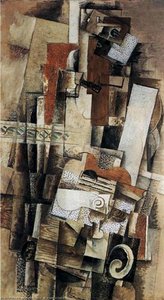
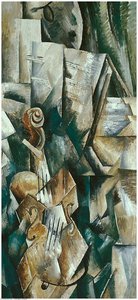
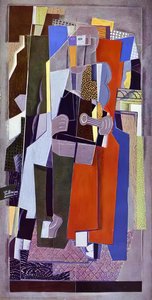
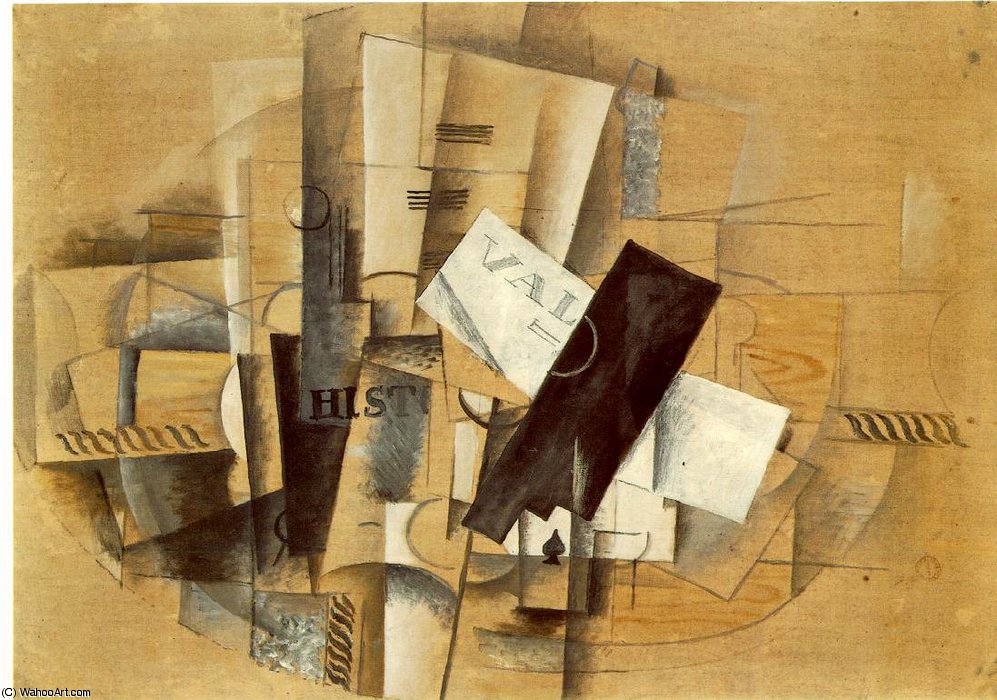
A Fragmented World: Georges Braque’s “Pedestal Table”
Georges Braque's "Pedestal Table," painted in 1913 during the pivotal years of Synthetic Cubism, isn’t merely a still life; it’s an architectural puzzle rendered in oil on canvas. This work, currently residing within the Kunstmuseum Basel, offers a glimpse into the artist’s radical experimentation with space and perception – a deliberate dismantling of traditional representation to reveal the underlying structure of form itself. The painting immediately captivates with its seemingly chaotic arrangement: a round pedestal table dominates the composition, supporting an assortment of objects—brushes, palettes, tubes of paint, cylinders, and even fragments of text—all presented in a flattened, almost two-dimensional space. Yet, this apparent disorder is meticulously orchestrated; Braque employs geometric abstraction to build a complex, self-contained world, inviting the viewer to engage in a process of deciphering its visual language.
The stylistic hallmarks of Synthetic Cubism are powerfully evident. Unlike Analytic Cubism’s dissection into smaller, interlocking facets, this painting embraces brighter colors and introduces collage elements – a technique that would become increasingly prominent in Braque's later work. The muted palette—primarily browns, whites, and blacks—creates a sense of solidity and materiality, while the strategic use of color adds subtle dynamism. Notice how the ochre tones subtly shift across the surfaces, suggesting texture and depth despite the flattened perspective. The inclusion of letters and numbers scattered throughout the composition isn’t arbitrary; they disrupt the purely visual experience, forcing us to consider the painting as a hybrid of image and text – a deliberate blurring of boundaries between art and everyday life.
Deconstructing Reality: The Principles of Synthetic Cubism
Braque's exploration within Synthetic Cubism stemmed directly from his collaboration with Pablo Picasso. They were driven by a desire to move beyond the analytical deconstruction of form, pioneered in Analytic Cubism, towards a more integrated and evocative representation. This new approach sought to capture not just the appearance of objects but their essence – their underlying structure and spatial relationships. Braque’s “Pedestal Table” exemplifies this shift. The table itself isn't depicted as a realistic object; instead, it becomes a structural element within a larger, invented space. The overlapping planes and fragmented forms create an illusion of depth, suggesting that the painting is not merely a representation of objects but a construction of spatial relationships.
Crucially, Braque’s use of collage—incorporating elements like newspaper clippings or fabric – further challenged traditional notions of artistic authorship. This technique blurred the lines between painting and other media, reflecting a broader cultural shift towards experimentation and interdisciplinary approaches during this period. The inclusion of these seemingly unrelated fragments contributes to the painting's overall sense of dynamism and complexity, mirroring the fragmented nature of modern experience.
Symbolism and the Everyday: A Reflection of Modern Life
While ostensibly a still life, “Pedestal Table” is rich in symbolic potential. The objects arranged on the table—brushes, palettes, paint tubes—are directly related to the act of painting itself, suggesting that the work is both a representation of the artist’s studio and a meditation on the creative process. The presence of musical instruments – hinted at by fragments resembling sheet music – adds another layer of meaning, evoking notions of leisure, inspiration, and perhaps even the pursuit of harmony. The table itself, a ubiquitous object in domestic life, becomes a stage for this carefully constructed tableau.
Furthermore, the inclusion of text—letters and numbers—introduces an element of abstraction and invites interpretation. These fragments disrupt the purely visual experience, prompting us to consider the painting as a dialogue between image and language. Braque’s deliberate ambiguity encourages viewers to actively engage with the work, projecting their own meanings onto its fragmented surface. “Pedestal Table” isn't simply a depiction of objects; it’s an invitation to contemplate the relationship between art, reality, and the human experience.
A Reproduction for Your Space: Bringing Braque Home
OriginalUniqueArt offers meticulously crafted hand-painted reproductions of Georges Braque’s “Pedestal Table,” allowing you to bring this iconic work into your own home or office. Our skilled artists replicate Braque's distinctive style and nuanced color palette with exceptional precision, ensuring that the reproduction captures the painting’s original depth and complexity. Available in a range of sizes and canvas materials, our reproductions provide an authentic representation of this groundbreaking artwork, making it accessible to art lovers and collectors alike.
Whether you appreciate Braque's pioneering contributions to Cubism or simply admire his masterful use of form and color, a OriginalUniqueArt reproduction of “Pedestal Table” is a beautiful addition to any collection. It’s more than just a print; it’s a tangible connection to one of the 20th century’s most influential artists.
Biographie de l'artiste
**Jeunesse et formation**
Georges Braque, peintre français renommé, collagiste, dessinateur, graveur et sculpteur, est né le 13 mai 1882 à Argenteuil, dans les Val-d'Oise. Il a grandi à Le Havre et a initialement été formé pour devenir peigneur et décorateur comme son père et son grand-père. Cependant, les inclinations artistiques de Braque l’ont conduit à étudier la peinture à l’École des Beaux-Arts de Le Havre de 1897 à 1899.**Évolution artistique et fauvisme**
En 1902, après avoir terminé son apprentissage auprès d'un décorateur à Paris, Braque a fréquenté l’Académie Humbert jusqu’en 1904. Cette période a marqué son introduction au fauvisme, un style caractérisé par des couleurs vives et des réponses émotionnelles. Influencé par les œuvres de Henri Matisse et André Derain, Braque a adopté une approche fauviste, comme en témoigne son tableau La Patience (fauvisme, huile sur toile).**Contribution au cubisme**
La collaboration de Braque avec Pablo Picasso de 1908 à 1912 a conduit au développement du cubisme. Leurs œuvres cubistes analytiques, telles que Georges Braque: La Patience et Pablo Picasso: Le Clarinette(cubisme analytique, huile sur toile), sont aujourd’hui considérées comme des jalons de l'histoire de l'art.**Héritage et œuvres notables**
* Maisons à l’Estaque : Témoignage de l'utilisation innovante de la géométrie et de la perspective simultanée par Braque. * La Patience(fauvisme, huile sur toile) : démontre le style fauve de Braque. * Le Clarinette(cubisme analytique, huile sur toile) : œuvre cubiste collaborative avec Picasso.**Musées et collections**
* Musée d'Orsay : présente une vaste collection d'art impressionniste et post-impressionniste, incluant des œuvres de Braque. * Musée de l'Orangerie : expose une large gamme d'œuvres d'art, incluant celles de Braque et d'autres artistes notables.- Découvrez-en davantage sur la vie et l’œuvre de Georges Braque sur OriginalUniqueArt.com
- Explorez la collection du Musée d'Orsay, présentant des œuvres de Braque et d'autres artistes, sur Musée d'Orsay - Wikipédia
- Apprenez-en davantage sur le fauvisme et son influence sur le développement du cubisme avec le mouvement artistique fauviste sur OriginalUniqueArt.com
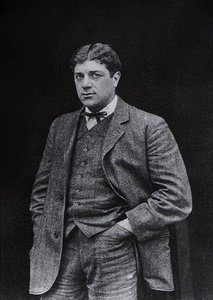
Georges Braque
1882 - 1963 , France
L'essentiel de l'artiste
- Artistes Influents:
- Henri Matisse
- André Derain
- Paul Cézanne
- Date De Décès: 1963
- Date De Naissance: 13 mai 1882
- Influence Sur Les Artistes: ['Pablo Picasso']
- Lieu De Naissance: Argenteuil, France
- Mouvement Artistique: Cubisme, Fauvisme
- Nationalité: Française
- Nom Complet: Georges Braque
- Oeuvres Notables:
- Maisons à L'Estaque
- La Patience
- Le Clarinette
- Nature morte avec cruets
Articles connexes
Deconstructing Reality: A Comprehensive Exploration of Cubist Still Life
Explore the revolutionary world of Cubist Still Life with OriginalUniqueArt. Discover Picasso & Braque's groundbreaking techniques, its philosophical roots, and lasting impact on modern art. Expert insights for collectors.

Jean Dominique Antony Metzinger: Pioneering Cubism & the Evolution of Abstract Form
Explore the life & work of Jean Metzinger, a pivotal Cubist painter and theorist. Discover his innovations in proto-Cubism, 'Du Cubisme,' and Crystal Cubism – a journey through modern art's evolution.
De la Nature Morte Classique à l'Abstraction Contemporaine : Élever les Espaces de Réception d'une Villa par la Reproduction Artistique
Découvrez l'histoire de la nature morte et sublimez votre villa avec des reproductions d'art exceptionnelles. Conseils d'experts, personnalisation sur mesure & qualité garantie par OriginalUniqueArt.
Georges Braque : De la Fauvisme à l'Essence du Cubisme – Une Révolution Formelle dans l'Art Moderne
Explorez l'évolution artistique de Georges Braque, du Fauvisme à la révolution cubiste. Analyse approfondie des techniques, influences et héritage durable de ce maître de l'art moderne. Un guide pour collectionneurs avertis.

The Dawn of Modernity: Exploring Artistic Transformations in the Pivotal Year of 1907
Explore the pivotal artistic shifts of 1907 – from Fauvism to Proto-Cubism. Discover key artists like Picasso & Braque, and gain insights for discerning art collectors. Expert analysis at OriginalUniqueArt.