

 Aperçu en situation
 Partager
 Partager
 Détails

 Télécharger
 Articles similaires
 Radiographie
 Voir le diaporama
 Statistiques
Mounted War Party Scouring a Thicket


 Afficher la suite
Giclées et impressions d'art
Impressions giclées ou sur toile de qualité musée, avec une production rapide et des finitions au choix. ( Acheter la peinture faite à la main Passer au format image numérique)




P118B $10

P118H $10

P118W $10

P438Z $10

P508JH $12

P508YH $12

P805H $10

P805Z $10

P919BZ $10

P919G $10

P919XJ $10

P959ZH $10

P968JZ $12

W106C $8

W218G $10

W218JH $8

W218Y $10

W307PJ $10

W316G $10

W316PJ $8

W316Y $10

W398PJ $8

W4111J $10

W500HY $15

W500JH $15

W692G $12

W849H $8

W940BG $15

W953PJ $8




Choisissez parmi nos formats prédéfinis qui respectent les proportions originales de l’œuvre.

Vous pouvez saisir vos propres dimensions pour vous adapter à un cadre ou à un espace spécifique. Si la taille sélectionnée ne correspond pas aux proportions de l'image originale, nous recadrerons l'œuvre ou étendrons l'image avec une bordure en miroir ou une couleur unie. Une maquette numérique vous sera envoyée pour approbation avant le début de la production.
Veuillez noter que l'aperçu à l'écran ne reflète pas le recadrage ou l'extension réelle. Seule la maquette montrera avec précision la composition finale.
Bien que des tailles personnalisées soient disponibles, nous vous recommandons de choisir une dimension dans la liste prédéfinie afin de préserver les proportions originales.
Livraison dans le monde entier () en 2 semaines au lieu des 4/5 semaines habituelles. (16 septembre)

Livraison express gratuite dans le monde entier

Toile de lin de haute qualité

Assurance transport complète

Garantie de remboursement des droits de douane

Garantie de fidélité des couleurs

Garantie de retour de 100 jours (uniquement en cas de défaut)

Garantie de remboursement à 100%

Tarifs dégressifs sur quantité
 L'option verre n'est disponible que pour les dimensions inférieures à 110 cm.

Mounted War Party Scouring a Thicket
Giclées et impressions d'art
Format de la reproduction
-


Prix total final
$ 80
A Pioneer’s Vision: Exploring George Catlin's Mounted War Party Scouring a Thicket
George Catlin’s *Mounted War Party Scouring a Thicket*, completed between 1846 and 1848, stands as a monumental achievement in American art history—a testament to both meticulous observation and fervent advocacy for Native American culture. More than just a depiction of a hunting expedition, it embodies Catlin's profound belief that the disappearing traditions of the Plains tribes deserved unwavering documentation before they vanished entirely from the landscape. This conviction fueled his ambitious project: to portray Native Americans not as primitive savages but as noble warriors embodying the spirit of their ancestral heritage.Subject Matter and Composition
The painting captures a pivotal moment in Plains Indian life—a war party venturing into dense woodland terrain, actively pursuing game animals like deer and elk. Catlin’s masterful composition draws the viewer's eye immediately to the central figures: several horseback riders dominate the foreground, their postures conveying determination and readiness for action. Scattered amongst them are additional individuals – likely members of the tribe – adding depth and dynamism to the scene. The artist skillfully utilizes perspective to convey the vastness of the prairie environment juxtaposed against the claustrophobia of the thicket, creating a visual narrative that speaks volumes about survival and resilience.Style and Technique: Romantic Idealization
Catlin’s style aligns firmly with the Romantic movement prevalent in mid-19th century America. Rejecting academic conventions, he prioritized capturing the immediacy of experience—the raw beauty and drama of the frontier wilderness. His technique is characterized by bold brushstrokes and vibrant color palettes – particularly reds and yellows – reflecting the fiery hues of the prairie sunset and emphasizing the heroic qualities of his subjects. Catlin employed a method known as “Indian Painting,” which involved applying pigment directly onto canvas, resulting in textured surfaces that convey a palpable sense of physicality and authenticity. This approach deliberately departed from traditional European portraiture, prioritizing expressive color and gesture over meticulous detail.Historical Context: The Quest for Documentation
Painted during a period of intense westward expansion and increasing pressure on Native American lands, *Mounted War Party Scouring a Thicket* reflects Catlin’s deep concern for preserving the cultural heritage of tribes facing imminent displacement. He tirelessly traveled across the Plains, documenting their customs, ceremonies, and artistic traditions through sketches and paintings—a pioneering effort to counteract prevailing stereotypes portraying Native Americans as uncivilized barbarians. The painting served as part of a larger series aimed at raising public awareness about the plight of these communities and advocating for governmental protection.Symbolism: Noble Warrior Spirit
Beyond its visual splendor, *Mounted War Party Scouring a Thicket* is laden with symbolic significance. Catlin consciously idealized his subjects—presenting them as embodiments of courage, honor, and spiritual fortitude. The warriors’ attire – adorned with feathers and beads – symbolizes tribal identity and connection to ancestral traditions. Their gaze directs towards the viewer, conveying confidence and asserting their rightful place within the natural order. Catlin's intention was not merely to record a hunting expedition but to elevate Native American culture to the level of heroic grandeur—a powerful statement about preserving cultural heritage in an era of rapid change.Emotional Impact: Reverence for Tradition
Ultimately, *Mounted War Party Scouring a Thicket* evokes a profound sense of reverence for tradition and a poignant awareness of cultural loss. Catlin’s artwork transcends mere representation; it communicates an emotional response—a deep admiration for the resilience and dignity of Native American peoples facing the encroaching forces of civilization. It remains a captivating image, transporting viewers back to a bygone era and prompting contemplation on the importance of safeguarding cultural legacies for generations to come.Biographie de l'artiste
George Catlin : Pionnier de la Peinture Indigène Américaine
- Né: 26 juillet 1796, Wilkes-Barre, comté de Luzerne, Pennsylvanie
- Décédé: 23 décembre 1872
- L'intérêt de Catlin pour les Amérindiens a été suscité par les récits de sa mère concernant la frontière occidentale et sa capture par une tribu.
- Ses premiers travaux comprenaient des gravures de sites le long du canal d'Erie dans l'État de New York, publiées dans le mémoire de Cadwallader D. Colden.
Contributions Artistiques & Style
- L’objectif principal de Catlin est devenu la documentation de la vie et de la culture amérindiennes à travers la peinture.
- Il a entrepris cinq expéditions dans l'ouest américain au cours des années 1830, observant méticuleusement et enregistrant ses expériences.
- Œuvres Notables:
- Ball-Play of the Choctaw – Met en évidence l’attention aux détails et la capture de la culture amérindienne.
- Mó-sho-la-túb-bee, He Who Puts Out and Kills, Chief of the Tribe – Démontre ses compétences en portraiture et son dévouement à la préservation du patrimoine.
- A Seminole Woman – Souligne sa capacité à capturer la beauté et la dignité.
- Style: Le style de Catlin se caractérise par le réalisme, des couleurs vives et un désir de représenter fidèlement les coutumes et les traditions amérindiennes. Il incluait souvent des arrière-plans détaillés et des paysages pour fournir un contexte à ses sujets.
Réalisations Majeures & La Galerie Indienne
- Catlin a créé une collection étendue de plus de 500 peintures représentant diverses tribus et aspects de leur vie.
- Il a compilé ces œuvres dans ce qui est devenu connu sous le nom de « Galerie Indienne », un document visuel complet de la culture amérindienne.
- La galerie indienne a été exposée à Londres, Paris et Berlin, gagnant une reconnaissance internationale pour le travail de Catlin.
- Ses publications, dont Manners, Customs, and Condition of the North American Indians (1841) et Last Rambles Amongst the Indians of the Rocky Mountains and the Andes (1868), ont renforcé sa réputation d’expert en culture amérindienne.
Vie ultérieure & Importance Historique
- Catlin a passé ses dernières années à tenter de vendre sa galerie indienne au gouvernement américain, rencontrant des rejets initiaux.
- Il a recréé plus de 400 peintures dans une « collection de cartons ».
- Malgré les difficultés, le travail de Catlin a eu un impact durable sur la façon dont les Amérindiens sont représentés dans l’art et la culture populaire.
- Importance Historique: La documentation méticuleuse de Catlin fournit des informations précieuses sur la vie des tribus amérindiennes avant des changements culturels importants dus à l'expansion vers l'ouest. Son travail est considéré comme un exploit artistique autant qu’un document historique important.
Influences & Informations Complémentaires

George Catlin
1796 - 1872 , États-Unis d'Amérique
En bref
- Artistic Movement Or Style: Peinture de la frontière
- Date Of Birth: 26 juillet 1796
- Full Name: George Catlin
- Nationality: Américain
- Notable Artworks:
- Ball-play des Choctaw
- Mó-sho-la-túb-bee, Chef
- Une femme Séminole
- Prairie Meadows Burning
- Place Of Birth: Wilkes-Barre, États-Unis
Articles similaires

Georges Braque : Les 25 Œuvres Maîtresses du Cubisme et de la Modernité | OriginalUniqueArt
Plongez dans l'univers de Georges Braque avec les 25 œuvres incontournables du cubisme. Découvrez l'histoire, les techniques et l'impact de ce maître de l'art moderne. Reproductions d'art exceptionnelles sur OriginalUniqueArt.com.

L'Huile sur Toile : Exploration Historique et Technique d'un Médium Artistique Intemporel
Explorez l'histoire fascinante de la peinture à l'huile, des techniques ancestrales aux maîtres flamands comme Van Eyck. Découvrez les secrets des pigments, liants et glacis pour comprendre cet art intemporel.
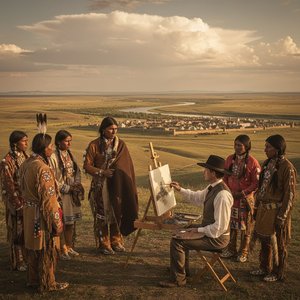
George Catlin: Witnessing & Representing Indigenous Life on the American Frontier
Explore the captivating art of George Catlin, renowned for his vivid portraits & landscapes documenting Native American life on the frontier. Discover a vanishing world through stunning paintings and historical context.

Georges Seurat : Les 25 Œuvres Maîtresses du Pointillisme | OriginalUniqueArt
Plongez dans l'univers lumineux de Georges Seurat ! Découvrez les 25 œuvres majeures du pointillisme, de 'Un dimanche après-midi à l'Île de la Grande Jatte' aux 'Poseuses'. Reproductions d'art exceptionnelles et inspiration déco sur OriginalUniqueArt.com.

The Enduring Legacy of Oil on Canvas: Technique, History & Aesthetic Impact
Explore the rich history & techniques of oil painting – from Renaissance masters to Impressionism. Discover pigments, layering methods, and why this timeless medium endures. Expert insights for artists & art enthusiasts.


