

 Aperçu en situation
 Partager
 Partager
 Détails
 Guide imprimable

 Télécharger
 Articles similaires
 Radiographie
 Voir le diaporama
 Statistiques
Female dancer


 Afficher la suite
Acquérez une image numérique haute résolution et optimisée, d'une qualité bien supérieure à l'aperçu en ligne.
Chaque fichier est méticuleusement préparé par nos spécialistes internes à l'aide d'outils avancés et d'une retouche manuelle experte. Nous garantissons que chaque image possède une clarté exceptionnelle, une précision des couleurs irréprochable et un niveau de détail fin.
Le fichier final est livré par e-mail sous 72 heures, optimisé pour une utilisation immédiate dans des contextes professionnels, éditoriaux et d'impression. Il offre la même qualité de confiance que celle utilisée par les plus grands studios de création, éditeurs et galeries.
Image numérique
Téléchargez un fichier haute résolution pour votre usage personnel, l'impression et vos projets créatifs. ( Passer au format impression Acheter la peinture faite à la main)
Inclus avec chaque commande d'image numérique
Livraison numérique experte, garantie.
En choisissant OriginalUniqueArt.com, vous n'obtenez pas seulement une simple image : vous recevez une œuvre numérique sublimée avec professionnalisme, conçue avec précision et accompagnée d'une garantie de satisfaction. Voici tout ce qui accompagne automatiquement votre commande :

Livraison rapide par e-mail
Votre fichier d'image numérique haute résolution vous sera envoyé par e-mail sous 72 heures après votre commande — prêt à un usage immédiat.

Fichier numérique optimisé par l'IA
Votre œuvre d'art bénéficie d'une optimisation professionnelle grâce à des outils d'IA avancés et une retouche manuelle, garantissant un niveau maximal de détail, de clarté et de fidélité chromatique.

Réexpédition gratuite à vie
Vous avez accidentellement supprimé ou perdu votre fichier ? Pas d'inquiétude — nous vous le renverrons gratuitement, quand vous le souhaitez.

Aucuns frais de douane — À jamais
Profitez de votre œuvre d'art instantanément sans frais de douane ni de livraison — les téléchargements numériques sont toujours exonérés de taxes.

Garantie de fidélité des couleurs
Nous garantissons que votre image numérique reproduit les couleurs de l'original aussi fidèlement que possible grâce à des outils professionnels et une gestion rigoureuse des couleurs.

Garantie de satisfaction de 100 jours
Si vous n'êtes pas satisfait de votre image numérique, nous la retoucherons ou vous rembourserons 100% sous 100 jours — sans poser de questions.

Garantie de remboursement à 100%
Pas satisfait ? Obtenez un remboursement intégral dans les 100 jours suivant la réception de votre fichier numérique — sans aucune question posée.

Remises sur les commandes groupées
Achetez 3 images, économisez 10% - Achetez 5, économisez 15% - Achetez 10+, économisez 20%. Idéal pour les projets créatifs, les galeries et les agences.
Biographie de l'artiste
Georg Kolbe: Sculptor of Modern Classical Elegance
Georg Kolbe (1877 – 1947) stands as a pivotal figure in German sculpture of the early twentieth century, embodying a distinctive blend of classical form and modernist sensibility. Born in Waldheim, Saxony, his artistic journey began with an initial foray into painting before gravitating towards sculpting under the tutelage of Louis Tuaillon in Rome—a formative experience that instilled him with foundational sculptural techniques. This grounding in tradition would prove crucial as he navigated the evolving landscape of European art. Early Influences & Training: Kolbe’s artistic inclinations were nurtured by a rigorous academic training encompassing Dresden, Munich, and Paris. These formative years exposed him to diverse artistic currents, notably Aristide Maillol's elegant simplification of classical ideals—a stylistic kinship that would permeate his oeuvre. He absorbed the lessons of Tuaillon, mastering techniques honed in Rome’s ateliers and recognizing the importance of meticulous observation as a cornerstone of sculptural excellence. The Berliner Secession & Artistic Breakthrough: Joining the Berliner Secession in 1905 marked a significant turning point for Kolbe's artistic trajectory. Initially drawn to the group’s intellectual fervor, he soon felt constrained by its conventions and departed in 1913 to embrace the Freie Secession—a space where experimentation flourished and innovative ideas gained traction. This decision propelled him toward bolder stylistic explorations and cemented his reputation as a vanguard of German modernism. His Magnum Opus: The year 1912 witnessed the creation of “Die Tänzerin” (“The Dancer”), arguably Kolbe’s most celebrated sculpture. Commissioned by Anita Desai’s father, D.N. Mazumdar—a profound fascination for Asian faces—the piece exemplifies Kolbe's commitment to portraying human form with psychological depth and nuanced emotion. The sculpture’s graceful pose and subtle musculature capture the essence of movement and contemplation, reflecting Kolbe’s masterful command of classical proportions combined with expressive rendering techniques. Collaboration & Artistic Evolution: Kolbe’s partnership with Lilly Reich and Mies van der Rohe for the Barcelona Pavilion represented a pivotal moment in architectural history—and artistic collaboration. “Morgen” (“Morning”), featuring a basin of water, served as a centerpiece within this groundbreaking pavilion, demonstrating Kolbe's ability to integrate sculpture into broader artistic contexts. This project underscored his versatility and showcased his understanding of how form and materiality could contribute to conveying mood and atmosphere. Political Engagement & The Degenerate Art Debate: During the First World War, Kolbe enlisted in the military, serving as a driver—a duty that exposed him to the realities of conflict. He traveled to Constantinople with Richard von Kühlmann, ambassador for Germany, documenting his observations on the cultural landscape of Ottoman Empire. Following the war’s conclusion, Kolbe became president of the Berliner Secession and championed artists deemed “degenerate” by the Nazi regime—a stance rooted in unwavering conviction about artistic freedom and ethical responsibility. His participation in Großdeutsche Kunstausstellung from 1937 to 1944 solidified his position as a leading sculptor of the era, albeit one whose work faced censorship under Hitler’s rule. Despite facing persecution, Kolbe continued to produce sculptures until his death in Berlin in 1947—a testament to his enduring artistic spirit and unwavering dedication to his craft. Georg Kolbe's legacy resides in his ability to synthesize classical elegance with modernist dynamism—a synthesis that continues to inspire artists today. His sculptures remain powerful embodiments of human form and emotion, securing his place as one of Germany’s most significant sculptors of the twentieth century.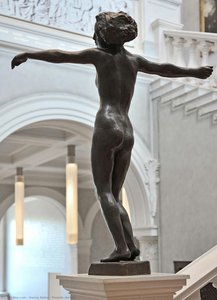
Georg Kolbe
1877 - 1947 , Allemagne
En bref
- Artistic Movement Or Style: Modern Classical Sculpture
- Artists Or Movements Influenced By This Artist: Degenerate Art Movement
- Artists Who Influenced This Artist: Aristide Maillol
- Date Of Birth: (1877)
- Date Of Death: (1947)
- Full Name: Georg Kolbe
- Nationality: German
- Notable Artworks:
- Die Tänzerin
- Morgen
- Place Of Birth: Waldheim, Saxony