Aperçu en situation
 Partager
 Partager
 Détails
 Guide imprimable

 Télécharger
 Articles similaires
 Radiographie
 Voir le diaporama
 Statistiques
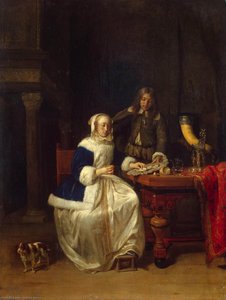
The Letter-Writer Surprised
 Oil
Oil- WallArt
- Baroque Dutch Painting
 1662
1662- Early Modern
 45.0 x 39.0 cm
 Wallace Collection
 Afficher la suite
Reproduction à l'huile faite à la main
Huile sur toile peinte à la main, avec cadre et dimensions personnalisés, réalisée sur commande par nos artistes. ( Passer au format impression Passer au format image numérique)




P118B €10

P118H €10

P118W €10

P438Z €10

P508JH €12

P508YH €12

P805H €10

P805Z €10

P919BZ €10

P919G €10

P919XJ €10

P959ZH €10

P968JZ €12

W106C €8

W218G €10

W218JH €8

W218Y €10

W307PJ €10

W316G €10

W316PJ €8

W316Y €10

W398PJ €8

W4111J €10

W500HY €15

W500JH €15

W692G €12

W849H €8

W940BG €15

W953PJ €8




Choisissez parmi nos formats prédéfinis qui respectent les proportions originales de l’œuvre.

Saisissez la largeur et la hauteur souhaitées, pour s'adapter à votre cadre ou à votre mur. Cette œuvre est peinte à la main ; ainsi, pour un format de forme différente, l'artiste peut peindre un peu plus autour du tableau ou réduire légèrement les bords — c'est vous qui choisissez. Nous vous envoyons une maquette numérique pour approbation avant que la peinture ne commence. L'image présentée sur cette page ne reflète pas le résultat réel — seule la maquette le fait.
Après la commande, l’équipe OriginalUniqueArt.com contactera le client par e-mail pour recueillir ses instructions et lui fournira une maquette d’aperçu
Livraison dans le monde entier () en 3 à 4 semaines au lieu des 5 semaines habituelles. (24 octobre). Aucun compromis sur la qualité.

Livraison express gratuite dans le monde entier

Toile de lin de haute qualité

Assurance transport complète

Garantie de remboursement des droits de douane

Garantie de fidélité des couleurs

Garantie de retour de 100 jours (uniquement en cas de défaut)

Garantie de remboursement à 100%

Tarifs dégressifs sur quantité
 L'option verre n'est disponible que pour les dimensions inférieures à 110 cm.

The Letter-Writer Surprised
Technique de reproduction
Format de la reproduction
-


Prix total final
€ 263
A Quiet Intrusion: The Intimacy of Metsu’s Masterpiece
In the soft, amber glow of a seventeenth-century Dutch interior, a single moment is suspended in time, caught between the act of creation and the sting of discovery. Gabriel Metsu’s “The Letter-Writer Surprised,” painted around 1662, is far more than a mere domestic scene; it is a psychological drama played out in the hushed tones of a bourgeois home. As we gaze upon the woman seated at her desk, her focus entirely consumed by the parchment before her, we feel the weight of the unseen observer. The painting invites us into a world where every fold of fabric and every flicker of candlelight tells a story of secret thoughts and social boundaries. For the collector or the lover of fine art, this work offers a profound window into the Dutch Golden Age, capturing that delicate, fleeting instant when privacy is breached by a sudden, unexpected presence.
The composition is a masterclass in the Baroque use of chiaroscuro, where light does not merely illuminate but actively sculpts the narrative. Metsu employs a dramatic contrast between deep, velvety shadows and luminous highlights to draw the eye toward the central figures. The light spills across the woman’s linen attire and the textured surface of the wooden table, lending an almost tactile realism to the scene. This technique, reminiscent of the legendary Vermeer, creates a sense of three-dimensional depth that pulls the viewer into the room. One can almost hear the scratch of the quill against paper and the heavy silence that follows the man's sudden appearance. The presence of objects like the violin resting nearby and the glint of a wine glass adds layers of sensory richness, suggesting a life of cultured leisure interrupted by a moment of tension.
Symbolism and the Art of Observation
Beyond its technical brilliance, “The Letter-Writer Surprised” is rich with the symbolic language characteristic of the Dutch genre painting. The act of letter writing itself was often a metaphor for intimacy, longing, and the exchange of private emotions. By placing a man in the periphery—seemingly attentive yet subtly distanced—Metsu explores the complex interplay between presence and absence. Is he a protector, or is his gaze an intrusion? This ambiguity is what gives the painting its enduring emotional impact. The carefully placed books and musical instruments serve as emblems of a refined, intellectual lifestyle, yet they also ground the scene in a tangible reality that resonates with anyone who appreciates the beauty of domestic tranquility.
For those looking to bring a sense of historical elegance and contemplative depth into a contemporary space, this masterpiece serves as an incomparable focal point. Whether placed in a sunlit study or a sophisticated dining room, a high-quality reproduction of Metsu’s work commands attention through its quiet power. It does not shout for recognition; instead, it rewards the patient observer with subtle nuances of expression and a timeless atmosphere of grace. To possess such a piece is to hold a fragment of history—a beautifully rendered testament to the human desire to capture the ephemeral beauty of life's most private moments.
Questions et réponses
À qui offrir "The Letter-Writer Surprised" en cadeau, et pour quelle occasion ?
« The Letter-Writer Surprised » est suggéré comme cadeau pour Anniversary, en vue de Statement.
De quelle époque date « The Letter-Writer Surprised » ?
«The Letter-Writer Surprised» appartient à l'époque Early Modern.
Combien de personnes consultent « The Letter-Writer Surprised » ?
Une page Statistiques est disponible pour « The Letter-Writer Surprised ». Elle présente l'évolution mensuelle des visites de l'œuvre ainsi que des autres créations de l'artiste, avec une répartition par pays et par langue.
Biographie de l'artiste
Une Vie D'Exploration Artistique : Gabriël Metsu
- Né : Leiden, Pays-Bas (1629)
- Décédé : 1667
Jeunesse et Influences
Gabriël Metsu a vécu une vie marquée par l'exploration artistique et l'innovation. Né en 1629, il était le fils de Jacques Metsu, travailleur du métier de tapissier et peintre originaire d’Hainault. Cet héritage diversifié a probablement influencé son intérêt précoce pour diverses techniques artistiques. Le déménagement de la famille à Leyde l'a exposé à de nombreuses influences culturelles.
Carrière Artistique : Un Style Éclectique
La carrière de Metsu s’est caractérisée par une absence d’adhésion à un style ou une technique unique, ce qui lui a valu le titre d'"artiste hautement éclectique". Son œuvre comprenait des peintures historiques, des natures mortes, des portraits et des œuvres de genre. Notamment, seulement 14 de ses 133 œuvres sont datées, laissant beaucoup à découvrir sur son processus créatif.
- Influences Précoces : L'influence de Rembrandt van Rijn sur les premiers travaux de Metsu est évidente dans son utilisation de la lumière et de la couleur.
- Période Amsterdamienne (à partir de 1655) : Son déménagement à Amsterdam a marqué un tournant vers des intérieurs domestiques et des scènes de genre, avec une plus grande emphase sur le détail et le réalisme.
- Formation et Mentorat : Il a formé Michiel van Musscher et Joost van Geel, reflétant son engagement envers la communauté artistique.
Œuvres Notables et Développement Artistique
Les peintures de Metsu comportaient souvent de jeunes femmes, des scènes de marché et des personnes âgées, puisant dans les emblèmes populaires de l’époque. Son style a évolué au cours de sa carrière, démontrant une maîtrise de diverses techniques.
- L'Enfant Malade (c. 1664) : Cette œuvre reflète l'admiration de Metsu pour le détail méticuleux et l'utilisation de la lumière par Johannes Vermeer.
- Portrait de la Famille Hinlopen : Un chef-d'œuvre combinant peinture de genre et portrait, mettant en valeur sa capacité à capturer à la fois le caractère individuel et la vie domestique.
- Le Fils Prodigue (c. 1640) : Démontre une influence baroque avec sa composition dramatique et ses détails riches.
- Thèmes Récurrents : Metsu dépeignait fréquemment des scènes de la vie quotidienne, souvent empreintes de sens symbolique.
Signification Historique et Héritage
L'héritage de Gabriël Metsu réside dans sa polyvalence et sa contribution à l’âge d’or néerlandais. Son style éclectique, bien que parfois énigmatique, a influencé les générations futures d'artistes. Aujourd'hui, ses œuvres sont conservées dans des musées prestigieux du monde entier.
- Peintre de l’âge d’or néerlandais : Il est reconnu comme une figure importante au sein du paysage artistique dynamique du XVIIe siècle aux Pays-Bas.
- Collections Muséales : Ses peintures se trouvent dans divers musées, dont le Rijksmuseum à Amsterdam.
- Appréciation Continue : L’art de Metsu continue de fasciner et d'inspirer les spectateurs par son réalisme, ses détails et ses récits subtils.

Gabriel Metsu
1629 - 1667 , Pays-Bas
En bref
- Artistic Movement Or Style: Âge d'or néerlandais
- Artists Or Movements Influenced By This Artist: ['Pieter de Hooch']
- Artists Who Influenced This Artist: ['Rembrandt van Rijn']
- Date Of Birth: 1629
- Date Of Death: 1667
- Full Name: Gabriël Metsu
- Nationality: Néerlandais
- Notable Artworks:
- L’Enfant malade
- Portrait de la famille Hinlopen
- Vendeur de volaille
- Place Of Birth: Leiden, Pays-Bas
Articles connexes

Gabriel Metsu: Illuminating Dutch Daily Life with Exquisite Detail
Explore the captivating world of Gabriel Metsu, a leading Dutch Golden Age painter. Discover his exquisite genre scenes, masterful realism, and insightful social commentary. Learn about key works & his lasting legacy.
Dutch Baroque Unlocked: Mastering Chiaroscuro, Epic Drama, and the High-Impact Legacy of Rembrandt
Explore the dramatic power of Dutch Baroque art. Master the secrets of Rembrandt’s chiaroscuro, discover the epic scale of the Golden Age, and learn how to bring high-impact, hand-painted historical masterpieces into your modern collection with expert precision.

Golden Light & Dutch Skies: The Timeless Magic of Dutch Golden Age Landscapes
Discover the breathtaking beauty of Dutch Golden Age landscapes. Explore the mastery of light, chiaroscuro, and 17th-century realism through an expert art history lens, celebrating the enduring legacy of the Dutch Masters for discerning collectors and art lovers.

Les 10 Chefs-d'œuvre du Baroque Néerlandais : Artistes et Décor Intemporels
Plongez au cœur du Baroque néerlandais avec les 10 œuvres incontournables de Rembrandt, Vermeer et autres maîtres hollandais. Découvrez l'histoire, la lumière et les couleurs qui ont façonné ce mouvement artistique. Reproductions d'art de qualité muséale sur OriginalUniqueArt.com

L'Âge d'Or Néerlandais : Splendeur Baroque et Révolution Artistique
Explorez l'Âge d'Or néerlandais : découvrez les maîtres baroques (Rembrandt, Fabritius) et leur révolution artistique. Analyse approfondie, contexte historique et héritage durable. Un voyage au cœur de la peinture du XVIIe siècle.