Envoyer
 Partager
 Détails de l'œuvre

 Télécharger
 Articles similaires
 Diaporama
The Stampede


 Lire la suite
Giclées et impressions d'art
Impressions giclées ou sur toile de qualité musée, avec une production rapide et des finitions au choix. ( Commander la reproduction peinte à la main Acheter l'image haute résolution)




































Choisissez parmi nos formats prédéfinis qui respectent les proportions originales de l’œuvre.

Vous pouvez saisir vos propres dimensions pour vous adapter à un cadre ou à un espace spécifique. Si la taille sélectionnée ne correspond pas aux proportions de l'image originale, nous recadrerons l'œuvre ou étendrons l'image avec une bordure en miroir ou une couleur unie. Une maquette numérique vous sera envoyée pour approbation avant le début de la production.
Veuillez noter que l'aperçu à l'écran ne reflète pas le recadrage ou l'extension réelle. Seule la maquette montrera avec précision la composition finale.
Bien que des tailles personnalisées soient disponibles, nous vous recommandons de choisir une dimension dans la liste prédéfinie afin de préserver les proportions originales.
Livraison dans le monde entier () en 2 semaines au lieu des 4/5 semaines habituelles. (28 août)

Livraison express gratuite dans le monde entier

Toile de lin de qualité supérieure

Assurance transport complète

Garantie de remboursement des droits de douane

Garantie de fidélité des couleurs

Politique de retour de 60 jours (uniquement en cas de défaut)

Garantie de remboursement à 100%

Offre de tarifs dégressifs
 L'option verre n'est disponible que pour les dimensions inférieures à 110 cm.

The Stampede
Giclées et impressions d'art
Format de la reproduction
-


Prix total
$ 80
The Stampede: A Chronicle of the American West
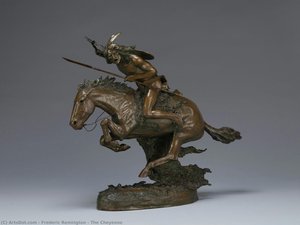
Frederic Remington’s “The Stampede” isn't merely a depiction of cowboys and cattle; it’s a visceral embodiment of the American frontier, a moment frozen in time that captures both the raw power of nature and the indomitable spirit of those who wrestled with it. Completed in 1910, this bronze sculpture stands as a testament to Remington’s profound understanding of his subject – not just cowboys and horses, but the very essence of the vanishing West he so passionately chronicled. The piece resonates deeply, evoking feelings of exhilaration, danger, and an undeniable connection to a bygone era.
Remington, born in Canton, New York, wasn’t destined for the dusty trails he immortalized. His lineage was rooted in Eastern industry – his father a Civil War colonel and newspaper editor, connected through distant cousins to the Remington Arms dynasty. Yet, an early fascination with military themes, coupled with a restless spirit and a keen eye for storytelling, propelled him westward. “The Stampede” exemplifies this journey; it’s a deliberate departure from the idealized romanticism of earlier Western art, presenting instead a brutally honest portrayal of the chaos and energy inherent in cattle drives. The sculpture's creation coincided with a period of rapid change in the West – the decline of open range ranching, the rise of railroads, and the encroachment of civilization – making it a poignant reflection on a way of life rapidly disappearing.
A Study in Dynamic Form and Bronze
Remington’s masterful use of bronze is central to the sculpture's impact. The material itself—dark, earthy, and subtly textured—provides an ideal foundation for capturing movement and conveying weight. He skillfully employed *lost-wax casting*, a technique that allowed him to achieve incredible detail in the musculature of both animals and men. Notice the tautness of the horses’ muscles as they surge forward, the powerful stance of the bull dominating the center, and the determined expressions on the cowboys' faces. The subtle variations in shading – from deep shadows highlighting the contours of the bodies to brighter areas catching the light – create a remarkable sense of depth and volume, drawing the viewer into the heart of the action.
The composition is deliberately dynamic, utilizing a strong diagonal flow that leads the eye through the scene. The overlapping figures, the intertwined limbs, and the sheer number of animals contribute to a feeling of overwhelming movement. Remington’s attention to anatomical accuracy is remarkable; he wasn't simply depicting cowboys riding horses; he was rendering the complex mechanics of animal locomotion with astonishing precision. Even the base of the sculpture—a simple geometric form—provides a grounding element, anchoring the frenetic energy above.
Symbolism and the Vanishing Frontier
“The Stampede” is rich in symbolic meaning. The stampede itself represents not just a literal event but also the relentless drive of progress – the westward expansion that fundamentally reshaped America. The cowboys, though undeniably skilled and courageous, are presented as participants in a process larger than themselves, caught within the currents of history. The bull, a symbol of both power and danger, embodies the untamed wilderness that defined the West. The sculpture subtly acknowledges the precariousness of this existence – the potential for chaos and destruction lurking beneath the surface of apparent control.
Furthermore, the piece speaks to the romantic ideal of the cowboy—a figure often idealized in popular culture. Remington’s depiction is far more complex, portraying a life of hardship, danger, and constant struggle. The sculpture isn't celebrating heroism; it’s documenting a reality, capturing the grit and determination required to survive on the frontier. The weathered faces of the cowboys, their clothing worn and dusty, hint at years spent battling the elements and confronting the unknown.
A Legacy in Bronze
“The Stampede” remains one of Frederic Remington’s most iconic works, a powerful testament to his artistic vision and his profound understanding of the American West. Its enduring appeal lies not only in its technical brilliance but also in its ability to evoke a strong emotional response – a sense of awe, excitement, and perhaps even a touch of melancholy for a way of life that is now largely lost. Reproductions capture much of this power, offering a tangible connection to this pivotal moment in American history and a lasting tribute to the artist who so brilliantly documented it.
Biographie de l'artiste
Premières années et éducation
- Naissance et Famille : Frédéric Sackrider Remington est né le 4 octobre 1861 à Canton, dans l'État de New York. Sa famille avait des origines basques françaises.
- Formation Militaire : Son père, le colonel Seth Pierrepont Remington, propriétaire d’une quincaillerie et vétéran de la guerre civile américaine, a considérablement influencé sa vie précoce. L'exposition aux thèmes militaires allait plus tard façonner son art.
- Première Éducation : Il a fréquenté l'Institut épiscopal du Vermont, une école militaire où il a commencé à dessiner. Par la suite, il a été transféré dans une autre académie militaire, mais il s’est finalement tourné vers l’art plutôt que vers une carrière militaire en raison d’un manque de concentration.
Carrière artistique et style
- Premières Illustrations : Sa première illustration publiée était un dessin animé pour le Yale Courant, démontrant ses compétences précoces dans la représentation de scènes d'action.
- Concentration sur l’Ouest : Un voyage décisif dans le Montana en 1881 a suscité sa fascination pour l’Ouest américain, devenant le thème central de sa carrière artistique.
- Sujets : Son travail mettait principalement en vedette des cow-boys, des Amérindiens et la cavalerie américaine, capturant l'esprit et les défis de la vie frontalière.
- Style Artistique : Remington a développé un style distinctif caractérisé par des compositions dynamiques, un travail de pinceau énergique et une concentration sur le réalisme mêlé d’un talent dramatique. Il utilisait souvent des croquis rapides pour capturer le mouvement et l'émotion.
Œuvres majeures et réalisations
- Tableaux Notables : Plusieurs œuvres se distinguent comme des exemples importants de son talent :
- Mon ranch – Présente le style unique de Remington et sa perspective sur l’Ouest.
- En attendant au clair de lune – Démontre sa capacité à capturer l'essence de l'Ouest américain à travers une imagerie évocatrice.
- Ridden Down (1905) - Une représentation puissante d'une attaque de cavalerie.
- The Long-Horn Cattle Sign (1908) – Capture la vitalité de la vie de cowboy.
- Illustrations et Sculpture : Au-delà de la peinture, Remington était également un illustrateur prolifique pour des magazines tels que Harper's Weekly et Collier’s. Il a également créé des sculptures, démontrant davantage sa polyvalence artistique.
- Reconnaissance : Son travail a connu une large reconnaissance de son vivant, l'établissant comme une figure de proue de l'art américain de l'Ouest.
Héritage et influence
- Impact sur l’Art de l’Ouest : Les contributions de Frederic Remington à la représentation de l’Ouest américain sont indéniables. Il a contribué à définir le genre et à populariser les images de cow-boys, d'Amérindiens et de la vie frontalière.
- Influence sur d’autres Artistes : Son travail a inspiré de nombreux artistes, dont N.C. Wyeth et Zane Grey.
- Musée d’art Frederic Remington : Le musée d’art Frederic Remington à Ogdensburg, dans l’État de New York, préserve son héritage grâce à une vaste collection de peintures, de croquis et de sculptures.
- Signification Historique : L'art de Remington fournit des informations précieuses sur l'histoire, la culture et la mythologie de l'Ouest américain pendant une période de changements et de conflits importants. Ses représentations, bien que parfois idéalisées, offrent un aperçu d’une époque cruciale de l’histoire américaine.
Dernières années et décès
- Production artistique continue : Remington a continué à produire des œuvres d'art avec diligence jusqu'à son décès.
- Déclin de la santé : En 1909, il souffrit d’une appendicite alors qu’il était en mission en Floride.
- Décès : Frederic Remington est décédé le 26 décembre 1909 à Bronxville, dans l'État de New York, à l'âge de 48 ans. Son héritage en tant que grand artiste américain continue d’inspirer et de captiver le public aujourd’hui.

Frédéric Remington
1861 - 1909 , États-Unis d'Amérique
L'essentiel de l'artiste
- Artistic Movement Or Style: Réalisme américain
- Artists Or Movements Influenced By This Artist:
- N.C. Wyeth
- Zane Grey
- Artists Who Influenced This Artist:
- Ernest Meissonier
- Édouard Detaille
- Date De Décès: 26 décembre 1909
- Date De Naissance: 4 octobre 1861
- Full Name: Frédéric Sackrider Remington
- Nationalité: Américaine
- Notable Artworks:
- Mon ranch
- En attendant au clair de lune
- Ridden Down
- The Long-Horn Cattle Sign
- The Trooper
- An Indian Trapper
- Place De Naissance: Canton, États-Unis
Articles connexes

Les 10 Chefs-d'œuvre en Bronze qui ont Révolutionné l'Art : Collection OriginalUniqueArt
Plongez dans l'univers fascinant des 10 chefs-d'œuvre en bronze qui ont marqué l'histoire de l'art. Découvrez Rodin, Degas et les secrets de ces sculptures iconiques. Reproductions d'art exceptionnelles sur OriginalUniqueArt.com – Explorez la collection !

Les 10 Chefs-d'œuvre Bronzes Qui Ont Révolutionné la Sculpture | OriginalUniqueArt
Plongez dans l'univers fascinant des 10 sculptures en bronze les plus emblématiques de l'histoire de l'art. Rodin, Degas et autres maîtres révélés ! Découvrez leur histoire, leurs techniques et trouvez l'œuvre parfaite pour sublimer votre intérieur sur OriginalUniqueArt.com.

The Enduring Legacy of Bronze: A Historical & Artistic Exploration for the Collector
Explore the rich history & enduring appeal of bronze sculpture with expert insights for collectors at OriginalUniqueArt. Learn about casting techniques, iconic artists, collecting tips & contemporary interpretations.

The Enduring Legacy of Bronze: History, Technique & Artistic Expression for the Collector
Explore the rich history & enduring appeal of bronze sculpture with expert insights for collectors at OriginalUniqueArt. Learn about casting techniques, iconic artists, and collecting tips.
The Enduring Legacy of Bronze Sculpture: A Collector's Guide to Form & Cultural Significance
Explore the rich history & enduring appeal of bronze sculpture with expert insights for collectors at OriginalUniqueArt. Learn about casting techniques, iconic artists, and collecting tips to build a discerning art collection.