

 Aperçu en situation
 Partager
 Partager
 Détails
 Guide imprimable

 Télécharger
 Articles similaires
 Radiographie
 Voir le diaporama
 Statistiques
Die Fahne Hoch!
 Acrylic On Canvas
- WallArt
- Minimalist Abstraction
 1959
1959 309.0 x 185.0 cm
 Whitney Museum of American Art
 Afficher la suite
Giclées et impressions d'art
Impressions giclées ou sur toile de qualité musée, avec une production rapide et des finitions au choix. ( Acheter la peinture faite à la main Passer au format image numérique)




P118B $10

P118H $10

P118W $10

P438Z $10

P508JH $12

P508YH $12

P805H $10

P805Z $10

P919BZ $10

P919G $10

P919XJ $10

P959ZH $10

P968JZ $12

W106C $8

W218G $10

W218JH $8

W218Y $10

W307PJ $10

W316G $10

W316PJ $8

W316Y $10

W398PJ $8

W4111J $10

W500HY $15

W500JH $15

W692G $12

W849H $8

W940BG $15

W953PJ $8




Choisissez parmi nos formats prédéfinis qui respectent les proportions originales de l’œuvre.

Vous pouvez saisir vos propres dimensions pour vous adapter à un cadre ou à un espace spécifique. Si la taille sélectionnée ne correspond pas aux proportions de l'image originale, nous recadrerons l'œuvre ou étendrons l'image avec une bordure en miroir ou une couleur unie. Une maquette numérique vous sera envoyée pour approbation avant le début de la production.
Veuillez noter que l'aperçu à l'écran ne reflète pas le recadrage ou l'extension réelle. Seule la maquette montrera avec précision la composition finale.
Bien que des tailles personnalisées soient disponibles, nous vous recommandons de choisir une dimension dans la liste prédéfinie afin de préserver les proportions originales.
Livraison dans le monde entier () en 2 semaines au lieu des 4/5 semaines habituelles. (26 septembre)

Livraison express gratuite dans le monde entier

Toile de lin de haute qualité

Assurance transport complète

Garantie de remboursement des droits de douane

Garantie de fidélité des couleurs

Garantie de retour de 100 jours (uniquement en cas de défaut)

Garantie de remboursement à 100%

Tarifs dégressifs sur quantité
 L'option verre n'est disponible que pour les dimensions inférieures à 110 cm.

Die Fahne Hoch!
Giclées et impressions d'art
Format de la reproduction
-


Prix total final
$ 80
The Stark Geometry of a Silent Statement
Frank Stella’s 1959 painting, *Die Fahne Hoch!*, isn't merely a composition of black lines on white canvas; it’s an arresting declaration of form and a subtle provocation. Emerging from the vibrant, emotionally charged world of Abstract Expressionism, Stella deliberately distanced himself from its subjective gestures, seeking instead to establish art as an object in itself – a flat surface with paint on it, as he famously stated. This painting embodies that philosophy with remarkable clarity. The work immediately commands attention not through color or narrative, but through the sheer rigor and precision of its execution. It’s a visual embodiment of order emerging from apparent simplicity, a testament to the power of geometric abstraction.
- The Grid as Foundation: Stella employed a meticulous process, utilizing a ruler and pencil to draw precise guidelines on the canvas before applying the enamel paint. This grid-like structure isn’t merely decorative; it's fundamental to the painting’s impact, providing an underlying framework for the black bands that dominate the composition.
- The Black Stripes: The black stripes themselves are applied with a house painter’s brush, creating a uniform width and consistent spacing – a deliberate rejection of spontaneous gesture. This controlled application contributes to the painting's sense of mechanical precision.
- Negative Space: Crucially, Stella leaves areas of unprimed canvas exposed between the black stripes. These spaces aren’t simply gaps; they are integral to the composition, defining the shape and rhythm of the overall design. They create a dynamic tension between solid form and empty space.
Historical Context: Echoes of Fascism and Minimalist Intent
The title *Die Fahne Hoch!* – “Raise the Flag!” – immediately introduces a layer of complexity. It’s taken from the “Horst-Wessel Lied,” a Nazi marching song, a piece inextricably linked to the horrors of World War II and the rise of fascism. Stella himself acknowledged this connection, recognizing that the painting's cruciform shape and flaglike proportions subtly evoked imagery associated with Nazi banners. However, he insisted that the work was deliberately devoid of any explicit political statement. Instead, he aimed to strip away all emotional content, focusing solely on the formal qualities of the artwork – its geometry, its surface, its materiality.
This deliberate distancing from overt symbolism reflects a broader shift in the art world during the late 1950s. Stella’s work aligned with the burgeoning minimalist movement, which sought to reduce art to its essential elements, rejecting the expressive ambitions of Abstract Expressionism. The painting's stark simplicity and emphasis on industrial processes – the use of enamel paint and a house painter’s brush – further underscored this shift.
Decoding the Visual Language: Form, Line, and Absence
The painting’s power lies in its deceptively simple visual language. The dominant element is undoubtedly line—straight, precise, and relentlessly repeated. These lines create a complex network of intersecting shapes, forming a central cross that anchors the composition. Yet, it's precisely *what’s missing* – the vast expanses of white space – that gives the painting its depth and dynamism. The unpainted canvas acts as a counterpoint to the black stripes, creating a subtle sense of recession and suggesting an implied three-dimensionality.
Stella’s use of enamel paint contributes to the work's smooth, almost industrial surface. The lack of texture reinforces the painting’s emphasis on form and geometry. It’s a testament to his belief that art should be experienced as an object – a self-contained entity with its own inherent qualities.
A Legacy of Precision: Stella’s Enduring Influence
*Die Fahne Hoch!* remains one of Frank Stella's most iconic works, representing the pivotal moment when he transitioned from Abstract Expressionism to minimalism. It exemplifies his commitment to reducing art to its essential elements – line, shape, and surface – while simultaneously acknowledging the complex historical context surrounding its creation. The painting’s stark geometry, deliberate simplicity, and subtle references continue to resonate with viewers today, solidifying Stella's place as a revolutionary figure in 20th-century art. Reproductions of this powerful piece offer a compelling glimpse into the mind of an artist who redefined the possibilities of abstraction.
Biographie de l'artiste
Frank Stella : Pionnier du Minimalisme et de l'Abstraction Post-Pictorale
- Né: 12 mai 1936, Malden, Massachusetts
- Décédé: 4 mai 2024, New York City, États-Unis
- Nationalité: Américain
- Connu pour: Peintre, graveur, sculpteur, architecte
- Mouvement: Minimalisme, Abstraction Post-Pictorale
Jeunesse et Formation
- Frank Philip Stella est né dans une famille italo-américaine de première génération à Malden, Massachusetts. Son père était gynécologue et sa mère, Constance, s'intéressait aux arts, notamment à la peinture de paysages.
- Il a fréquenté Phillips Academy à Andover, Massachusetts, où il a été exposé à des artistes modernistes abstraits comme Josef Albers et Hans Hofmann.
- Stella a étudié l’histoire à l’Université Princeton, où il a rencontré Darby Bannard et Michael Fried, des figures influentes qui ont façonné sa trajectoire artistique.
- Les premières visites dans les galeries de New York City ont considérablement influencé son développement, l'exposant à l'expressionnisme abstrait de Jackson Pollock et Franz Kline.
- En 1958, après avoir obtenu son diplôme de Princeton, Stella a déménagé à New York City, marquant un moment décisif dans sa carrière.
L’Émergence du Minimalisme : Peintures Noires et Toiles Formées
- Stella a réagi contre l'utilisation expressive de la peinture prévalant dans l'expressionnisme abstrait, cherchant plutôt des surfaces "plus plates" rappelant le travail de Barnett Newman et les peintures “cibles” de Jasper Johns.
- Il a déclaré en notoriété qu’une peinture devait être « une surface plane avec de la peinture dessus – rien de plus », soulignant la qualité d'objet de son art.
- Sa première percée est venue avec les Peintures Noires (1959), caractérisées par des bandes régulières de peinture noire séparées par des bandes minces de toile non peinte, comme Die Fahne Hoch!. Le lien du titre avec un hymne nazi a suscité la controverse mais a mis en évidence le détachement délibéré et le rejet de l'expression émotionnelle de Stella.
- Stella a commencé à expérimenter avec des toiles formées – des formes autres que le rectangle ou le carré traditionnel (formes L, N, U, T) – utilisant de l’aluminium et de la peinture cuivrée dans des œuvres qui reflétaient ses peintures noires avec une gamme de couleurs plus large.
- La série des polygones irréguliers (1967) a développé ce concept de toile formée, repoussant les limites de l'espace pictural.
Horizons Élargis : Série Protracteur, Gravure et Relief
- Stella’s Protractor Series (1971) featured arcs arranged within square borders, creating full and half circles in concentric rings of color, named after circular cities he visited in the Middle East.
- Il s'est engagé de manière extensive dans la gravure à partir du milieu des années 1960, utilisant la lithographie, la sérigraphie, l’eau-forte et la lithographie offset pour créer des estampes abstraites comme Quathlamba I (1968).
- En 1967, Stella a conçu les décors et les costumes pour la pièce de danse de Merce Cunningham, Scramble.
- Le Museum of Modern Art a présenté une rétrospective de son œuvre en 1970, faisant de lui le plus jeune artiste à recevoir un tel honneur.
- Stella a introduit le relief dans son art au cours des années 1970, évoluant vers une peinture « maximaliste » avec des qualités sculpturales. Cela comprenait l'incorporation d'éléments de collage et l'utilisation de l'aluminium comme support principal.
Œuvres Ultérieures et Héritage
- Au fur et à mesure que la carrière de Stella progressait, son style devenait de plus en plus exubérant, marqué par des formes courbes, des couleurs "day-glo" et des coups de pinceau griffonnés – un glissement du minimalisme antérieur vers une esthétique plus baroque.
- Il a été commandé par BMW pour peindre une 3.0 CSL pour le projet BMW Art Car en 1976, adaptant son style de dessin à la forme de la voiture.
- Le travail de Stella a considérablement influencé le développement du minimalisme et de l'abstraction post-pictorale, influençant des générations d’artistes par son insistance sur la structure formelle, l’abstraction géométrique et le rejet de la représentation picturale traditionnelle.
- Il a reçu de nombreux prix tout au long de sa carrière, notamment la médaille nationale des arts en 2009 et le prix pour l'ensemble de sa carrière en sculpture contemporaine du International Sculpture Center en 2011.

Frank Stella
1936 - , États-Unis d'Amérique
En bref
- Artistic Movement Or Style:
- Minimalisme
- Post-peinture
- Artists Or Movements Influenced By This Artist:
- Carl Andre
- Lee Bontecou
- Ralph Humphrey
- Artists Who Influenced This Artist:
- Jackson Pollock
- Franz Kline
- Barnett Newman
- Jasper Johns
- Date De Décès: 4 mai 2024
- Date De Naissance: 12 mai 1936
- Full Name: Frank Philip Stella
- Lieu De Naissance: Malden, États-Unis
- Nationalité: Américain
- Notable Artworks:
- Darabjerd III
- Untitled (AQZTY3)
- Concentric Squares
- Coxuria
Articles similaires

Lyrical Abstraction: The High-Energy Soul of Modern Art’s Most Vibrant Movement
Dive into the high-energy world of Lyrical Abstraction. Explore how bold colors, fluid motion, and emotional depth define this modern masterpiece movement. Discover iconic artists and learn to bring this vibrant, soulful energy into your contemporary space.
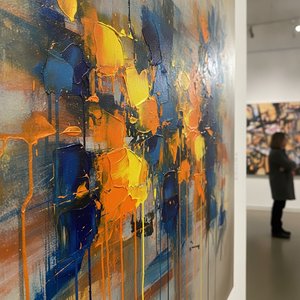
Beyond the Lines: Mastering the High-Impact World of Contemporary Abstraction
Master the high-impact world of contemporary abstraction. Discover how bold colors, textures, and modern movements like Abstract Expressionism can transform your space with premium, high-energy art curated for the design-conscious professional.

The Soul of Color: A Journey into the Emotional Resonance of Lyrical Abstraction
Embark on a cultural journey through Lyrical Abstraction. Explore how masters like Kandinsky used color and motion to translate emotion into visual poetry. Discover the profound beauty of abstract expressionism and learn to curate emotional resonance in your own art collection.

Expressionnisme Abstrait : Les 10 Chefs-d'Œuvre Incontournables pour Décorer avec Art et Histoire
Plongez au cœur de l'Expressionnisme Abstrait avec ! Découvrez les 10 œuvres majeures de Pollock, Rothko et De Kooning. Histoire, techniques & inspiration déco. Explorez la collection complète en ligne.

Abstraction Géométrique : Les 10 Chefs-d'œuvre qui ont Marqué l'Histoire de l'Art
Plongez au cœur de l'abstraction géométrique avec OriginalUniqueArt.com ! Découvrez les 10 œuvres majeures de Mondrian, Malevitch et Kandinsky qui ont révolutionné l'art moderne. Inspirez votre décoration intérieure avec des reproductions de tableaux exceptionnelles. Explorez la collection en ligne !
