Passer au format impression
 Lire la suite







































 Pour les œuvres ou reproductions dont un côté mesure plus de 105 cm (environ 41 pouces), le cadre sera expédié sous forme de kit démonté. Cette méthode garantit une livraison sécurisée et prévient tout dommage pendant le transport.


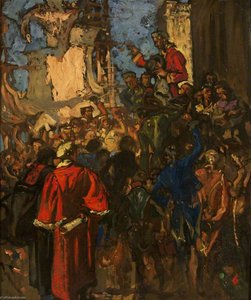
Roman Triumph by Sir Frank William Brangwyn
Frank Brangwyn’s “Roman Triumph” stands as a monumental testament to British imperial ambition and artistic grandeur during the early 20th century. Executed in 1924, this colossal mural—measuring approximately 67 x 89 centimeters—was commissioned for the House of Lords Gallery, reflecting a desire to commemorate the centenary of the Battle of Trafalgar and celebrate Britain’s dominion over vast territories. Brangwyn, deeply influenced by Orientalist traditions and driven by an unwavering belief in the transformative power of art, embarked on this ambitious project with characteristic fervor.- Style: The painting embodies a vibrant blend of Symbolism and Art Deco influences. Its bold color palette—dominated by reds, golds, and blues—contrasts sharply against muted browns and blacks, creating a dramatic visual experience that immediately captures the viewer’s attention.
- Technique: Brangwyn employed oil paint on canvas, utilizing layering techniques to achieve remarkable depth and luminosity. He meticulously crafted intricate details, capturing the movement of horses and figures with astonishing precision—a hallmark of his artistic prowess. The artist skillfully blended tonal gradations to convey a sense of atmosphere and grandeur.
- Historical Context: Created during the First World War, “Roman Triumph” served as a powerful symbol of national pride and resilience. It reflects the prevailing mood of optimism and confidence within Britain at the time—a belief in progress and triumph over adversity. The mural’s imagery draws upon classical mythology and heraldic symbolism to reinforce these themes.
- Symbolism: The central figures depict Roman emperors overseeing a procession of soldiers, symbolizing imperial authority and military might. The vibrant colors evoke associations with royalty and splendor, while the stylized horses convey dynamism and nobility. Furthermore, the composition incorporates elements of Christian iconography—a subtle nod to Britain’s spiritual heritage—adding layers of meaning to the artwork.
- Emotional Impact: “Roman Triumph” aims to inspire awe and admiration for British history and culture. Its monumental scale commands attention, transporting viewers back in time to an era of imperial grandeur. The painting's emotive intensity communicates a sense of triumph over hardship—a celebration of national identity and artistic achievement.
Questions et réponses
Quelle place occupe « Roman Triumph » parmi les thèmes récurrents de Frank Brangwyn ?
Les thèmes récurrents de Frank Brangwyn incluent british empire, decorative arts, orientalist style, symbolic imagery, monumental mural ; « Roman Triumph » se concentre sur roman triumph, frank brangwyn, british empire, orientalism, painting, murals, maritime.
«Roman Triumph» de Frank Brangwyn est-elle une œuvre lumineuse ou sombre ?
La luminosité perçue de «Roman Triumph» de Frank Brangwyn est ombres profondes. Elle peut être harmonisée avec la lumière de l'espace prévu.
Dans quel mouvement et à quelle époque s'inscrit «Roman Triumph» de Frank Brangwyn ?
Dans «Roman Triumph» de Frank Brangwyn, le mouvement Orientalist Painting rencontre l'époque XIXe siècle.
 Aperçu en situation
 Envoyer
 Partager
 Détails de l'œuvre
 Guide
Guide

 Télécharger l'image
 Articles similaires
 Radiographie
 Diaporama
 Q&A
Q&A Statistiques