

 Aperçu en situation
 Partager
 Partager
 Détails

 Télécharger
 Articles similaires
 Radiographie
 Voir le diaporama
 Statistiques
Bull-Hunting
 Oil On Canvas
- WallArt
- Rococo
 1736
1736- Early Modern
 114.0 x 150.0 cm
 Gallerie dell’Accademia
 Afficher la suite
Giclées et impressions d'art
Impressions giclées ou sur toile de qualité musée, avec une production rapide et des finitions au choix. ( Acheter la peinture faite à la main Passer au format image numérique)




P118B $10

P118H $10

P118W $10

P438Z $10

P508JH $12

P508YH $12

P805H $10

P805Z $10

P919BZ $10

P919G $10

P919XJ $10

P959ZH $10

P968JZ $12

W106C $8

W218G $10

W218JH $8

W218Y $10

W307PJ $10

W316G $10

W316PJ $8

W316Y $10

W398PJ $8

W4111J $10

W500HY $15

W500JH $15

W692G $12

W849H $8

W940BG $15

W953PJ $8




Choisissez parmi nos formats prédéfinis qui respectent les proportions originales de l’œuvre.

Vous pouvez saisir vos propres dimensions pour vous adapter à un cadre ou à un espace spécifique. Si la taille sélectionnée ne correspond pas aux proportions de l'image originale, nous recadrerons l'œuvre ou étendrons l'image avec une bordure en miroir ou une couleur unie. Une maquette numérique vous sera envoyée pour approbation avant le début de la production.
Veuillez noter que l'aperçu à l'écran ne reflète pas le recadrage ou l'extension réelle. Seule la maquette montrera avec précision la composition finale.
Bien que des tailles personnalisées soient disponibles, nous vous recommandons de choisir une dimension dans la liste prédéfinie afin de préserver les proportions originales.
Livraison dans le monde entier () en 2 semaines au lieu des 4/5 semaines habituelles. (17 septembre)

Livraison express gratuite dans le monde entier

Toile de lin de haute qualité

Assurance transport complète

Garantie de remboursement des droits de douane

Garantie de fidélité des couleurs

Garantie de retour de 100 jours (uniquement en cas de défaut)

Garantie de remboursement à 100%

Tarifs dégressifs sur quantité
 L'option verre n'est disponible que pour les dimensions inférieures à 110 cm.

Bull-Hunting
Giclées et impressions d'art
Format de la reproduction
-


Prix total final
$ 80
A Pastoral Symphony in Pastel
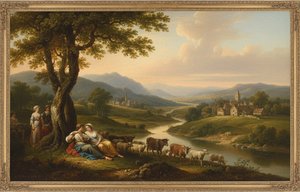
In the heart of the mid-18th century, the Venetian landscape underwent a profound transformation, moving away from the dramatic tensions of the Baroque toward the luminous, airy grace of the Rococo. At the forefront of this movement stood Francesco Zuccarelli, a master whose brush possessed the unique ability to capture the ephemeral soul of nature. His masterpiece, “Bull-Hunting,” serves as a breathtaking window into an idealized world, where the ruggedness of a hunt is softened by the poetic elegance of an Arcadian dream. The painting does not merely depict a scene; it invites the viewer to step into a realm of perpetual spring, where the air feels light and the atmosphere is saturated with a gentle, rhythmic vitality.
The visual experience begins with Zuccarelli’s exquisite command of color. Eschewing heavy shadows and somber tones, the artist employs a palette of delicate pastels that seems to glow from within. Pale, cerulean blues mirror the clarity of a Venetian sky, while muted mossy greens and soft, sun-drenched ochres create a lush, velvety landscape. These colors work in harmony to establish a sense of profound tranquility, making the piece an ideal centerpiece for any space seeking to evoke serenity and sophistication. The light in the composition is diffused and ethereal, casting no harsh shadows, which allows the eye to wander effortlessly across the rolling hills and through the dappified groves.
The Dance of Humanity and Nature
Beyond its aesthetic beauty, “Bull-Hunting” is a complex narrative of movement and mythological resonance. The composition is alive with a choreographed energy; figures dressed in the elegant attire of the 1730s are scattered across the terrain, engaged in a spirited pursuit. The bulls themselves, varying in size and posture, introduce a dynamic tension that prevents the scene from becoming static. Yet, even in this moment of action, there is an underlying sense of order and nobility. Zuccarelli subtly weaves in elements of classical allegory, suggesting that this hunt is not merely a feat of strength, but a celebration of the harmonious relationship between humanity and the natural world.
The technique employed here is nothing short of masterful. Zuccarelli’s brushwork is remarkably fluid and loose, a hallmark of the Rococo style that avoids rigid outlines in favor of soft, blended textures. This painterly approach allows the foliage to appear as if it might rustle in a passing breeze and gives the figures a sense of weightless motion. For the discerning collector or interior designer, this fluidity offers a sense of organic movement that breathes life into a room. To possess a reproduction of such a work is to bring a piece of historical grandeur and rhythmic grace into a contemporary setting, offering an enduring sense of luxury and peace.
An Enduring Legacy for the Modern Collector
To contemplate “Bull-Hunting” is to engage with the very essence of the 18th-century European ideal. It captures a moment in time when art sought to elevate the mundane into the magnificent, turning a simple pastoral event into a timeless tableau of beauty. The painting’s ability to balance vigorous action with a soothing color temperature makes it a versatile treasure, capable of anchoring a formal gallery wall or providing a soft, sophisticated accent in a sunlit study.
For those looking to invest in high-quality art reproductions, this work represents a pinnacle of the Venetian tradition. It is more than a decoration; it is an emotional experience—a reminder of the beauty found in balance, light, and the eternal dance of life. Whether adorning a grand estate or a curated modern apartment, Zuccarelli’s vision continues to inspire awe, offering a window into a world where nature and humanity exist in perfect, sun-drenched accord.
Biographie de l'artiste
Francesco Zuccarelli : Un Maître du Paysage Italien
- Période: Fin baroque / Rococo (1702-1788)
- Origine: Pitigliano, Italie
- Autres noms: Giacomo Francesco Zuccarelli
Jeunesse et Formation
- Né le 15 août 1702 à Pitigliano, en Toscane.
- Son père était un vigneron prospère et commerçant.
- Vers l'âge de onze ou douze ans, il commence son apprentissage à Rome auprès des portraitistes Giovanni Maria Morandi et Pietro Nelli. Il y apprend les bases du dessin et s’imprègne du classicisme romain.
- En 1725-1727, il réalise sa première commande importante : une paire de retables pour une chapelle dans sa ville natale.
- Grâce au mécène Francesco Maria Niccolò Gabburri, il se consacre principalement à la gravure de 1728 à 1731, produisant plus de 43 estampes documentant les fresques dégradées de Giovanni da San Giovanni et Andrea del Sarto.
- Pendant son séjour florentin, il commence à expérimenter avec des dessins de paysages, conservés aux archives de l'Uffizi.
Développement Artistique et Succès
- En 1732, après un passage par Bologne, Zuccarelli s’installe à Venise, profitant du vide laissé par le décès de Marco Ricci dans le domaine de la peinture de paysage.
- Il combine des œuvres religieuses et mythologiques avec une attention croissante aux paysages, inspirés par Claude Lorrain et l'école romaine.
- Ses premières peintures des années 1730 montrent l’influence d’Alessandro Magnasco puis de Ricci. Il apporte une palette plus douce et aérée que les couleurs vénitiennes traditionnelles, donnant vie à ses paysages idylliques grâce à des valeurs tonales lumineuses.
- Il connaît un succès rapide à Venise, attirant le mécénat du maréchal Schulenburg, de Joseph Smith (son protecteur principal), et de Francesco Algarotti qui le recommande au prince électeur de Saxe, Auguste III de Pologne.
- En 1735, il épouse Giustina Agata Simonetti et a quatre enfants, dont deux meurent en bas âge.
Collaborations et Œuvres Majeures
- Il collabore avec d'autres artistes comme Bernardo Bellotto et Antonio Visentini, notamment pour une série de paysages néo-palladiens (Burlington House, 1746).
- Une collaboration notable est la création d’un jeu de cartes des personnages de l'Ancien Testament en 1748.
- Un ensemble de sept toiles représentant Rebecca avec Jacob et Ésaü, actuellement au château de Windsor, témoigne du sommet de sa première période vénitienne. Ces œuvres délicates et oniriques ornaient probablement la villa de Joseph Smith à Mogliano.
- Il réalise également des pastiches d'œuvres de maîtres hollandais du XVIIe siècle.
Déclin et Postérité
- Bien qu’il ait connu une grande renommée de son vivant, sa réputation décline au début du XIXe siècle avec l'essor du naturalisme dans la peinture de paysage.
- Turner a critiqué son travail, tout en reconnaissant la beauté de ses figures.
- L'historien de l'art Michael Levey a souligné en 1959 l’attrait décoratif de son œuvre, expliquant son succès contemporain auprès des Anglais.
- Depuis les années 1990, un regain d'intérêt pour Zuccarelli est observé parmi les érudits italiens, qui lui accordent une place importante dans leurs publications et expositions.

Francesco Zuccarelli
1702 - 1788 , Italie
En bref
- Artistes Influents:
- Paolo Anesi
- Claude Lorrain
- Date De Décès: 30 décembre 1788
- Date De Naissance: 15 août 1702
- Influences Artistiques: ['École romaine']
- Lieu De Naissance: Pitigliano, Italie
- Mouvement Artistique: Rococo et Baroque
- Nationalité: Italienne
- Nom Complet: Francesco Zuccarelli
- Oeuvres Notables:
- Bacchanal
- Capriccio...
- Paysage pastoral
Articles similaires

Les 10 Chefs-d'œuvre du Paysage Romantique : Artistes et Décor d'Intérieur
Plongez dans l'émotion du Romantisme avec les 10 plus beaux paysages de Friedrich, Turner & Delacroix. Découvrez leur histoire et trouvez l'inspiration déco idéale sur OriginalUniqueArt.com !

Constable : Les 25 Chefs-d'Œuvre du Maître Anglais | OriginalUniqueArt
Plongez dans l'univers de John Constable avec les 25 œuvres incontournables du maître anglais. Découvrez l'histoire, la technique et l'émotion derrière ses paysages romantiques. Reproductions de qualité muséale sur OriginalUniqueArt.com.

Idyllic Visions: Exploring the Pastoral Scene in Art History – From Arcadia to Modern Interpretations
Explore the captivating history of pastoral art from classical Arcadia to modern masterpieces. Discover key artists like Millet & Cole at OriginalUniqueArt. Find serene landscape paintings for your home.

Hokusai : Les 25 Œuvres Maîtresses d'un Génie Japonais | OriginalUniqueArt
Plongez dans l'univers de Katsushika Hokusai avec les 25 œuvres incontournables du maître japonais. Découvrez l'histoire, les techniques d'ukiyo-e et la beauté intemporelle de 'La Grande Vague'. Reproductions tableaux de qualité muséale sur OriginalUniqueArt.com.
Idyllic Visions: Exploring the Pastoral Tradition in Western Art – Themes, Techniques & Enduring Appeal
Explore the rich history of pastoral art from classical Arcadia to contemporary interpretations. Discover key artists, themes & collecting tips at OriginalUniqueArt.