
 Aperçu en situation
 Envoyer
 Partager
 Détails de l'œuvre
 Guide
Guide

 Télécharger l'image
 Articles similaires
 Radiographie
 Diaporama
 Statistiques
Bacchanal
 Oil On Canvas
- WallArt
- Rococo Period
 1740
1740- Early Modern
 142.0 x 210.0 cm
 Gallerie dell’Accademia
 Lire la suite
Giclées et impressions d'art
Impressions giclées ou sur toile de qualité musée, avec une production rapide et des finitions au choix. ( Commander la reproduction peinte à la main Passer au format numérique)




P118B €10

P118H €10

P118W €10

P438Z €10

P508JH €12

P508YH €12

P805H €10

P805Z €10

P919BZ €10

P919G €10

P919XJ €10

P959ZH €10

P968JZ €12

W106C €8

W218G €10

W218JH €8

W218Y €10

W307PJ €10

W316G €10

W316PJ €8

W316Y €10

W398PJ €8

W4111J €10

W500HY €15

W500JH €15

W692G €12

W849H €8

W940BG €15

W953PJ €8




Choisissez parmi nos formats prédéfinis qui respectent les proportions originales de l’œuvre.

Saisissez la largeur et la hauteur souhaitées pour qu'elles s'adaptent à votre cadre ou à votre mur. Une impression peut être recadrée, mais jamais agrandie au-delà de l'image originale ; ainsi, un format de forme différente entraînera la perte d'une partie de l'image. Nous vous envoyons une maquette numérique pour approbation avant toute impression. L'image présentée sur cette page ne montre pas le recadrage réel — seule la maquette le permet.
Livraison dans le monde entier () en 2 semaines au lieu des 4/5 semaines habituelles. (27 octobre)

Livraison express gratuite dans le monde entier

Toile de lin de qualité supérieure

Assurance transport complète

Garantie de remboursement des droits de douane

Garantie de fidélité des couleurs

Politique de retour de 100 jours (uniquement en cas de défaut)

Garantie de remboursement à 100%

Offre de tarifs dégressifs
 L'option verre n'est disponible que pour les dimensions inférieures à 110 cm.

Bacchanal
Giclées et impressions d'art
Format de la reproduction
-


Prix total
€ 70
Francesco Zuccarelli’s Bacchanal: A Symphony of Pastoral Elegance
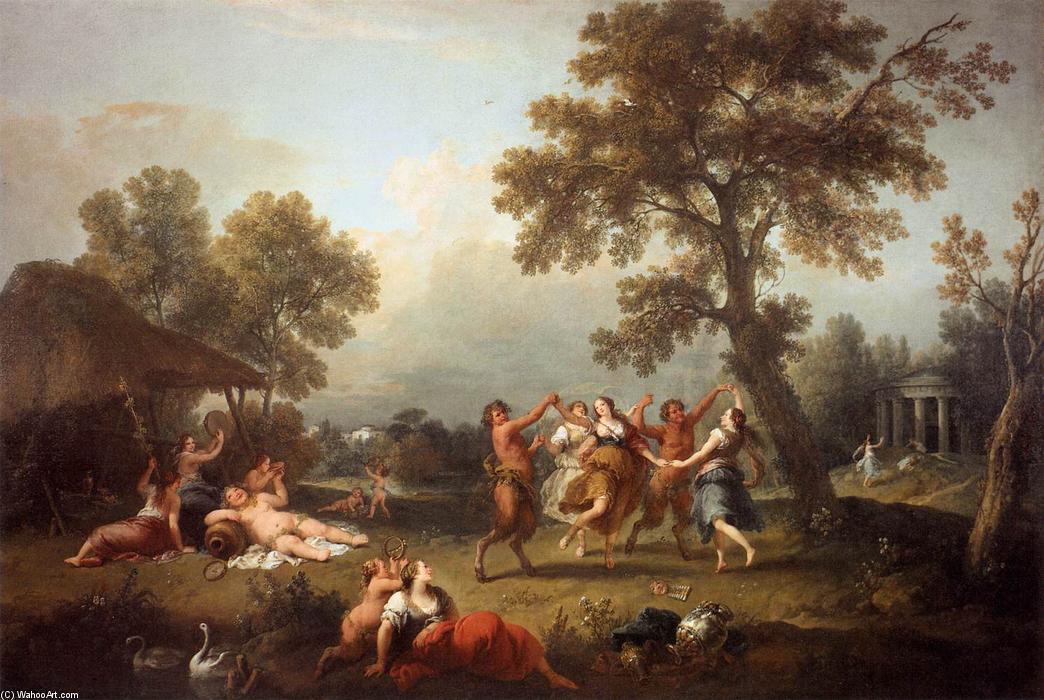
The Bacchanal by Francesco Zuccarelli stands as an emblem of the Rococo artistic movement, capturing not merely a scene but an entire ethos—one steeped in aristocratic indulgence and idealized beauty. Painted circa 1740-50, this oil on canvas masterpiece resides within the Gallerie dell’Accademia in Venice, Italy, offering visitors a glimpse into a period defined by opulent interiors and refined sensibilities. Zuccarelli's skill lies not just in depicting figures engaged in joyous revelry but in crafting an immersive experience that transports the viewer to a realm of pastoral serenity infused with vibrant color and masterful composition.Composition and Style: Balancing Chaos and Harmony
Zuccarelli’s approach distinguishes itself from the more dramatic Baroque tradition, prioritizing balance and grace over theatrical grandeur. The painting depicts a lively bacchanal—a celebration honoring Dionysus, the Greek god of wine and ecstasy—yet it avoids overwhelming visual sensation. A central group of figures dominates the canvas, their postures dynamic yet carefully arranged around a prominent architectural element: a classical structure reminiscent of Roman temples, subtly anchoring the scene in antiquity. The artist employs meticulous detailing to portray each participant’s attire and expression, conveying both physicality and emotion with remarkable precision. Notice how Zuccarelli utilizes light and shadow to sculpt forms, creating depth and enhancing the sense of movement—a hallmark of Rococo aesthetics.Color Palette and Technique: Embracing Pastel Radiance
The color palette is dominated by earthy tones – ochre, umber, Sienna – providing a grounding counterpoint to the splashes of vibrant hues adorning the figures’ clothing. Crimson reds, emerald greens, and sapphire blues punctuate the scene, symbolizing fertility, vitality, and divine inspiration. Zuccarelli's technique showcases exceptional brushwork, layering pigments with subtle gradations to achieve luminous surfaces that shimmer with reflected light. The artist skillfully blends colors on canvas, creating a velvety texture that contributes to the painting’s overall impression of luxurious softness. This meticulous attention to detail underscores Zuccarelli’s dedication to capturing not just what is seen but also how it feels—a testament to the transformative power of art.Historical Context: Venetian Aristocracy and Artistic Patronage
The Bacchanal reflects the cultural landscape of Venice during the mid-18th century, a city ruled by an aristocratic elite deeply invested in artistic patronage. Zuccarelli’s work exemplifies the Rococo style's fascination with idealized landscapes and mythological narratives—themes favored by Venetian noble families eager to express their status and sophistication. The painting aligns perfectly with broader European trends toward decorative art and emotional expression, signaling a shift away from Baroque solemnity towards a celebration of sensual pleasure and imaginative vision.Symbolism: Dionysian Ecstasy and Pastoral Tranquility
Beyond its visual splendor, Bacchanal is laden with symbolic significance. The bacchanalia itself represents the unrestrained pursuit of joy and indulgence—a deliberate rejection of Puritan morality—while simultaneously evoking images of Arcadia, the mythical pastoral paradise inhabited by shepherds and nymphs. The figures’ gestures convey a profound connection to nature and divine inspiration, mirroring the Rococo preoccupation with themes of beauty, harmony, and sensual experience. Zuccarelli's masterful depiction captures not only the outward spectacle of celebration but also its inner resonance—a reminder that art can transcend mere representation to communicate deeper truths about human emotion and spiritual aspiration.Legacy: Rediscovering Zuccarelli’s Vision
Francesco Zuccarelli’s reputation waned in the early 19th century, yet his work has experienced a resurgence of interest in recent decades, displayed prominently in museums worldwide. Bacchanal stands as a cornerstone of Rococo art history—a testament to Zuccarelli's artistic genius and his ability to distill the essence of an era into a single unforgettable image. Its enduring appeal lies in its exquisite beauty, balanced composition, and profound exploration of human emotion, continuing to inspire artists and collectors alike.Questions et réponses
Est-il possible de télécharger l'image de « Bacchanal » ?
«Bacchanal» de Francesco Zuccarelli peut être téléchargé depuis la page Téléchargement de l'œuvre, en tant que téléchargement d'une image numérique haute résolution.
Quelle est la luminance de «Bacchanal» de Francesco Zuccarelli ?
«Bacchanal» de Francesco Zuccarelli présente une luminance de Gentle Luminance. La luminance décrit la quantité de lumière que les couleurs semblent réfléchir.
En quelle année «Bacchanal» de Francesco Zuccarelli a-t-il été créé ?
L'œuvre «Bacchanal» de Francesco Zuccarelli date de 1740.
Biographie de l'artiste
Francesco Zuccarelli : Un Maître du Paysage Italien
- Période: Fin baroque / Rococo (1702-1788)
- Origine: Pitigliano, Italie
- Autres noms: Giacomo Francesco Zuccarelli
Jeunesse et Formation
- Né le 15 août 1702 à Pitigliano, en Toscane.
- Son père était un vigneron prospère et commerçant.
- Vers l'âge de onze ou douze ans, il commence son apprentissage à Rome auprès des portraitistes Giovanni Maria Morandi et Pietro Nelli. Il y apprend les bases du dessin et s’imprègne du classicisme romain.
- En 1725-1727, il réalise sa première commande importante : une paire de retables pour une chapelle dans sa ville natale.
- Grâce au mécène Francesco Maria Niccolò Gabburri, il se consacre principalement à la gravure de 1728 à 1731, produisant plus de 43 estampes documentant les fresques dégradées de Giovanni da San Giovanni et Andrea del Sarto.
- Pendant son séjour florentin, il commence à expérimenter avec des dessins de paysages, conservés aux archives de l'Uffizi.
Développement Artistique et Succès
- En 1732, après un passage par Bologne, Zuccarelli s’installe à Venise, profitant du vide laissé par le décès de Marco Ricci dans le domaine de la peinture de paysage.
- Il combine des œuvres religieuses et mythologiques avec une attention croissante aux paysages, inspirés par Claude Lorrain et l'école romaine.
- Ses premières peintures des années 1730 montrent l’influence d’Alessandro Magnasco puis de Ricci. Il apporte une palette plus douce et aérée que les couleurs vénitiennes traditionnelles, donnant vie à ses paysages idylliques grâce à des valeurs tonales lumineuses.
- Il connaît un succès rapide à Venise, attirant le mécénat du maréchal Schulenburg, de Joseph Smith (son protecteur principal), et de Francesco Algarotti qui le recommande au prince électeur de Saxe, Auguste III de Pologne.
- En 1735, il épouse Giustina Agata Simonetti et a quatre enfants, dont deux meurent en bas âge.
Collaborations et Œuvres Majeures
- Il collabore avec d'autres artistes comme Bernardo Bellotto et Antonio Visentini, notamment pour une série de paysages néo-palladiens (Burlington House, 1746).
- Une collaboration notable est la création d’un jeu de cartes des personnages de l'Ancien Testament en 1748.
- Un ensemble de sept toiles représentant Rebecca avec Jacob et Ésaü, actuellement au château de Windsor, témoigne du sommet de sa première période vénitienne. Ces œuvres délicates et oniriques ornaient probablement la villa de Joseph Smith à Mogliano.
- Il réalise également des pastiches d'œuvres de maîtres hollandais du XVIIe siècle.
Déclin et Postérité
- Bien qu’il ait connu une grande renommée de son vivant, sa réputation décline au début du XIXe siècle avec l'essor du naturalisme dans la peinture de paysage.
- Turner a critiqué son travail, tout en reconnaissant la beauté de ses figures.
- L'historien de l'art Michael Levey a souligné en 1959 l’attrait décoratif de son œuvre, expliquant son succès contemporain auprès des Anglais.
- Depuis les années 1990, un regain d'intérêt pour Zuccarelli est observé parmi les érudits italiens, qui lui accordent une place importante dans leurs publications et expositions.

Francesco Zuccarelli
1702 - 1788 , Italie
L'essentiel de l'artiste
- Artistes Influents:
- Paolo Anesi
- Claude Lorrain
- Date De Décès: 30 décembre 1788
- Date De Naissance: 15 août 1702
- Influences Artistiques: ['École romaine']
- Lieu De Naissance: Pitigliano, Italie
- Mouvement Artistique: Rococo et Baroque
- Nationalité: Italienne
- Nom Complet: Francesco Zuccarelli
- Oeuvres Notables:
- Bacchanal
- Capriccio...
- Paysage pastoral
Articles connexes

L'Esthétique Rococo : Opulence, Rébellion et la Quête du Plaisir au XVIIIe Siècle
Explorez l'esthétique rococo : opulence, rébellion et quête du plaisir au XVIIIe siècle. Découvrez les maîtres (Watteau, Boucher, Fragonard) et l'influence durable de ce style artistique raffiné. Analyse approfondie & reproductions d'exception.

Pietro Longhi's Venetian Scenes: A Study of Rococo Society & Domestic Life
Explore the captivating world of Pietro Longhi's Venetian scenes! Discover insightful analysis of his Rococo masterpieces & social commentary on 18th-century life. Learn about this 'Venetian Hogarth' and his lasting artistic legacy.

The Allure of Elegance in Art: A Historical & Aesthetic Exploration of Refinement & Grace
Explore the exquisite world of Rococo art! Discover its history, masters (Watteau, Boucher & more), and defining elegance. Expert insights for collectors seeking museum-quality reproductions & custom portraits.

Les 10 Chefs-d'Œuvre du Rococo : Artistes, Histoire & Décor Intérieur
Plongez dans l'univers raffiné du Rococo avec les 10 chefs-d'œuvre de Fragonard, Boucher & Watteau. Découvrez l'histoire, les techniques et la magie de ce mouvement artistique. Reproductions tableaux de qualité muséale sur .

Francesco Guardi: Venetian Light, Atmospheric Perspective & the Rococo to Neoclassical Transition
Explore the captivating world of Francesco Guardi, master of Venetian light and atmosphere. Discover his transition from Rococo to Neoclassicism, influence on Impressionism & investment potential with OriginalUniqueArt.

