

 Aperçu en situation
 Envoyer
 Partager
 Détails de l'œuvre
 Guide
Guide

 Télécharger l'image
 Articles similaires
 Radiographie
 Diaporama
 Statistiques
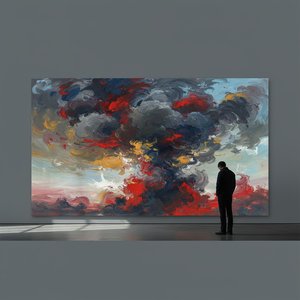
Duino-Nueve (Orrantia/92)
 Acrylique sur toile
- Art mural
- Abstract Expressionism
 1992
1992 Galerie d’Art LAC de la Banque Interaméricaine de Développement
 Lire la suite
L’œuvre d'art présentée sur cette page est protégée par le droit d'auteur, ce qui signifie que nous ne pouvons légalement créer ou vendre de reproduction identique. Cette protection est appliquée en vertu d'accords internationaux tels que la Convention de Berne et par les lois nationales, notamment celles énoncées par le Loi américaine sur le droit d'auteur - Titre 17.
En tant qu'alternative respectueuse et légale, nous proposons des œuvres d'art personnalisées, peintes à la main et inspirées de l'original. Nos artistes talentueux et professionnels étudient avec soin le style, l'ambiance et l'essence artistique de l'œuvre originale pour créer une pièce nouvelle et unique qui évoque la même émotion — tout en restant une création originale en soi.
Cette méthode est pleinement conforme aux réglementations sur le droit d'auteur car elle ne repose pas sur la copie ou la duplication de l'œuvre protégée. Il s'agit plutôt d'une réinterprétation créative — une nouvelle peinture qui s'inspire de l'original sans pour autant lui être identique.
Reproduction à l'huile faite à la main
Huile sur toile peinte à la main, avec cadre et dimensions personnalisés, réalisée sur commande par nos artistes. ( Passer au format impression Passer au format numérique)




P118B €10

P118H €10

P118W €10

P438Z €10

P508JH €12

P508YH €12

P805H €10

P805Z €10

P919BZ €10

P919G €10

P919XJ €10

P959ZH €10

P968JZ €12

W106C €8

W218G €10

W218JH €8

W218Y €10

W307PJ €10

W316G €10

W316PJ €8

W316Y €10

W398PJ €8

W4111J €10

W500HY €15

W500JH €15

W692G €12

W849H €8

W940BG €15

W953PJ €8




Choisissez parmi nos formats prédéfinis qui respectent les proportions originales de l’œuvre.

Saisissez la largeur et la hauteur souhaitées, pour s'adapter à votre cadre ou à votre mur. Cette œuvre est peinte à la main ; ainsi, pour un format de forme différente, l'artiste peut peindre un peu plus autour du tableau ou réduire légèrement les bords — c'est vous qui choisissez. Nous vous envoyons une maquette numérique pour approbation avant que la peinture ne commence. L'image présentée sur cette page ne reflète pas le résultat réel — seule la maquette le fait.
Après la commande, l’équipe OriginalUniqueArt.com contactera le client par e-mail pour recueillir ses instructions et lui fournira une maquette d’aperçu
Livraison dans le monde entier () en 3 à 4 semaines au lieu des 5 semaines habituelles. (28 octobre). Aucun compromis sur la qualité.

Livraison express gratuite dans le monde entier

Toile de lin de qualité supérieure

Assurance transport complète

Garantie de remboursement des droits de douane

Garantie de fidélité des couleurs

Politique de retour de 100 jours (uniquement en cas de défaut)

Garantie de remboursement à 100%

Offre de tarifs dégressifs
 L'option verre n'est disponible que pour les dimensions inférieures à 110 cm.

Duino-Nueve (Orrantia/92)
Technique de reproduction
Format de la reproduction
-


Prix total
€ 264
Fernando de Szyszlo: Bridging Ancient Echoes and Modern Expression
Fernando de Szyszlo (1925-2017) stands as a monumental figure in Peruvian art history, recognized for his pioneering role in establishing abstract expressionism within Latin America while simultaneously honoring the profound legacy of Andean culture. Born in Lima to a Peruvian mother of Spanish-Indian descent and a Polish father, Szyszlo’s formative years instilled in him an appreciation for both European intellectual traditions and indigenous heritage—a duality that would profoundly shape his artistic vision. This confluence of influences is palpable throughout his oeuvre, resulting in canvases that resonate with a unique blend of formal innovation and symbolic depth. Szyszlo's journey into art began at the National University of Engineering but was swiftly redirected by an irresistible passion for architecture before he decisively embraced the School of Plastic Arts of Pontifical Catholic University of Peru. Graduating in 1948, he embarked on a transformative voyage across Europe, immersing himself in the groundbreaking works of masters like Rembrandt and Titian—artists who championed dramatic chiaroscuro and psychological realism. These encounters ignited Szyszlo’s imagination and fueled his determination to forge a path distinct from established artistic conventions. His stylistic evolution culminated in the embrace of abstract expressionism during the mid-1950s, marking a pivotal moment in Peruvian art. Rejecting representational accuracy, Szyszlo sought to convey emotion and experience directly onto the canvas through spontaneous gestures and bold color palettes—a technique championed by artists like Jackson Pollock and Willem de Kooning. However, unlike his contemporaries who often prioritized purely formal experimentation, Szyszlo consistently incorporated elements of Andean iconography and symbolism into his paintings. Recurring motifs such as llamas, condors, and geometric patterns hark back to the rich artistic traditions of Peru’s pre-Columbian past, grounding his abstract explorations in a tangible connection to Peruvian cultural heritage. The painting "Duino-Nueve (Orrantia/92)" exemplifies Szyszlo's distinctive approach. The image depicts a solitary figure wielding a knife—a potent symbol representing both vulnerability and decisive action—against a dark backdrop punctuated by flashes of intense color. The artist’s meticulous attention to detail, particularly in capturing the texture and contours of the hand holding the blade, underscores his commitment to conveying palpable physicality alongside conceptual ideas. Furthermore, Szyszlo's masterful use of pigment creates an atmosphere of dramatic tension, mirroring the psychological complexities inherent in the subject matter. Szyszlo’s artistic legacy extends beyond stylistic innovation; he served as a crucial catalyst for fostering dialogue between Peruvian art and Andean culture—a contribution that continues to inspire artists and scholars alike. His unwavering dedication to exploring the expressive potential of abstraction combined with his reverence for indigenous traditions solidified his position as one of Peru's most influential visual artists, ensuring that his work remains relevant and captivating for generations to come.- Artist: Fernando de Szyszlo
- Born Year: 1925
- Death Year: 2017
- Birth City: Lima
- Birth Country: Peru
Historical Context
Szyszlo’s artistic endeavors unfolded during the formative years of Peruvian art history—a period marked by burgeoning interest in European modernism alongside an increasing awareness of Andean cultural identity. The influence of Surrealist artists like René Magritte and Salvador Dalí can be discerned in Szyszlo's exploration of dreamlike imagery and subconscious symbolism, reflecting a broader artistic preoccupation with psychological depth and imaginative vision.Style & Technique
Szyszlo’s signature style—abstract expressionism infused with Andean motifs—characterized by spontaneous brushstrokes, bold color combinations, and textural layering—represents a radical departure from traditional Peruvian painting practices. He skillfully manipulated pigment to create luminous surfaces that capture the essence of emotion and experience, mirroring the expressive dynamism found in the works of European masters like Willem de Kooning and Franz Kline.Symbolism
Recurring motifs such as llamas, condors, and geometric patterns—elements drawn from Andean iconography—serve as powerful symbols representing resilience, spiritual aspiration, and connection to ancestral traditions. Szyszlo’s deliberate incorporation of these visual cues underscores his commitment to honoring Peruvian cultural heritage while simultaneously elevating abstract expressionism beyond purely formal considerations.Emotional Impact
“Duino-Nueve (Orrantia/92)” evokes a profound sense of contemplation and unease—a reflection of Szyszlo’s masterful ability to convey psychological complexity through visual language. The painting's dramatic chiaroscuro contrasts heighten the tension between vulnerability and determination, prompting viewers to confront existential questions about human experience and artistic expression.Questions et réponses
Quel artiste et quel style se cachent derrière « Duino-Nueve (Orrantia/92) » ?
L'œuvre « Duino-Nueve (Orrantia/92) » est signée Fernando De Szyszlo et s'inscrit dans le mouvement Abstract Expressionism.
Quelle est la notoriété de « Duino-Nueve (Orrantia/92) » par Fernando De Szyszlo ?
Le niveau de popularité enregistré pour «Duino-Nueve (Orrantia/92)» de Fernando De Szyszlo est Reconnue.
Quelle ambiance et quelle émotion «Duino-Nueve (Orrantia/92)» de Fernando De Szyszlo exprime-t-il ?
L'atmosphère qui se dégage de «Duino-Nueve (Orrantia/92)» de Fernando De Szyszlo est Dramatique, et sa tonalité émotionnelle est Dramatique.
Biographie de l'artiste
L'Alchimiste de l'Abstraction Andine
Fernando de Szyszlo (1925-2017) s'impose comme une figure monumentale de l'histoire de l'art péruvien, reconnu pour son rôle pionnier dans l'établissement de l'expressionnisme abstrait en Amérique latine, tout en honorant simultanément le profond héritage de la culture andine. Né à Lima d'une mère péruvienne d'ascendance espagnole et indienne et d'un père polonais, les années de formation de Szyszlo lui ont inculqué une appréciation tant pour les traditions intellectuelles européennes que pour l'héritage indigène — une dualité qui allait profondément façonner sa vision artistique. Ses premières études à l'Université Nationale d'Ingénierie furent brièvement interrompues par une passion pour l'architecture avant qu'il n'embrasse résolument l'École des Arts Plastiques de l'Université Pontificale Catholique du Pérou, où il perfectionna ses compétences et s'engagea dans un voyage vers une exploration artistique profonde.
La trajectoire de la carrière de Szyszlo fut irrévocablement transformée par ses voyages à travers l'Europe à la fin des années 1940. En s'immergeant dans les œuvres des Maîtres Anciens tels que Rembrandt, Titien et Tintoret, il absorba une maîtrise de la lumière dramatique et de l'intensité émotionnelle qui allait plus tard informer son approche unique de l'ombre et de la profondeur. Son séjour à Paris et à Florence entre 1948 et 1955 le plaça au cœur de la scène vibrante de l'avant-garde latino-américaine centrée autour du Café Flore. Engagé dans des dialogues passionnés avec des luminaires tels que le poète surréaliste Octavio Paz et André Breton, Szyszlo fut confronté à une tension centrale et déterminante : comment réconcilier les idéaux modernistes internationaux avec la préservation d'une identité culturelle latino-américaine distincte.
Une Synthèse de la Modernité et du Mythe
À son retour au Pérou, Szyszlo devint un catalyseur du renouveau artistique, repoussant les limites en exprimant des sujets péruviens sous des formes non représentatives. Ce fut une rupture audacieuse avec les conventions stylistiques dominantes de l'indigénisme qui régnaient à l'époque. Son travail cherchait à réinventer les thèmes surréalistes dans un contexte latino-amissant, se concentrant moins sur le simple artifice artistique que sur les sentiments profonds liés au mysticisme indigène. En tissant l'imagerie précolombienne et les motifs incas dans la trame de l'abstraction, il créa un langage visuel qui semblait à la fois ancestral et avant-gardiste.
Sa technique se caractérisait par une manipulation magistrale de la texture et de la lumière. À travers l'utilisation d'un impasto épais, de couleurs superposées et d'une palette fréquemment sourde, Szyszlo évoquait les surfaces érodées des reliques archéologiques et le poids atmosphérique des paysages andins. Ses peintures présentent souvent :
- Des palettes de couleurs lyriques qui équilibrent les tons terreux avec des nuances soudaines et frappantes.
- Des formes géométriques suggérant la permanence structurelle de l'architecture ancienne.
- Une richesse texturale créée par d'épais empâtements pour évoquer un sentiment de temps géologique.
- Des formes ambiguës qui invitent le spectateur dans un état d'émerveillement contemplatif et surréaliste.
Héritage et Importance Historique
L'importance historique de Fernando de Szyszlo ne peut être surestimée ; il fut le pont entre le passé ancestral et le futur moderne. Sa capacité à articuler la modernité à travers le symbolisme précolombien a généré une rupture profonde avec la tradition tout en engageant simultanément un dialogue profond et respectueux avec elle. Il ne se contentait pas de peindre de manière abstraite ; il cherchait à trouver l'« âme » du Pérou dans le langage de l'abstraction internationale, veillant à ce que l'esprit indigène ne se perde pas dans la transition vers le modernisme.
Au-delà de ses toiles, Szyszlo fut un humaniste et un éducateur, occupant le poste de professeur d'art à l'Université Cornell et contribuant de manière significative à la vie intellectuelle de son pays. Aujourd'hui, son héritage est préservé dans certaines des institutions les plus prestigieuses au monde, notamment le Museum of Modern Art (MoMA) à New York, le Museum of Fine Arts à Houston et le Museo de Arte Contemporaneo Arequipa. Alors que nous approchons du centenaire de sa naissance, Szyszlo demeure un sujet d'étude vital, nous rappelant que la véritable innovation réside souvent dans l'acte courageux de se souvenir.

Fernando De Szyszlo
1925 - 2017 , Pérou
L'essentiel de l'artiste
- Artistic Movement Or Style: Abstract Expressionism
- Artists Or Movements Influenced By This Artist:
- Cubism
- Surrealism
- Artists Who Influenced This Artist:
- Rembrandt
- Titian
- Tintoretto
- Date Of Birth: Lima, Peru (1925)
- Date Of Death: October 9, 2017
- Full Name: Abraham Fernando de Szyszlo Valdelomar
- Nationality: Peruvian
- Notable Artworks:
- Trashumantes
- Untitled, SZY #1
- Camino a Mendieta V
- Place Of Birth: Lima
Articles connexes

Goya : 25 Chefs-d'Œuvre Inoubliables d'un Maître de l'Âme
Plongez au cœur de l'œuvre inégalable de Goya ! Découvrez 25 chefs-d’œuvre emblématiques, des portraits saisissants aux scènes dramatiques. Explorez la vie et l'art du maître espagnol avec OriginalUniqueArt.com – reproductions d'art de qualité musée et inspirations déco.
Au-Delà de la Représentation : Exploration du Paysage Émotionnel de l'Expressionnisme Abstrait
Explorez l'univers fascinant de l'Expressionnisme Abstrait avec OriginalUniqueArt. Analyse approfondie des maîtres (Pollock, Rothko, De Kooning) et conseils d'experts pour collectionner ces œuvres emblématiques. Découvrez une sélection unique.

Expressionnisme Abstrait : Les 10 Chefs-d'Œuvre Incontournables pour Décorer avec Art et Histoire
Plongez au cœur de l'Expressionnisme Abstrait avec ! Découvrez les 10 œuvres majeures de Pollock, Rothko et De Kooning. Histoire, techniques & inspiration déco. Explorez la collection complète en ligne.

Willem de Kooning : Abstraction, Geste et Évolution de la Peinture Américaine d'Après-Guerre
Explorez l'évolution artistique de Willem de Kooning et son rôle clé dans l'expressionnisme abstrait américain. Analyse approfondie, influences européennes et héritage durable pour les collectionneurs avertis.

Kandinsky : Les 25 Œuvres Maîtresses d'un Pionnier de l'Art Abstrait | OriginalUniqueArt
Plongez dans l'univers vibrant de Kandinsky ! Découvrez les 25 œuvres majeures du pionnier de l'art abstrait. Explorez son expressionnisme, ses couleurs audacieuses et l'histoire fascinante derrière chaque tableau. Reproductions d'exception sur OriginalUniqueArt.com.
