Aperçu en situation
 Partager
 Partager
 Détails

 Télécharger
 Articles similaires
 Radiographie
 Voir le diaporama
 Statistiques
Walk in the hills


 Afficher la suite
Giclées et impressions d'art
Impressions giclées ou sur toile de qualité musée, avec une production rapide et des finitions au choix. ( Acheter la peinture faite à la main Passer au format image numérique)




P118B $10

P118H $10

P118W $10

P438Z $10

P508JH $12

P508YH $12

P805H $10

P805Z $10

P919BZ $10

P919G $10

P919XJ $10

P959ZH $10

P968JZ $12

W106C $8

W218G $10

W218JH $8

W218Y $10

W307PJ $10

W316G $10

W316PJ $8

W316Y $10

W398PJ $8

W4111J $10

W500HY $15

W500JH $15

W692G $12

W849H $8

W940BG $15

W953PJ $8




Choisissez parmi nos formats prédéfinis qui respectent les proportions originales de l’œuvre.

Vous pouvez saisir vos propres dimensions pour vous adapter à un cadre ou à un espace spécifique. Si la taille sélectionnée ne correspond pas aux proportions de l'image originale, nous recadrerons l'œuvre ou étendrons l'image avec une bordure en miroir ou une couleur unie. Une maquette numérique vous sera envoyée pour approbation avant le début de la production.
Veuillez noter que l'aperçu à l'écran ne reflète pas le recadrage ou l'extension réelle. Seule la maquette montrera avec précision la composition finale.
Bien que des tailles personnalisées soient disponibles, nous vous recommandons de choisir une dimension dans la liste prédéfinie afin de préserver les proportions originales.
Livraison dans le monde entier () en 2 semaines au lieu des 4/5 semaines habituelles. (16 septembre)

Livraison express gratuite dans le monde entier

Toile de lin de haute qualité

Assurance transport complète

Garantie de remboursement des droits de douane

Garantie de fidélité des couleurs

Garantie de retour de 100 jours (uniquement en cas de défaut)

Garantie de remboursement à 100%

Tarifs dégressifs sur quantité
 L'option verre n'est disponible que pour les dimensions inférieures à 110 cm.

Walk in the hills
Giclées et impressions d'art
Format de la reproduction
-


Prix total final
$ 80
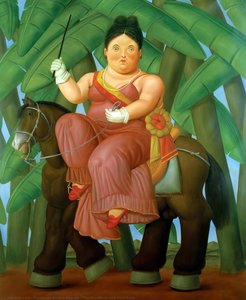
A Vision of Volumetric Stillness
In the vast landscape of twentieth-century Latin American art, few figures command attention with as much whimsical gravity as Fernando Botero. His 1977 masterpiece, Walk in the hills, serves as a profound window into the artist's signature aesthetic, often referred to as "Boterismo." At first glance, the painting presents a scene of quietude: a solitary figure, draped in heavy, dark garments and crowned with a black hat, stands amidst the rolling greenery of a hillside. Yet, beneath this deceptively simple surface lies a complex exploration of form and presence. Botero utilizes exaggerated volumes to breathe life into his subjects, transforming the human figure into a monumental sculpture of flesh and fabric that commands the space it occupies.
The technique employed in this work is a masterful nod to the Naïve Art and Primitivism movements. Rather than striving for hyper-realistic anatomical precision, Botero embraces a deliberate, smoothed texture and a simplified perspective that evokes a sense of timelessness and innocence. This stylistic choice allows the viewer to bypass the distractions of modern complexity and focus on the pure, sculptural essence of the subject. The brushwork is controlled and smooth, creating a surface where light and shadow play softly across the rounded contours of the priest, lending the piece a tactile quality that makes it an exquisite centerpiece for any sophisticated interior.
Symbolism and the Weight of Tradition
Beyond its aesthetic allure, Walk in the hills is a deeply symbolic narrative that invites intense contemplation. The central figure, a priest characterized by a peculiar, cross-eyed gaze, stands as a silent sentinel within the natural world. He holds an umbrella—a curious object to carry on a clear day—which serves as a poignant metaphor for a psychological or institutional defense mechanism. This umbrella represents a barrier, a way of shielding oneself from the external realities of the world, much like the insulating layers of bureaucracy or religious dogma can isolate an individual from true experience. The presence of the cross in his hand further anchors the piece in themes of spirituality and the heavy mantle of tradition.
There is a palpable sense of inertia within the composition; the priest does not move through the hills so much as he exists within them, embodying a state of passive existence. This tension between the vibrant, living landscape and the static, shielded figure creates an emotional resonance that is both unsettling and deeply moving. For the collector, this painting offers more than just visual beauty; it provides a conversation piece that explores the human condition, the concept of isolation, and the delicate balance between protection and disconnection.
An Elegant Addition to the Modern Collection
For interior designers and art enthusiasts alike, a high-quality reproduction of Walk in the hills offers a unique opportunity to introduce character and intellectual depth into a living space. The painting’s palette—a harmonious blend of earthy greens, deep blacks, and soft sky tones—allows it to integrate seamlessly into various decor styles, from contemporary minimalism to classic, traditional settings. Its ability to evoke both a sense of peace and a subtle, underlying critique makes it a versatile and captivating work.
Owning a piece that captures the essence of Botero’s genius means bringing a fragment of Colombian visionary art into one's private sanctuary. Whether placed in a sunlit gallery or a quiet study, this work continues to perform its primary function: inviting the observer to pause, to look closer, and to reflect on the beautiful, voluminous complexities of life itself.
Biographie de l'artiste
**Premières années et inspirations**
Fernando Botero Angulo, un artiste et sculpteur colombien renommé, est né le 19 avril 1932 à Medellín, en Colombie. Son style distinctif, connu sous le nom de « botérisme », caractérisé par des volumes larges et exagérés, a suscité à la fois des critiques politiques et un humour, selon l'œuvre.**Développement artistique et influence primitiviste**
L’enfance de Botero a été marquée par son isolement face à l’art exposé dans les musées et autres institutions culturelles. Cependant, il a été influencé par le style baroque des églises coloniales et la vie urbaine à Medellín. Cette influence primitiviste se manifeste dans son œuvre, qui présente souvent des formes simples mais puissantes.**Œuvres notables et expositions**
- Walk in the hills (art naïf / primitivisme, huile sur toile), une peinture qui met en valeur le style unique de Botero, est présentée sur OriginalUniqueArt.
- La Government Art Collection, un musée du Royaume-Uni, a exposé des œuvres de divers artistes, dont ceux influencés par le primitivisme. (plus d'informations sur Hastings Museum and Art Gallery)
**Reconnaissance internationale et héritage**
L’œuvre de Botero a été reconnue dans le monde entier, avec plus de 50 expositions dans les grandes villes du monde. Son art se vend à des prix atteignant des millions de dollars, ce qui consolide son statut de figure de proue de l'art colombien.- Prix importants : Botero a reçu le prix pour l’ensemble de sa carrière en sculpture contemporaine de l’International Sculpture Center en 2012.
- Expositions notables : Le Salón de Artistas Colombianos (1958) et la Government Art Collection (Royaume-Uni).
- Style artistique : Primitivisme, caractérisé par des formes simples et des volumes exagérés.
**Conclusion**
Le style primitiviste unique de Fernando Botero Angulo a laissé une marque indélébile sur le monde de l’art. Son œuvre continue d’inspirer les artistes et les collectionneurs, consolidant son héritage en tant que maître de l'art colombien. En savoir plus sur Fernando Botero Angulo sur OriginalUniqueArt. Source : Wikipédia
Fernando Botero
1932 - 1959 , Colombie
En bref
- Artistes Influents:
- Xul Solar
- Consuelo Hernández
- Alberto Valenzuela Llanos
- Date De Naissance: 19 avril 1932
- Lieu De Naissance: Medellín, Colombie
- Mouvement Artistique: Primitivisme, Boterismo
- Nationalité: Colombien(ne)
- Nom Complet: Fernando Botero Angulo
- Oeuvres Notables:
- Walk in the Hills
- Le bain des évêques
Articles similaires

The Pure Charm of Naïve Art: Finding Beauty in Simplicity, Soul, and the Unfiltered Vision
Discover the profound beauty of Naïve Art. Explore how self-taught masters bypass academic tradition to capture raw emotional truth through vibrant color and soulful simplicity. A cultural journey for the true art lover seeking depth beyond convention.
L'Étonnante Vision Naïve : Exploration des Caractéristiques, de l'Histoire et de l'Appel Durable de l'Art Naïf
Explorez l'univers fascinant de l'art naïf : histoire, caractéristiques et artistes emblématiques. Découvrez pourquoi cette forme d'expression continue d'inspirer et collectionnez des œuvres uniques avec OriginalUniqueArt.
Raw, Bold, Unfiltered: Why Naive Art is the Ultimate Vibe for Your Space
Ditch the boring decor. Discover why Naive Art's raw, bold, and unfiltered aesthetic is the ultimate trend for modern urban spaces. Learn how to use vibrant colors and unstudied sincerity to create a high-impact, authentic vibe in your home or studio.

L'Éclosion de l'Instinct : Exploration de l'Art Naïf et du Primitivisme, une Révolte contre les Conventions
Explorez l'art naïf et le primitivisme : Rousseau, Modigliani, Chagall… Découvrez l'histoire, les caractéristiques et les figures clés de ces mouvements artistiques authentiques. Guide expert OriginalUniqueArt.
Le Primitivisme en Art : Aux Sources de la Modernité et son Héritage Durable
Explorez les origines et l'héritage du Primitivisme en art. Découvrez l'influence de Picasso, Gauguin et des arts non-occidentaux sur la modernité artistique. Analyse approfondie et passion pour l'histoire de l'art.