
 Aperçu en situation
 Envoyer
 Partager
 Détails de l'œuvre

 Télécharger
 Articles similaires
 Radiographie
 Diaporama
 Statistiques
Stalingrad


 Lire la suite
Reproduction à l'huile faite à la main
Huile sur toile peinte à la main, avec cadre et dimensions personnalisés, réalisée sur commande par nos artistes. ( Passer au format impression Passer à l'image numérique)




P118B $10

P118H $10

P118W $10

P438Z $10

P508JH $12

P508YH $12

P805H $10

P805Z $10

P919BZ $10

P919G $10

P919XJ $10

P959ZH $10

P968JZ $12

W106C $8

W218G $10

W218JH $8

W218Y $10

W307PJ $10

W316G $10

W316PJ $8

W316Y $10

W398PJ $8

W4111J $10

W500HY $15

W500JH $15

W692G $12

W849H $8

W940BG $15

W953PJ $8




Choisissez parmi nos formats prédéfinis qui respectent les proportions originales de l’œuvre.

Vous pouvez saisir vos propres dimensions pour l'adapter à un cadre ou à un espace spécifique. Si la taille sélectionnée ne correspond pas aux proportions de l'image d'origine, nous recadrerons l'œuvre ou prolongerons la peinture avec des éléments peints à la main supplémentaires. Une maquette numérique vous sera envoyée pour approbation avant le début de la production.
Veuillez noter que l'aperçu à l'écran ne reflète pas le recadrage ou l'extension réels. Seule la maquette montrera fidèlement la composition finale.
Bien que des tailles personnalisées soient disponibles, nous vous recommandons de sélectionner une dimension dans la liste prédéfinie afin de préserver les proportions d'origine.
Après la commande, l’équipe OriginalUniqueArt.com contactera le client par e-mail pour recueillir ses instructions et lui fournira une maquette d’aperçu
Livraison dans le monde entier () en 3 à 4 semaines au lieu des 5 semaines habituelles. (9 septembre). Aucun compromis sur la qualité.

Livraison express gratuite dans le monde entier

Toile de lin de haute qualité

Assurance transport complète

Garantie de remboursement des droits de douane

Garantie de fidélité des couleurs

Garantie de retour de 100 jours (uniquement en cas de défaut)

Garantie de remboursement à 100%

Tarifs dégressifs sur quantité
 L'option verre n'est disponible que pour les dimensions inférieures à 110 cm.

Stalingrad
Technique de reproduction
Format de la reproduction
-


Prix total final
$ 300
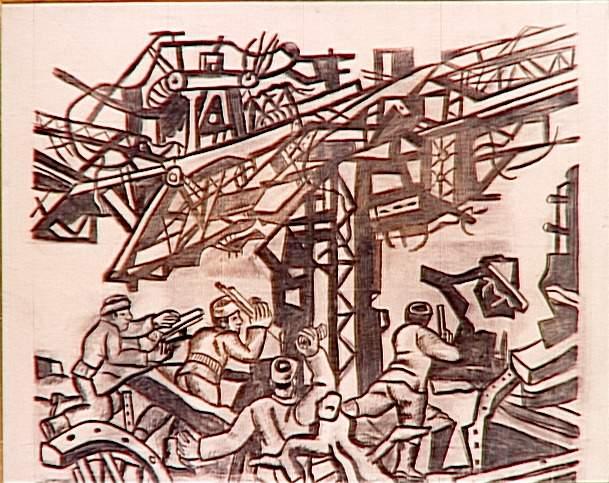
A Vision of Mechanized Conflict: The Soul of Stalingrad
In the vast landscape of twentieth-century modernism, few works capture the intersection of human tragedy and industrial power as viscerally as Fernand Léger’s Stalingrad. Created in 1954, this masterpiece transcends a mere historical chronicle of one of World War II's most devastating sieges; it serves as a profound meditation on the collision between man and machine. To gaze upon this canvas is to enter a world where the boundaries between organic life and mechanical force blur, creating an experience that is not merely seen through the eyes, but felt within the chest. Léger invites the viewer into a space where the echoes of battle are rendered through a language of pure, unadulterated form.
The artwork stands as a striking embodiment of Naïve Art, a movement that deliberately rejected the polished academic conventions of the past in favor of direct observation and raw emotional honesty. Rather than seeking to replicate the photographic reality of the Soviet battlefield, Léger utilizes a simplified visual vocabulary. He employs bold, decisive lines and flattened planes that strip away the illusion of depth, forcing the viewer to confront the essential geometry of conflict. This technique, heavily influenced by his fascination with industrial aesthetics, transforms the chaos of war into a structured, rhythmic composition of circles, squares, and triangles.
The Rhythm of the Machine Age
Léger’s technical mastery lies in his ability to imbue static shapes with an incredible sense of dynamism. By avoiding traditional shading and the subtle blending of colors, he relies instead on a vibrant palette of primary hues to drive the narrative forward. This lack of chiaroscuro creates a high-contrast environment where every element—from the jagged fragments of destroyed architecture to the silhouettes of advancing vehicles—pops with an urgent, electric energy. The artist’s signature linear style mirrors the relentless, grinding pace of mechanized warfare, where the movement of tanks and the trajectory of artillery become part of a larger, unstoppable mechanical dance.
This aesthetic choice serves a deeper symbolic purpose. In Stalingrad, the machine is not merely a tool of destruction but a central protagonist. Léger explores the complex relationship between humanity and technology, questioning whether the advancements of the industrial age have become inseparable from our capacity for violence. The geometric precision of the vehicles and weaponry contrasts sharply with the desperate human struggle, creating a tension that is both intellectually stimulating and emotionally harrowing. For the collector or designer, this piece offers a sophisticated dialogue between the structured beauty of abstraction and the profound weight of historical memory.
A Legacy of Resilience and Form
To understand the impact of this work, one must consider the historical gravity of its subject. The Siege of Stalingrad was a period of unimaginable hardship, characterized by starvation, bombardment, and an iron will to endure. Léger captures this atmosphere of desperation and determination with remarkable acuity. Amidst the debris of a shattered city, he portrays a landscape where the remnants of civilization are being reshaped by the forces of modern combat. The painting does not offer a literal or sanitized representation; instead, it offers a psychological portrait of a world in flux.
For those seeking to adorn a space with art that commands attention and provokes thought, Stalingrad is an incomparable choice. It brings a sense of historical depth and avant-garde strength to any interior, acting as a focal point that bridges the gap between mid-century modernism and contemporary emotional expression. Owning a high-quality reproduction of this work means possessing a fragment of art history—a piece that celebrates the resilience of the human spirit even when caught within the gears of an indifferent, mechanical age.
Biographie de l'artiste
jeune vie et formation
fernand léger, peintre, sculpteur et cinéaste français, est né le 4 février 1881 à Argentan, Orne, en Normandie inférieure. Son père élevait du bétail, et léger a initialement été formé à l'architecture de 1897 à 1899. Il s’est ensuite installé à Paris en 1900, se débrouillant comme dessinateur architectural.développement artistique
Le travail précoce de léger a été influencé par l'impressionnisme, comme le montrent le jardin de ma mère (mon jardin) (1905). Après avoir fréquenté l'école des beaux-arts et l’académie Julian, il a commencé à travailler sérieusement comme peintre à 25 ans. Son style s'est développé en une forme personnelle de cubisme, que les critiques ont qualifié de "tubisme" pour son accent sur les formes cylindriques.cubisme et le groupe des Puteaux
En 1910, léger a exposé au Salon d’automne aux côtés de jean metzinger et henri le fauconnier. Il a rejoint le groupe des Puteaux, également connu sous le nom de section d’or (la section dorée), avec d'autres artistes tels que francis picabia et marcel duchamp.guerre et son influence sur le travail de léger
Les expériences de léger à la Première Guerre mondiale ont eu un impact significatif sur son œuvre. Pendant son séjour au front, il a produit des croquis d'artillerie, d'avions et de soldats. Sa peinture soldier avec un tuyau (1916) reflète cette période.œuvre ultérieure et héritage
L'œuvre post-guerre de léger, caractérisée par des formes machine-like élégantes, le lia à la tradition de la peinture figurative française. Ses paysages animés de 1921 ont présenté des figures et des animaux dans des formes harmonieuses et rationalisées.- voir les œuvres de fernand léger sur OriginalUniqueArt
- en savoir plus sur fernand léger sur wikipedia
- découvrez le musée national fernand léger (france) avec OriginalUniqueArt
- la femme assise (100 x 81 cm, tubisme)
- élément de machine (cubisme)

Fernand Léger
1881 - 1955 , France
En bref
- Artistes Influents:
- Cézanne
- Impressionnisme
- Date De Décès: 1955
- Date De Naissance: 4 février 1881
- Influences Artistiques: ['Pop Art']
- Lieu De Naissance: Argentan, France
- Mouvement Artistique: Cubisme, Tubisme
- Nationalité: Française
- Nom Complet: Fernand Léger
- Oeuvres Notables:
- La Grande Parade
- Machine Élément
- Femme assise
- Paysages animés
Articles similaires
L'Âme Industrielle : 10 Chefs-d'œuvre Révélant la Beauté du Monde Moderne | OriginalUniqueArt
Plongez dans l'âme industrielle de 10 chefs-d'œuvre emblématiques ! Découvrez les histoires fascinantes de Van Gogh, Monet et d'autres artistes ayant capturé la beauté brute du monde moderne. Reproductions de qualité musée sur OriginalUniqueArt.com – Explorez la collection en ligne.

Angelo Chiacchio: A Mid-Century American Illustration Master & the Rise of Commercial Art
Explore the captivating world of Angelo Chiacchio, a master of mid-century American illustration. Discover his evolution, signature style, and lasting impact on commercial art & design. Learn about his legacy at the Museum of American Illustration.

Kay Rasmus Nielsen: A Golden Age Illustrator's Enchanting Legacy of Symbolism & Narrative
Explore the captivating world of Kay Rasmus Nielsen, a celebrated Golden Age illustrator renowned for his Art Nouveau fairy tale art & Disney contributions. Discover his unique style, enduring legacy, and how to collect his enchanting works.
Fernand Léger : Les 25 Œuvres Maîtresses d'un Pionnier du Modernisme | OriginalUniqueArt
Plongez dans l'univers vibrant de Fernand Léger ! Découvrez les 25 œuvres majeures du cubisme et du tubisme, explorant formes géométriques et couleurs audacieuses. Retrouvez des reproductions d'art exceptionnelles sur OriginalUniqueArt.com.

Modern Geometry & Machine Age Beauty: A Collector's Guide to the Cubist Vision of Fernand Léger
Explore the profound geometric mastery of Fernand Léger. Discover how his 'Tubism' and Machine Age aesthetics redefined modern art, offering timeless inspiration for discerning collectors seeking to integrate Cubist dynamism into sophisticated contemporary interiors.


