

 Aperçu en situation
 Partager
 Partager
 Détails
 Guide imprimable

 Télécharger
 Articles similaires
 Radiographie
 Voir le diaporama
 Statistiques
Still Life


 Afficher la suite
Giclées et impressions d'art
Impressions giclées ou sur toile de qualité musée, avec une production rapide et des finitions au choix. ( Acheter la peinture faite à la main Passer au format image numérique)




P118B €10

P118H €10

P118W €10

P438Z €10

P508JH €12

P508YH €12

P805H €10

P805Z €10

P919BZ €10

P919G €10

P919XJ €10

P959ZH €10

P968JZ €12

W106C €8

W218G €10

W218JH €8

W218Y €10

W307PJ €10

W316G €10

W316PJ €8

W316Y €10

W398PJ €8

W4111J €10

W500HY €15

W500JH €15

W692G €12

W849H €8

W940BG €15

W953PJ €8




Choisissez parmi nos formats prédéfinis qui respectent les proportions originales de l’œuvre.

Saisissez la largeur et la hauteur souhaitées pour qu'elles s'adaptent à votre cadre ou à votre mur. Une impression ne peut être que découpée, elle ne peut jamais être agrandie au-delà de l'image originale ; ainsi, un format de forme différente entraînera la perte d'une partie de l'image. Nous vous envoyons une maquette numérique pour approbation avant toute impression. L'image présentée sur cette page ne montre pas le recadrage réel — seule la maquette le permet.
Livraison dans le monde entier () en 2 semaines au lieu des 4/5 semaines habituelles. (22 octobre)

Livraison express gratuite dans le monde entier

Toile de lin de haute qualité

Assurance transport complète

Garantie de remboursement des droits de douane

Garantie de fidélité des couleurs

Garantie de retour de 100 jours (uniquement en cas de défaut)

Garantie de remboursement à 100%

Tarifs dégressifs sur quantité
 L'option verre n'est disponible que pour les dimensions inférieures à 110 cm.

Still Life
Giclées et impressions d'art
Format de la reproduction
-


Prix total final
€ 70
A Moment Frozen in Time: Ferdinand Guillaimin’s “Still Life”
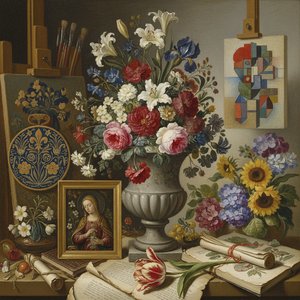
Ferdinand Guillaimin's "Still Life," painted in 1872, isn’t merely a depiction of objects arranged on a table; it’s a carefully constructed tableau brimming with quiet observation and subtle symbolism. This work, rendered in the heart of the Impressionist movement, captures a fleeting moment of domestic tranquility – a scene both familiar and imbued with an understated elegance. The painting immediately draws the eye to the central arrangement: a vase overflowing with vibrant red and yellow flowers, their petals seemingly caught mid-bloom, radiating warmth against the cooler tones that dominate the rest of the composition. Beside them rests a worn book, its pages hinting at untold stories and intellectual pursuits, while a simple bowl holds what appears to be fruit – perhaps apples or pears – adding another layer of earthly abundance.
Guillaimin’s technique is distinctly Impressionistic, prioritizing capturing the *impression* of light and color rather than precise detail. Loose brushstrokes dance across the canvas, creating an atmospheric haze that softens the edges of each object. He masterfully employs broken color – applying small dabs of paint side-by-side to build up hues and create a shimmering effect, particularly noticeable in the reflections on the table’s surface. The dark background serves not as mere backdrop but as a crucial element, intensifying the luminosity of the floral arrangement and lending the scene a sense of intimacy and depth. The artist's focus is less on photographic realism and more on conveying the *feeling* of being present within this quiet space.
The Context of Parisian Impressionism
To fully appreciate “Still Life,” it’s essential to understand the artistic climate in which Guillaimin was working. The 1870s were a period of profound change and experimentation for French art, marked by the rise of Impressionism. Artists like Monet, Renoir, and Pissarro sought to break free from the rigid conventions of academic painting, embracing plein air (outdoor) painting and capturing the ephemeral qualities of light and atmosphere. Guillaimin’s work reflects this spirit of innovation, moving away from traditional subject matter and exploring new ways of representing the world around him.
Guillaimin's connection to Pissarro is particularly noteworthy. The artist spent a significant period painting alongside Pissarro in Pontoise, a suburb of Paris, where he found inspiration in the everyday life of the region. This proximity fostered a collaborative environment, allowing Guillaimin to refine his style and develop his unique approach to capturing light and color. The Impressionists were not simply interested in depicting what they *saw*; they were driven by a desire to express their subjective experience of the world.
Symbolism and the Language of Objects
Beyond its aesthetic qualities, “Still Life” is rich with symbolic meaning. The flowers themselves represent beauty, fragility, and the fleeting nature of life – themes frequently explored in Impressionist art. The book suggests knowledge, contemplation, and a connection to the past. The bowl of fruit symbolizes abundance, nourishment, and the pleasures of earthly existence. Even the dark background can be interpreted as representing mortality or the unknown.
Guillaimin’s use of these objects is deliberate and carefully considered, inviting the viewer to engage in a process of interpretation. He doesn't offer explicit explanations; instead, he presents a series of interconnected symbols that resonate with universal themes of beauty, life, and death. The arrangement feels deliberately balanced, creating a harmonious composition that evokes a sense of peace and serenity.
A Legacy of Delicate Beauty
Ferdinand Guillaimin’s “Still Life” stands as a testament to the power of observation and the enduring appeal of simple subjects rendered with exquisite sensitivity. It's a painting that rewards close attention, revealing layers of meaning and emotional depth with each viewing. Reproductions capture much of the original atmosphere, but nothing quite replicates the subtle nuances of light and color that define Guillaimin’s masterful technique.
Today, this work is celebrated for its evocative beauty and its contribution to the development of Impressionism. It remains a poignant reminder of the quiet moments of everyday life – a timeless meditation on beauty, mortality, and the enduring power of art.
Questions et réponses
Quelle palette de couleurs utilise "Still Life" ?
«Still Life» de Jean Baptiste Armand Guillaumin utilise une palette de couleurs Earthy. Cette palette résume le caractère chromatique global de l'œuvre.
Existe-t-il des œuvres similaires à « Still Life » ?
La page Œuvres similaires de «Still Life» de Jean Baptiste Armand Guillaumin présente des œuvres similaires.
Qui a créé « Still Life », et en quelle année ?
L'auteur de « Still Life » est Jean Baptiste Armand Guillaumin, et l'œuvre date de 1872.
Biographie de l'artiste
early life and career
Armand Guillaumin est né à Moulins (Allier) le 11 août 1842 et mort à Paris le 9 mars 1927, il fut l’un des premiers et des plus fidèles participants du groupe des impressionnistes. Ses paysages de la Creuse, notamment ceux des alentours de Crozant, se rangent parmi ses œuvres les plus prisées.
Originaire de Moulins, Armand Guillaumin s'installe en 1857 à Paris pour y travailler avec son oncle Besnard. Il suit des cours du soir avec le sculpteur Louis Denis Caillouette.
En 1860, il entre à la Compagnie du chemin de fer de Paris à Orléans. L’année suivante, il rencontre Paul Cézanne et Camille Pissarro à l’Académie Suisse et participe au Salon des refusés de 1863.
Au début des années 1870, il peint à Pontoise avec Pissarro. Il y développe son goût pour la peinture de paysages. Il exécute sa première eau-forte chez le docteur Gachet à Auvers-sur-Oise en 1872 ; Guillaumin en produira dix-sept tout au long de sa vie, ainsi que quelques lithographies en couleurs.
Rejoints par Cézanne, ils peignent sur les bords de la Seine vers 1873. Ces vues témoignent de la vive préférence de l’artiste pour l’eau. Depuis les rives de la Creuse, il observe l’animation de la rivière, des ponts et des Chamil.
Armand Guillaumin est fidèle au groupe impressionniste. Il participe à six des huit expositions des peintres impressionnistes. Il est en particulier présent à la Première exposition des peintres impressionnistes de 1874 et à la dernière de 1886.
Il est ami avec Cézanne, qui apprécie le talent de coloriste et la palette de couleurs vives de Guillaumin.
notable works and associations
Armand Guillaumin est attaché à la direction artistique de la Manufacture nationale de Sèvres, puis à l’atelier de Luc-Olivier Merson, nommé à l’Académie des Beaux-Arts, cette année-là.
Il peint notamment les vues des rives de la Seine et plus particulièrement les vues d’Ivry-sur-Seine, de Clamart et de Charenton, ainsi que les paysages d’Épinay-sur-Orge dans la banlieue sud de Paris.
Il est en particulier présent à la Première exposition des peintres impressionnistes de 1874 et à la dernière de 1886.
Sa peinture perd une certaine intensité durant ses années à Crozant, avec des verts et des violets devenant plus dominants dans sa palette.
Il est proche de Van Gogh qui apprécie le talent de coloriste et la palette de couleurs vives de Guillaumin.
influence and style
Armand Guillaumin découvre la ville d’Amiens en 1887 et décide de s'y installer. Il y fréquente les peintres de l’École de Crozant, dans les environs de Fresselines, où habite le poète Maurice Rollinat.
Il est considéré comme un artiste ayant une sensibilité particulière à la lumière et aux couleurs. Ses œuvres sont caractérisées par une esthétique pleine d'émotion et une recherche constante de transparence.
Ses peintures sont composées dans des tons très expressifs qui anticipent les mouvements artistiques ultérieurs tels que le fauvisme.
legacy and remembrance
Il meurt à Paris en juin 1927, mais ses œuvres restent une référence pour l’histoire de l'impressionnisme. Ses peintures sont conservées dans plusieurs musées et collections importantes.
Ses paysages sont particulièrement appréciés pour leur beauté et leur capacité à évoquer les atmosphères naturelles.
major achievements
Il remporte le Prix Chenavard en 1897, ce qui lui ouvre les portes du Salon des Artistes Français l’année suivante. Il y présente La ville d’Amiens recevant les hommages de ses industries.
La toile est achetée par l’État et figure à l'exposition universelle de 1900 avant d'être placée à l’hôtel de ville d’Amiens.

Jean Baptiste Armand Guillaumin
1841 - 1927 , France
En bref
- Artistic Movement Or Style: Impressionism
- Artists Who Influenced This Artist:
- Vincent van Gogh
- Claude Monet
- Paul Cézanne
- Date Of Birth: February 16, 1841
- Date Of Death: June 26, 1927
- Full Name: Jean Baptiste Armand Guillaumin
- Nationality: French
- Notable Artworks:
- Garden in Janville in June
- River Scene
- View of Puy de Dôme
- Place Of Birth: Paris, France
Articles connexes

Blossoms of Time: A Historical Journey Through Flower Painting
Explore the captivating history of flower painting! Discover Dutch masters, symbolic meanings, & botanical art. Expert insights & high-quality reproductions at OriginalUniqueArt.
Blossoming Symbolism: A Historical Journey Through Flowers in Western Painting
Explore the rich history of flower symbolism in Western painting! Discover how artists from the Renaissance to Modernism used blossoms to convey meaning, emotion & beauty. Learn about iconic artworks and movements.

Impressionnisme : Top 10 des Œuvres Incontournables pour une Décoration Raffinée
Plongez dans l'univers vibrant de l'impressionnisme avec notre sélection des 10 œuvres les plus emblématiques : Monet, Renoir, Degas… Découvrez l'histoire et la magie de ces chefs-d'œuvre. Reproductions d'art de qualité muséale sur OriginalUniqueArt.com

Silent Narratives: Exploring the Enduring Appeal of Still Life Painting Across Centuries
Explore the rich history of still life painting with OriginalUniqueArt. Discover Dutch Masters, decode vanitas symbolism & learn about collecting timeless art. Expert insights and museum-quality reproductions.

Paul Cézanne : Les 25 Œuvres Maîtresses d'un Génie Révolutionnaire | OriginalUniqueArt
Plongez dans l'univers de Paul Cézanne avec les 25 œuvres incontournables du maître post-impressionniste. Découvrez l'histoire, la technique et l'émotion derrière ses tableaux iconiques comme 'Les Baigneuses' ou 'Mont Sainte-Victoire'. Reproductions d'art haute qualité sur OriginalUniqueArt.com.


