Aperçu en situation
 Partager
 Partager
 Détails
 Guide imprimable

 Télécharger
 Articles similaires
 Radiographie
 Voir le diaporama
 Statistiques
The Soup Kitchen
 Oil On Canvas
- WallArt
- Biedermeier Realism
 1859
1859 94.0 x 122.0 cm
 Galerie Autrichienne Belvedere
 Afficher la suite
Giclées et impressions d'art
Impressions giclées ou sur toile de qualité musée, avec une production rapide et des finitions au choix. ( Acheter la peinture faite à la main Passer au format image numérique)




P118B €10

P118H €10

P118W €10

P438Z €10

P508JH €12

P508YH €12

P805H €10

P805Z €10

P919BZ €10

P919G €10

P919XJ €10

P959ZH €10

P968JZ €12

W106C €8

W218G €10

W218JH €8

W218Y €10

W307PJ €10

W316G €10

W316PJ €8

W316Y €10

W398PJ €8

W4111J €10

W500HY €15

W500JH €15

W692G €12

W849H €8

W940BG €15

W953PJ €8




Choisissez parmi nos formats prédéfinis qui respectent les proportions originales de l’œuvre.

Saisissez la largeur et la hauteur souhaitées pour qu'elles s'adaptent à votre cadre ou à votre mur. Une impression ne peut être que découpée, elle ne peut jamais être agrandie au-delà de l'image originale ; ainsi, un format de forme différente entraînera la perte d'une partie de l'image. Nous vous envoyons une maquette numérique pour approbation avant toute impression. L'image présentée sur cette page ne montre pas le recadrage réel — seule la maquette le permet.
Livraison dans le monde entier () en 2 semaines au lieu des 4/5 semaines habituelles. (23 octobre)

Livraison express gratuite dans le monde entier

Toile de lin de haute qualité

Assurance transport complète

Garantie de remboursement des droits de douane

Garantie de fidélité des couleurs

Garantie de retour de 100 jours (uniquement en cas de défaut)

Garantie de remboursement à 100%

Tarifs dégressifs sur quantité
 L'option verre n'est disponible que pour les dimensions inférieures à 110 cm.

The Soup Kitchen
Giclées et impressions d'art
Format de la reproduction
-


Prix total final
€ 70
A Window into Victorian Charity: Ferdinand Georg Waldmüller’s “The Soup Kitchen”
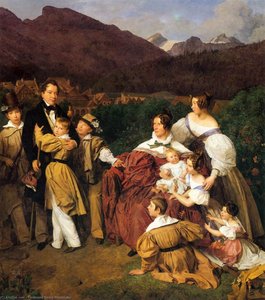
Ferdinand Georg Waldmüller's "The Soup Kitchen," painted in 1859, isn’t merely a depiction of a charitable institution; it’s a poignant snapshot of Victorian society grappling with poverty and the burgeoning role of public assistance. This oil on canvas, now residing within the Österreichische Galerie Belvedere in Vienna, offers a remarkably intimate glimpse into a world often obscured by grand narratives of progress – a world where simple sustenance was a profound act of compassion.
The scene unfolds within a long, echoing hallway, leading the eye towards an arched doorway that hints at a larger, unseen space. The composition is meticulously structured, drawing us immediately to a central group of women and children patiently awaiting their turn for a meal. Waldmüller’s skill lies not just in his realistic portrayal of these figures – their worn clothing, weathered faces, and expressions ranging from quiet hope to weary resignation – but also in the subtle orchestration of light and shadow. The muted palette, dominated by earthy browns, greys, and ochres, creates a somber yet strangely comforting atmosphere, mirroring the hardships faced by those seeking aid.
The Biedermeier Aesthetic: Intimacy and Everyday Life
“The Soup Kitchen” is firmly rooted in the Biedermeier art movement, a reaction against the grandiosity of Neoclassicism. Biedermeier artists prioritized depicting scenes from everyday life – domestic interiors, landscapes, and portraits of ordinary people – with an emphasis on realism and emotional honesty. Waldmüller masterfully embodies this aesthetic, eschewing dramatic poses or heroic narratives in favor of capturing a quiet moment of shared humanity. The painting’s focus isn't on the act of giving, but rather on the receiving—the dignity and resilience displayed by those who rely on charity.
Notice the details: the worn fabric of the women’s dresses, the small hands clutching bowls, the attentive gazes exchanged between neighbors. These seemingly insignificant elements collectively build a powerful narrative of community and mutual support. The artist's careful attention to texture – the rough wool of the clothing, the smooth surface of the tables – further grounds the scene in tangible reality.
Technique and Composition: A Masterclass in Realism
Waldmüller’s technical prowess is evident throughout the painting. He employs a meticulous approach to rendering form and light, utilizing subtle gradations of color to create a sense of depth and volume. The long hallway, with its receding perspective, draws the viewer into the scene, while the arched doorway offers a tantalizing glimpse beyond – perhaps symbolizing hope or the promise of a brighter future.
The composition is carefully balanced, with the central group of figures anchoring the scene and the background elements providing context. The use of horizontal lines—the hallway floor, the tables—creates a sense of stability, while the verticality of the doorway suggests aspiration. Waldmüller’s ability to capture both the physical details and the emotional nuances of his subjects is truly remarkable.
Symbolism and Historical Context: A Reflection of Victorian Society
“The Soup Kitchen” isn't simply a record of poverty; it’s a commentary on the social conditions of 19th-century Vienna. The rise of industrialization and urbanization had led to widespread unemployment and poverty, creating a significant need for charitable institutions like soup kitchens. These spaces offered not just food but also a sense of community and dignity to those who were marginalized by society.
Interestingly, Waldmüller’s work resonates with the style of Hans Makart, another prominent Austrian painter known for his dramatic landscapes and portraits. However, while Makart often depicted heroic figures and grand scenes, Waldmüller focuses on the quiet dignity of everyday life—a subtle yet powerful shift in artistic perspective. The painting serves as a poignant reminder of the social challenges faced by Victorian society and the importance of compassion and empathy.
High-quality reproductions of “The Soup Kitchen” are available through OriginalUniqueArt.com, allowing art enthusiasts to bring this evocative masterpiece into their homes and connect with its powerful message. The original resides at the Österreichische Galerie Belvedere in Vienna, a testament to Waldmüller’s enduring legacy.
Questions et réponses
Quel âge avait Ferdinand Georg Waldmüller lors de la création de « The Soup Kitchen » en 1859 ?
Ferdinand Georg Waldmüller a réalisé « The Soup Kitchen » à l'âge de 66. L'artiste est né en 1793 et l'œuvre date de 1859.
Quelles sont les dimensions de l'œuvre originale « The Soup Kitchen » ?
Les dimensions enregistrées de «The Soup Kitchen» de Ferdinand Georg Waldmüller sont 94 x 122 cm. Des reproductions peuvent être commandées dans d'autres formats tout en conservant les mêmes proportions.
Quel artiste et quel style se cachent derrière « The Soup Kitchen » ?
« The Soup Kitchen » a été créé par Ferdinand Georg Waldmüller dans le style Biedermeier Realism. L'artiste et le mouvement définissent la tradition de l'œuvre.
Biographie de l'artiste
Première Vie et Éducation
- Né: Le 15 janvier 1793, à Vienne, en Autriche
- Décédé: Le 23 août 1865, à Hinterbrühl, en Autriche (âgé de 72 ans)
- Nationalité: Autrichien
- La première vie a été marquée par des difficultés financières suite au décès de son père.
- A fréquenté l'Académie des Beaux-Arts de Vienne à partir de 1807, bien que la fréquentation ait été irrégulière.
- S'est initialement consacré à la peinture de portraits, mais s'est ensuite intéressé vivement aux paysages et aux scènes de genre.
Carrière et Développement Artistique
- Au début de sa carrière, il a travaillé comme décorateur de théâtre et peintre portrait tout en effectuant des tournées avec son épouse, la chanteuse Katharina Weidner.
- A développé un style distinctif caractérisé par des représentations réalistes de la vie quotidienne, en particulier des scènes rurales.
- Est devenu professeur à l'Académie des Beaux-Arts de Vienne en 1819, mais a été confronté à des différends en raison de sa défense de l'observation naturelle et de ses critiques envers le système de l'académie.
- De fréquents voyages en Italie (à partir de 1825) et dans la région du Salzkammergut ont grandement influencé son style de peinture de paysage.
- Connu pour ses descriptions détaillées et raffinées des textures et de la lumière, représentant souvent la vie rurale quotidienne avec une perspective socialement critique.
- Ses œuvres ont été initialement critiquées par ses contemporains pour leur réalisme, mais ont ensuite été reconnues pour leur mérite artistique.
Œuvres Majeures et Thèmes
- Vendeur de fruits vénitien (1826) : Un exemple précoce de son style de peinture de genre.
- Autoportrait (1828) : Démontre ses compétences en portraiture.
- Louise Mayer (1836) Une œuvre notable de portrait.
- Vue d'Ischl (1838) : Met en valeur ses capacités de peinture de paysage.
- Le jour des morts (1839) : Capture une scène de la vie rurale.
- La lettre d'amour (1849) : Une scène de genre représentant l'intimité domestique.
- Les femmes se baignant (c. 1848–1849) : Un exemple de son exploration des thèmes sociaux.
- Thèmes récurrents incluent : la vie rurale, les dynamiques familiales, l'impact de la pauvreté et du malheur, et la beauté de la nature.
Signification Historique et Héritage
- Considéré comme l'un des peintres autrichiens les plus importants de la période Biedermeier.
- A défendu l'observation naturelle et la peinture en plein air, anticipant ainsi des mouvements artistiques ultérieurs tels que l'impressionnisme.
- Ses peintures de genre socialement critiques ont remis en question les représentations conventionnelles de la vie rurale à son époque.
- A influencé une génération d'artistes grâce à son réalisme détaillé et à son intérêt pour les sujets du quotidien.
- Malgré les critiques et les revers rencontrés tout au long de sa carrière, l'œuvre de Waldmüller a acquis une reconnaissance internationale plus tard dans sa vie.
- Son héritage réside dans sa contribution à l'art autrichien et son approche pionnière de la peinture de paysage et de genre.
Vie ultérieure et Reconnaissance
- A épousé Anna Bayer en 1851.
- A connu des difficultés financières malgré certains succès.
- A participé à l'Exposition Universelle de Paris (1855) et a exposé au Buckingham Palace (1856), obtenant ainsi la reconnaissance de Napoléon III et de la reine Victoria, respectivement.
- A été contraint de prendre sa retraite de l'Académie des Beaux-Arts de Vienne en 1857 en raison de ses critiques persistantes.
- A reçu une pension et a été anobli peu avant son décès le 23 août 1865 à Hinterbrühl.

Ferdinand Georg Waldmüller
1793 - 1865 , Autriche
En bref
- Date De Décès: 23 août 1865
- Date De Naissance: 15 janvier 1793
- Lieu De Naissance: Vienne, Autriche
- Mouvement Artistique: Biedermeier
- Nationalité: Autrichien(ne)
- Nom Complet: Ferdinand Georg Waldmüller
- Oeuvres Notables:
- Marchand de fruits vénitien
- Autoportrait (1828)
- Louise Mayer (1836)
- Vue d'Ischl (1838)
- Le jour des morts (1839)
- La lettre d'amour (1849)
Articles connexes

The Enduring Legacy of Oil on Canvas: Technique, History & Aesthetic Impact
Explore the rich history & techniques of oil painting – from Renaissance masters to Impressionism. Discover pigments, layering methods, and why this timeless medium endures. Expert insights for artists & art enthusiasts.

L'Huile sur Toile : Exploration Historique et Technique d'un Médium Artistique Intemporel
Explorez l'histoire fascinante de la peinture à l'huile, des techniques ancestrales aux maîtres flamands comme Van Eyck. Découvrez les secrets des pigments, liants et glacis pour comprendre cet art intemporel.

The Enduring Power of Painting: A Historical & Contemporary Exploration of Form and Emotion
Explore the rich history & enduring techniques of oil painting with OriginalUniqueArt. Discover masterpieces, learn about art collecting, and find authentic handmade reproductions crafted by skilled artists.
The Soul of Impressionism: Why Oil on Canvas Captures Eternal Light and Timeless Emotion
Discover the enchanting alchemy of Impressionism. Explore how the mastery of oil on canvas, through glazing and impasto, captures eternal light and emotion. Perfect for lovers of Monet and Van Gogh seeking the profound depth of hand-painted fine art.

L'héritage durable de la peinture à l'huile : technique, histoire et pratique contemporaine
Explorez l'histoire fascinante de la peinture à l'huile, des techniques ancestrales aux pratiques contemporaines. Découvrez les maîtres, apprenez et trouvez votre œuvre d'art idéale chez .